How Much Can You Borrow on a Personal Loan in Singapore?
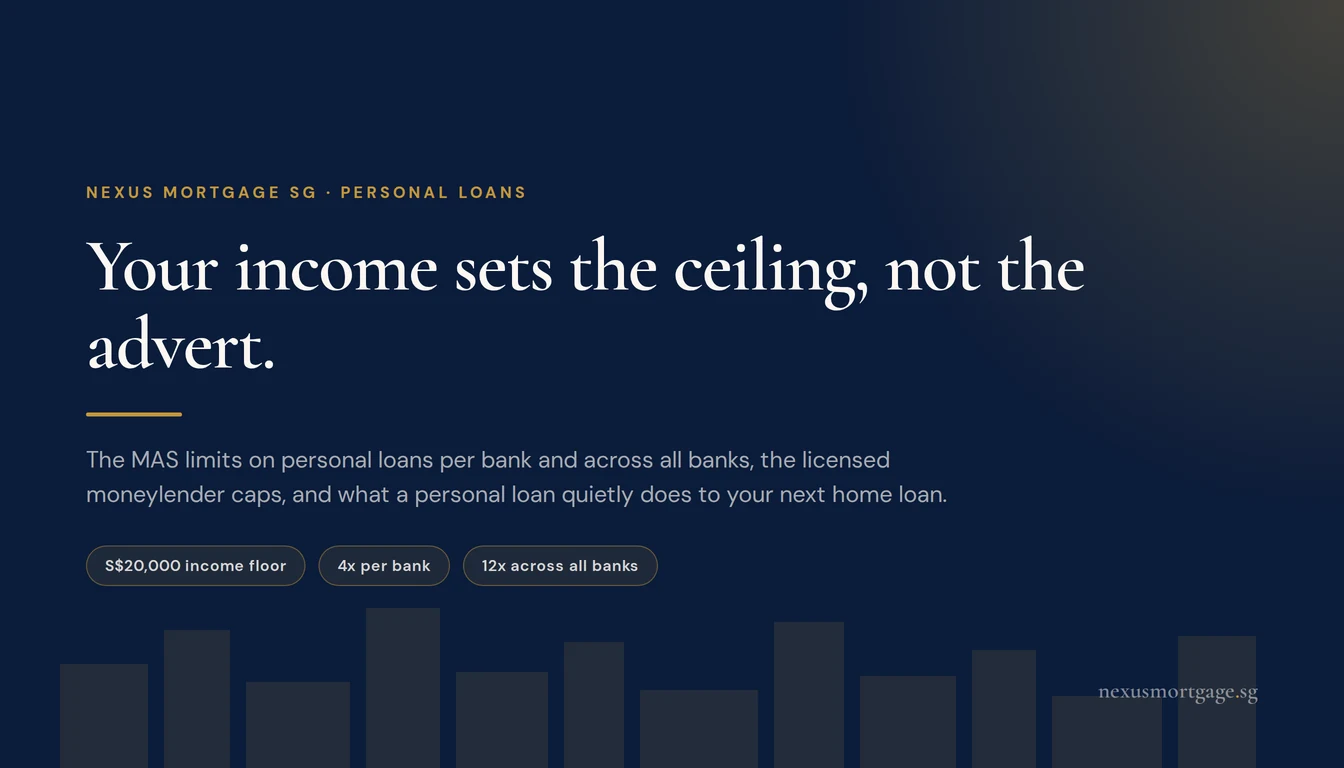
Your income sets the ceiling. A bank can only lend you a personal loan if you earn at least S$20,000 a year. Each bank can then extend up to 2 months' income if you earn under S$30,000, or 4 months' income from S$30,000 to below S$120,000. Across all banks and card issuers, your interest-bearing unsecured debt should stay under 12 times your monthly income, or your facilities are suspended. Licensed moneylenders have their own cap: 6 times monthly income across all of them. And if you plan to buy property, remember that every dollar of personal loan instalment cuts your home loan by far more than a dollar.
Personal loan adverts lead with a rate. The more useful question comes first: how much are you allowed to borrow at all? In Singapore that is not left to the bank. MAS sets income-based limits on unsecured credit, and they apply to every bank, finance company and card issuer at once.
The Income Floor
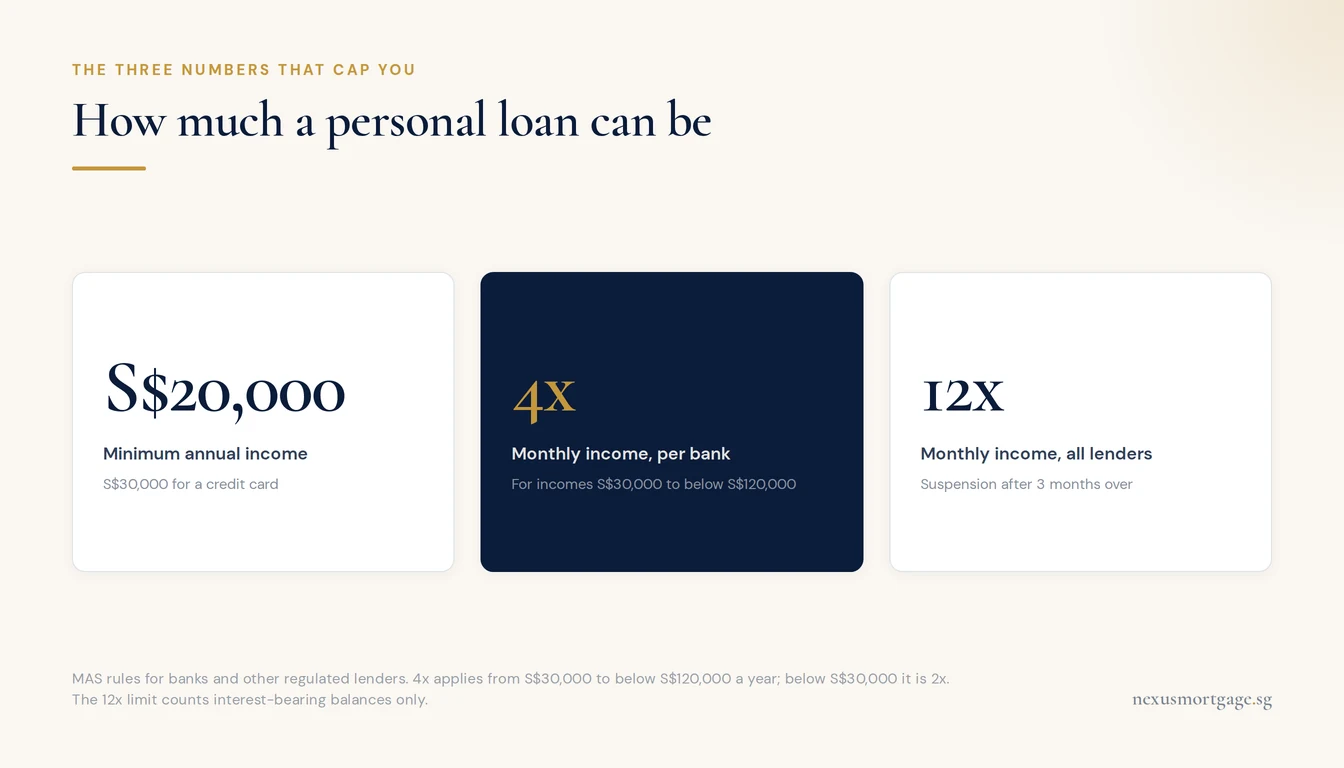
A bank can grant a personal loan, credit line or other non-card unsecured credit only if your annual income is at least S$20,000. For a credit card, the floor is S$30,000.
There is one important exception. Loans taken for education, business, renovation or medical purposes are exempt from the minimum income requirement. That is why a renovation loan can sometimes be available when a general personal loan is not.
What One Bank Can Lend You
An existing credit card limit at the same bank uses up the same room.
Each bank then caps your total unsecured credit with it, across personal loans, credit lines and credit cards, by reference to your income.
| Annual income | Maximum unsecured credit per bank | Example |
|---|---|---|
| Below S$20,000 | Not eligible (except the exempt purposes above) | |
| S$20,000 to below S$30,000 | 2 months' income | S$24,000 a year: up to S$4,000 |
| S$30,000 to below S$120,000 | 4 months' income | S$60,000 a year: up to S$20,000 |
| S$120,000 and above | No regulatory limit | Set by the bank's own assessment |
The per-bank limit also falls away if you have net personal assets of at least S$2 million or net financial assets of at least S$1 million, regardless of income.
Two practical points. First, the limit covers everything unsecured you hold with that bank, so an existing credit card limit uses up room that a personal loan would otherwise take. Second, the bank must either ask you what limit you want or get your consent to the limit it sets. You are allowed to ask for less than the maximum, and usually should.
The 12 Times Limit Across All Banks
The per-bank cap stops one lender over-extending you. The industry-wide borrowing limit stops the total across lenders from getting out of hand. Since 1 June 2019 it has been 12 times your monthly income, after being phased down from 24 times in 2015 and 18 times in 2017.
It counts interest-bearing unsecured debt only:
- Credit card balances rolled over rather than paid in full.
- Unsecured loans that accrue interest, including personal loans and credit lines.
- Interest charged on other debts, such as late payment on an interest-free instalment plan.
Card spending you clear in full each month does not count. Secured loans such as your home loan or car loan do not count either.
If your interest-bearing unsecured debt stays above the limit for three consecutive months, you cannot get additional credit, and your existing unsecured facilities are suspended. The suspension lifts only after you bring the debt back under the limit and the lender runs fresh credit bureau and income checks. Lenders may, however, go beyond the limit to help you consolidate and refinance what you owe. That is the gap the banks' Debt Consolidation Plan fills, for borrowers whose unsecured debt has passed 12 times their monthly income.
The 6 Times Early Warning
Since 1 January 2018 there has been a second, earlier trip-wire called the Credit Limit Management Measure. If your outstanding unsecured debt exceeds 6 times your monthly income, no lender may give you a new unsecured facility or a limit increase that takes your total credit limits across all lenders above 12 times your monthly income.
This one does not touch what you already have. You can keep using your existing cards and credit lines, and your limits are not cut. It only blocks new credit. Secured loans, and loans for medical, education or business purposes, are excluded.
In practice, this is the rule most people meet first. It surfaces at the point you apply, as an unexplained decline or a limit far below what you asked for.
Licensed Moneylenders: A Separate Set of Caps
Licensed moneylenders are regulated by the Ministry of Law, not MAS, and have their own limits on how much they may lend you unsecured, counted across all licensed moneylenders combined:
| Annual income | Total you can owe to licensed moneylenders |
|---|---|
| At least S$20,000 | 6 times monthly income |
| Below S$20,000 (Singapore Citizens and PRs) | S$3,000 |
There is no quantum cap on secured loans from a moneylender. Their pricing is capped too, at 4% interest a month, but that is still far above bank pricing. Before dealing with any moneylender, check it against the Ministry of Law's list of licensed moneylenders. A licensed moneylender is not allowed to ask for your Singpass password or keep your NRIC.
What the Bank Actually Approves
The MAS limits are ceilings, not entitlements. Within them, the bank sets your actual amount from:
- Documented income. Salaried applicants usually show payslips or CPF contribution history. Self-employed applicants usually show their IRAS Notice of Assessment. Our self-employed borrowing guide explains why variable income is often discounted.
- What you already owe. Your existing limits and balances across all lenders, which the bank sees on your credit bureau report.
- Your repayment record. Late payments and high utilisation lower what a bank will offer and raise the rate it quotes.
The rate you are quoted also moves with that assessment. The headline rate in an advert is the best case. To compare offers properly you need the Effective Interest Rate, not the advertised flat rate, because a flat rate charges interest on the original amount for the whole term.
What a Personal Loan Does to Your Home Loan
Planning to buy property? Clear or shorten the personal loan first.
This is the part the personal loan adverts never mention, and it is where a small loan can cost you a great deal.
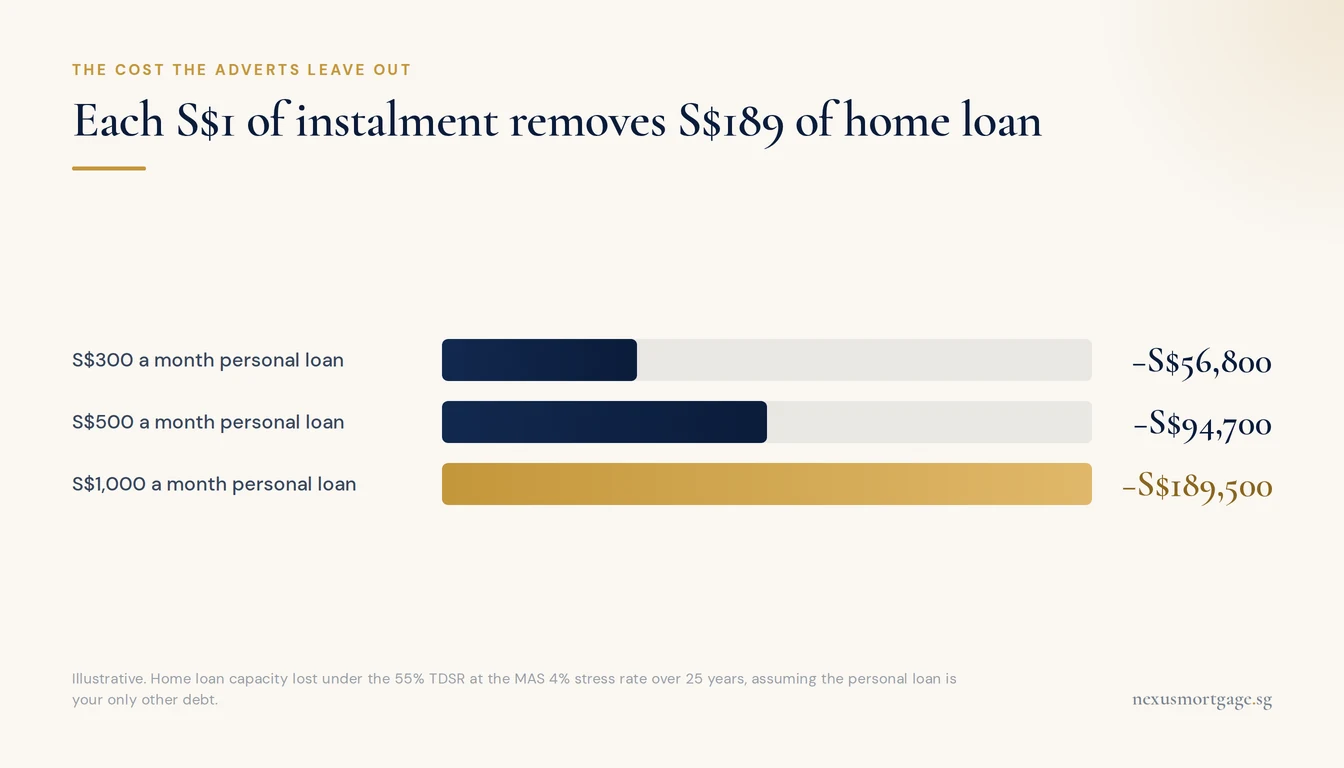
When you apply for a home loan, the bank adds up every monthly debt repayment you have, including personal loans, and caps the total at 55% of your income under the Total Debt Servicing Ratio. The home loan is then sized at a 4% stress rate over its full tenure. So each dollar of monthly personal loan repayment removes far more than a dollar of home loan.
| Monthly personal loan instalment | Home loan capacity lost (4%, 25 years) |
|---|---|
| S$300 | about S$56,800 |
| S$500 | about S$94,700 |
| S$1,000 | about S$189,500 |
If a property purchase is anywhere in your next year or two, sequence it deliberately. Clearing or shortening a personal loan before you apply for a home loan can restore a surprising amount of borrowing power. Our TDSR and MSR guide shows the full calculation, and we are happy to run your numbers before you commit to either loan.
Frequently Asked Questions
S$20,000 a year for a personal loan or other non-card unsecured credit from a bank, and S$30,000 for a credit card. Loans for education, business, renovation and medical purposes are exempt from the minimum.
Up to 2 months' income if you earn below S$30,000 a year, and up to 4 months' income from S$30,000 to below S$120,000. At S$120,000 and above, or with net personal assets of S$2 million or net financial assets of S$1 million, there is no regulatory cap.
Your interest-bearing unsecured debt across all banks and card issuers should stay under 12 times your monthly income. Above it for three consecutive months, you cannot get additional credit and your existing unsecured facilities are suspended.
No. Only interest-bearing balances count, such as rolled-over card balances and unsecured loans that accrue interest.
Up to 6 times your monthly income across all licensed moneylenders if you earn at least S$20,000 a year. Singapore Citizens and PRs earning less can borrow up to S$3,000 in total. There is no quantum cap on secured loans.
Yes. Its monthly repayment counts towards the 55% TDSR, and because the home loan is sized at a 4% stress rate over a long tenure, a S$500 monthly instalment removes about S$94,700 of home loan capacity over 25 years.
Further reading
- TDSR and MSR explained: how every monthly debt caps your home loan
- Self-employed borrowing: how banks assess variable income
- How to apply for a home loan: the documents and the order of steps
- Affordability calculator: what your income supports once existing debts are counted
This article is general information about Singapore's rules on unsecured credit. It is not financial advice, and it is not an offer of credit. Nexus Mortgage does not provide personal loans; we advise on home and property financing. Limits described are the regulatory maximums set by MAS for banks and other regulated lenders, and by the Ministry of Law for licensed moneylenders, as published at September 2026; each lender applies its own credit assessment within them. Home loan figures are illustrative, use the MAS 4% medium-term rate over 25 years, and assume the personal loan instalment is the only other debt. Sources: MAS: Granting non-card unsecured credit, MAS: Borrowing limit on unsecured credit, MAS: Credit Limit Management Measure, Ministry of Law: Borrowing from licensed moneylenders.

About the author — Dan Ler has advised on Singapore home loans since 2017 at Nexus Mortgage SG, an independent brokerage comparing 16+ MAS-regulated lenders. Nexus has facilitated 500+ home loans across HDB, EC, private condo and landed property segments. Banks pay Nexus on disbursement, so there is no cost to the borrower.