Refinancing a Home Loan in Singapore (2026): A Real Case Study

Refinancing means moving your home loan to a better package once your lock-in ends. I had one client, an early-30s couple with a S$1.2M condo loan stuck at 2.45%, who switched to 1.35% fixed for two years. That cut their repayment by about S$645 a month and saved roughly S$25,800 in interest over the two-year term. A S$2,500 subsidy from the new bank covered the legal and valuation fees, and because their lock-in had expired there was no penalty. So the switch cost them effectively nothing. As it is owner-occupied, the refinance was also exempt from TDSR.
People mix up two different moves. Repricing means switching to a new package with your current bank (fast, small admin fee, no redemption). Refinancing means moving the loan to a different bank for a better rate (about three months' notice, new legal work, but the new bank usually subsidises it). This case is a refinance. We compare both below. Always price the repricing offer first, then see if another bank beats it.
- Refinancing vs repricing: what each one is
- The real case: a S$1.2M condo stuck at 2.45%
- The numbers: S$645/month, ~S$25,800 saved
- Why 2026 was the moment to move
- Does TDSR apply when you refinance?
- The refinancing route, step by step
- Repricing vs refinancing: which is cheaper
- When refinancing is worth it, and when it isn't
- FAQ
Refinancing vs Repricing: What Each One Is
Almost every Singapore home loan is cheap for the first two or three years, then it steps up. A fixed rate expires. A thin floating spread widens. A teaser discount falls away. When that happens you have two ways to get back to a good rate.
- Repricing is when you stay with your existing bank and switch to one of their newer packages. There's usually a small conversion fee of a few hundred dollars, no redemption, and it completes quickly.
- Refinancing is when you move the loan to a different bank that offers a better rate. It needs roughly three months' redemption notice and fresh conveyancing, but the incoming bank often hands you a legal and valuation subsidy to win your business.
The right answer is whichever is cheaper after costs. Get your own bank's repricing quote first, then check it against the rest of the market. If a competitor is meaningfully lower, you refinance. That's exactly what happened here. (Our guide on when and how to refinance covers the timing rules in full.)
The Real Case: a S$1.2M Condo Stuck at 2.45%
A young married couple, both Singapore Citizens in their early thirties, own an owner-occupied condominium in the city fringe (RCR). They'd bought it a couple of years earlier for S$1,780,000 with a 75% loan of about S$1,335,000, on a package priced around 2.45%. That was a sharp rate at the time.
By 2026 their outstanding balance had come down to roughly S$1,200,000, with 27 years left to run. Two things had changed. Their original lock-in was ending, so a redemption penalty was no longer in the way. And rates that had sat above 2% when they first borrowed had eased, with fixed packages now available from around 1.35%. They were paying a rate the market had moved well below.
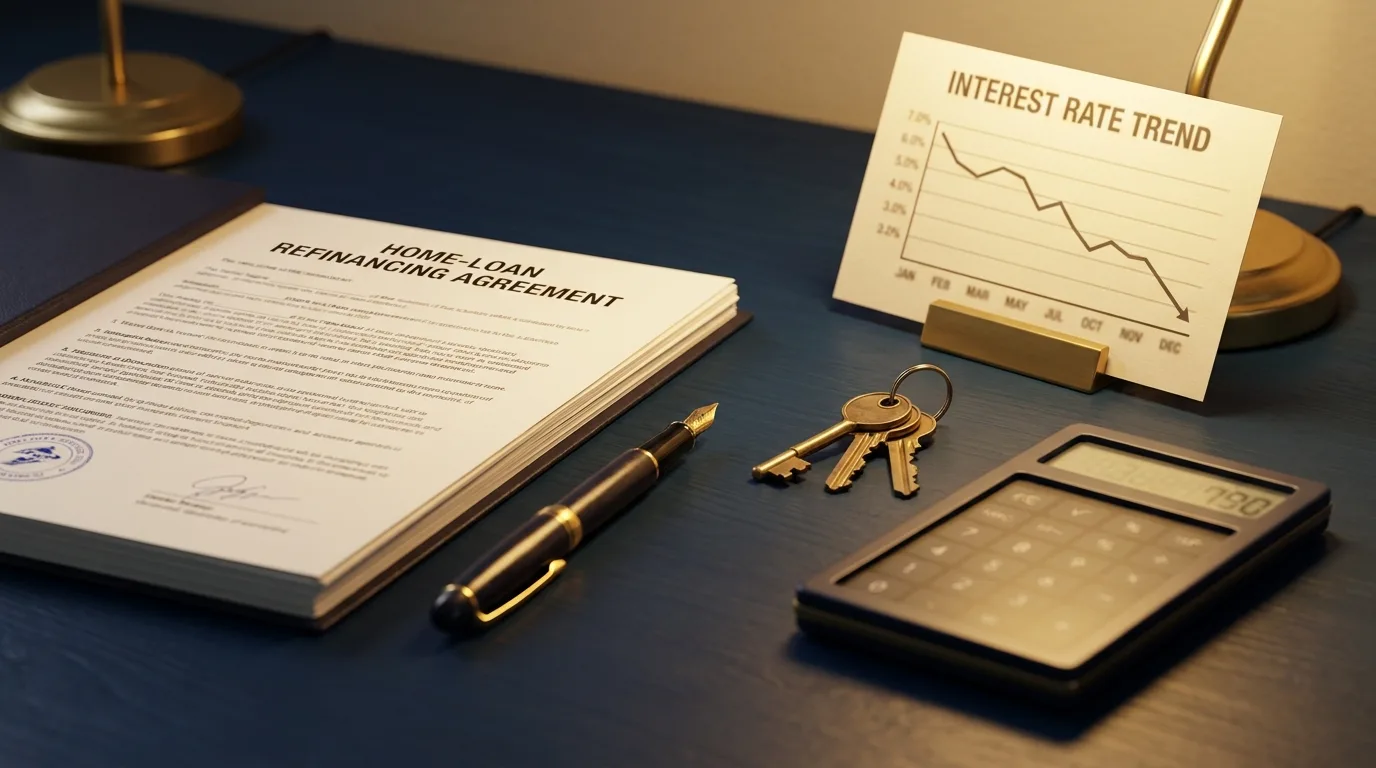
Refinancing is a real transaction: a new loan with a new bank, redeeming the old one. The bigger the rate gap, the bigger the case to move.
We compared all 16 banks and moved them to a package at 1.35% fixed for two years, with free repricing after 12 months. That free repricing matters: if rates fall further during the first year, they can switch to a cheaper package with the same bank at no cost. The new bank gave a S$2,500 subsidy that covered the legal and valuation fees, and the expired lock-in meant no penalty to redeem the old loan.
The Numbers: S$645/Month, ~S$25,800 Saved
Here is the full arithmetic on a S$1,200,000 balance over the remaining 27-year tenure.
| The loan | Detail |
|---|---|
| Property | City-fringe (RCR) condo, owner-occupied |
| Original purchase / loan | S$1,780,000 / S$1,335,000 (75% LTV) |
| Outstanding balance at refinance | ~S$1,200,000 |
| Remaining tenure | 27 years |
| Old rate (expiring) | 2.45% |
| New rate | 1.35% fixed 2 yrs (free reprice after 12 mths) |
| Per year | At 2.45% (old) | At 1.35% (new) |
|---|---|---|
| Monthly repayment | ~S$5,067 | ~S$4,422 |
| Interest paid, year 1 | ~S$29,000 | ~S$16,000 |
| Principal paid, year 1 | ~S$31,800 | ~S$37,100 |
The headline saving is about S$645 a month, roughly S$7,740 a year back in their pocket. The interest matters more, though. At the old rate they'd have paid about S$29,000 in interest in year one. At the new rate it's about S$16,000. That's ~S$13,000 less in the first year alone, and roughly S$25,800 less across the two-year fixed term.
There's a quieter win too. Because more of each lower payment now goes to principal, they pay down about S$5,300 more of the loan in year one. So they're paying less and building equity faster at the same time.
Why 2026 Was the Moment to Move
Timing made this work, and it's the part borrowers most often miss. The couple's original 2.45% looked great in its day. But a rate is only good relative to the market, and the market had fallen. Two windows lined up at once.
- Their lock-in had expired. Refinance while still locked in and the bank charges a redemption penalty, typically around 1.5% of the outstanding loan, which would have been about S$18,000 here. That usually destroys the saving. Outside the lock-in, that barrier is gone.
- Rates had dropped below their package. A gap of more than a full percentage point on a seven-figure loan is large, well past the rough threshold (around 0.3–0.5%) where a switch starts paying for itself.
The lesson isn't "rates are low, refinance now", because rates move. It's that the moment your lock-in ends, you should re-price your loan against the whole market, every time. A package that was sharp two years ago can quietly become one of the most expensive on your street. For where rates sit today, see current fixed vs SORA home loan rates.
Does TDSR Apply When You Refinance?
This is the question that worries people who've seen their income dip, taken on a car loan, or gone self-employed since they first borrowed. For most homeowners the answer is reassuring: refinancing your own home is exempt from TDSR.
Since September 2016, MAS does not apply the Total Debt Servicing Ratio (the 55% cap) to refinancing of an owner-occupied residential property loan. So even if your TDSR today would breach 55%, you can still refinance your home. The new bank will still ask for income documents and run its own light credit check, but that internal check is not the regulatory TDSR test.
Two carve-outs matter, because they flip the rule back on.
- Cash-out or equity loans are one. If you refinance and also borrow extra against your equity, TDSR applies to that cash-out portion. (See cash-out refinancing.)
- Investment property is the other. Refinancing a non-owner-occupied property is still subject to TDSR, unless you commit to a debt-reduction plan that meets MAS's conditions.
Our couple's loan was a straight owner-occupied refinance with no cash-out, so TDSR simply didn't gate it. The bank verified their income for its own files and approved. That's why this kind of refinance is usually far smoother than the original purchase application.
The Refinancing Route, Step by Step

An owner-occupied refinance is usually smoother than the original purchase: no TDSR gate, and the new bank often subsidises the legal and valuation cost.
A refinance is a real transaction, a new loan that redeems the old one, but it's routine when you sequence it right.
- 1Find your lock-in expiry and count back about 4 months. Most banks need around three months' redemption notice, so the work starts before your cheap rate even ends.
- 2Get your bank's repricing offer, then compare the market. Price the easy option (repricing) first, then check all 16 banks. Refinance only if a competitor clearly beats it after costs.
- 3Apply, value, and serve notice. The new bank issues a letter of offer and arranges the valuation and legal work (often subsidised), and you serve the redemption notice to your current bank.
- 4Completion lines up with your lock-in ending. The new loan takes over the moment the notice expires, with no overlap and no penalty, and you start on the lower rate.
Start to finish, plan for about three to four months, governed by that redemption notice. Run the figures first with our refinance savings calculator.
Repricing vs Refinancing: Which Is Cheaper
Refinancing isn't always the winner. Sometimes your own bank's repricing offer is close enough that the switching effort isn't worth it. Here are the trade-offs.
| Repricing (same bank) | Refinancing (switch bank) | |
|---|---|---|
| Rate you can get | Your bank's offers only | Best of all 16 banks |
| Legal & valuation | Small conversion fee (~S$200–800) | New bank often subsidises (~S$2,000–2,500) |
| Speed | Faster — no redemption | ~3-month notice + completion |
| TDSR (owner-occupied) | Exempt | Exempt |
| Best when | Your bank matches the market | A real rate gap exists elsewhere |
In this case the couple's existing bank couldn't match 1.35%, and the rate gap on a S$1.2M loan was far too large to leave on the table. Refinancing clearly won, especially once the subsidy wiped out the switching cost. On a smaller balance, or with only a few years left, repricing often makes more sense.
When Refinancing Is Worth It, and When It Isn't
It's worth it when
- You're past your lock-in, or within about 3 to 4 months of it. There's no redemption penalty, and you serve notice early.
- There's a real rate gap. As a rule of thumb, more than about 0.3 to 0.5%, or a saving of a few hundred dollars a month.
- Your outstanding balance is still large, so the rate gap outweighs the switching cost.
- It's owner-occupied with no cash-out, which means refinancing is TDSR-exempt and approval is straightforward.
Wait, or just reprice, when
- You're still inside the lock-in. The redemption penalty, around 1.5% of the loan, usually swallows the saving.
- You're within your current bank's subsidy clawback period, often 3 years, so you'd have to repay the legal subsidy they gave you.
- The balance is small or the tenure is short, so the rate gap won't beat the fees and repricing is cleaner.
- You want to cash out. Go ahead, but remember TDSR applies to the cash-out portion, so size it first.
Frequently Asked Questions
It depends on the rate gap and your outstanding balance. In this 2026 case, a couple moved a S$1,200,000 condo loan with 27 years left from 2.45% to 1.35%. That cut the monthly repayment from about S$5,067 to S$4,422 — around S$645 a month — and saved roughly S$13,000 of interest in the first year and about S$25,800 over the two-year fixed term. As a rough rule, refinancing is worth exploring when the rate gap is at least 0.3–0.5 percentage points and your loan is still large.
Repricing means switching to a new package with your existing bank — quick, with a small conversion fee and no redemption. Refinancing means moving the loan to a different bank for a better rate, which needs roughly three months' notice and new conveyancing, though the new bank often subsidises the legal and valuation cost. Reprice when your own bank matches the market; refinance when another bank is meaningfully cheaper.
No. Since September 2016 MAS does not apply the 55% TDSR cap to refinancing of an owner-occupied residential property loan, so you can refinance even if your TDSR today would exceed it. The new bank still asks for income documents and runs its own light credit check, but that isn't the regulatory TDSR test. Exceptions: cash-out (an equity loan) is subject to TDSR on the cash-out portion, and refinancing an investment property is still subject to TDSR unless you commit to a debt-reduction plan.
Start looking about three to four months before your lock-in ends, since most banks need around three months' redemption notice. Refinance when there's a real rate gap, when you're past your lock-in so there's no penalty, and when your balance is large enough that the saving beats the switching cost. A fixed or teaser rate that has just reset higher is usually the trigger to act.
Refinance inside your lock-in and the bank charges a redemption penalty, typically around 1.5% of the outstanding loan, which usually wipes out the saving. You may also have to repay legal or valuation subsidies from your current bank if you're still within their clawback period (often three years). Outside those windows, the main costs are new legal and valuation fees — which the incoming bank frequently subsidises. Here, a S$2,500 subsidy covered them, so the switch cost was effectively zero.
Plan for about three to four months end to end. The binding step is the three-month redemption notice to your current bank. While that runs, the new bank handles your application, valuation and legal work, so completion lines up roughly when the notice expires. Applying early means the new loan takes over the moment your lock-in ends.
Yes — you can refinance an HDB concessionary loan to a bank loan to chase a lower rate, but it's a one-way move: once you leave the HDB loan you can't switch back. Weigh the lower bank rate against the stability of the HDB rate. See our HDB loan vs bank loan guide for the full comparison.
Paying More Than 2% on Your Home Loan? Check the Saving.
Nexus Mortgage SG compares all 16 banks, prices your current bank's repricing offer against the market, and tells you exactly what refinancing would save you — net of any penalty, subsidy and legal cost. Independent, and at no cost to you.
Start My Free Report →Lock-in ending soon? WhatsApp Dan Ler at +65 8752 0859 for a free, no-obligation refinancing review. Banks pay our fee — you pay nothing.
Run your numbers: refinance savings calculator · current rates.

About the author — Dan Ler has advised on Singapore home loans since 2017 at Nexus Mortgage SG, an independent brokerage comparing 16+ MAS-regulated lenders. The case in this article is a real client he advised — an owner-occupied condo refinanced from 2.45% to 1.35%, saving about S$645 a month. Figures are rounded and anonymised. Banks pay Nexus on disbursement, so there is no cost to the borrower.
Nexus Mortgage SG is an independent Singapore mortgage advisory. This article is general information, not financial advice, and client figures are rounded and anonymised. Monthly repayments and interest are computed on a S$1,200,000 loan over 27 years at the stated rates and assume the rate holds; your actual figures depend on your balance, tenure, rate and package terms. TDSR, refinancing and CPF rules are governed by MAS, HDB and CPF policy; rates and positions reflect 10 June 2026 and can change. Always confirm current packages and your own eligibility before acting. Sources: MAS TDSR, MAS Notice 645, CPF home ownership.