Reprice vs Refinance in Singapore 2026: Which Actually Saves More?

When your home loan's teaser rate ends, you have two ways to get a cheaper one: reprice (stay with your bank, switch to a new package) or refinance (move to a different bank). They sound similar and are often confused, but the cost, the effort and the potential saving are quite different. Here is how to pick.
The One-Line Difference
Repricing keeps you with your current bank on a new package. Refinancing moves you to a new bank. That single distinction drives everything else — the paperwork, the cost, the timeline, and how much you can save.
What Repricing Is
Repricing means asking your existing bank to move you onto one of its current packages. Because you are not changing lender, there is no new mortgage to register, no law firm, and usually no valuation. Most banks charge a small conversion or administrative fee (often around S$200–S$800, sometimes waived), and the switch typically completes in a few weeks.
The trade-off is choice. You are limited to your own bank's shelf — you cannot access another bank's promotional rate or its new-customer legal subsidy. If your bank happens to be pricing competitively that month, repricing is quick and cheap. If it is not, you may be leaving money on the table.
What Refinancing Is
Refinancing means redeeming your current loan and taking a new one with a different bank. That involves a conveyancing lawyer and a fresh valuation — legal and valuation costs of roughly S$1,800–S$2,500 in total. In return you get the entire market: every bank's live pricing, and any new-loan subsidy or cash rebate, which on larger loans (typically above ~S$500,000) often covers most or all of those switching costs.
Refinancing takes longer — usually 4–6 weeks end to end, because of the legal redemption and registration. But it is where the bigger savings live, especially on larger balances where a small rate improvement is worth thousands a year. Model your own number with our refinance savings calculator.
Cost and Speed, Side by Side
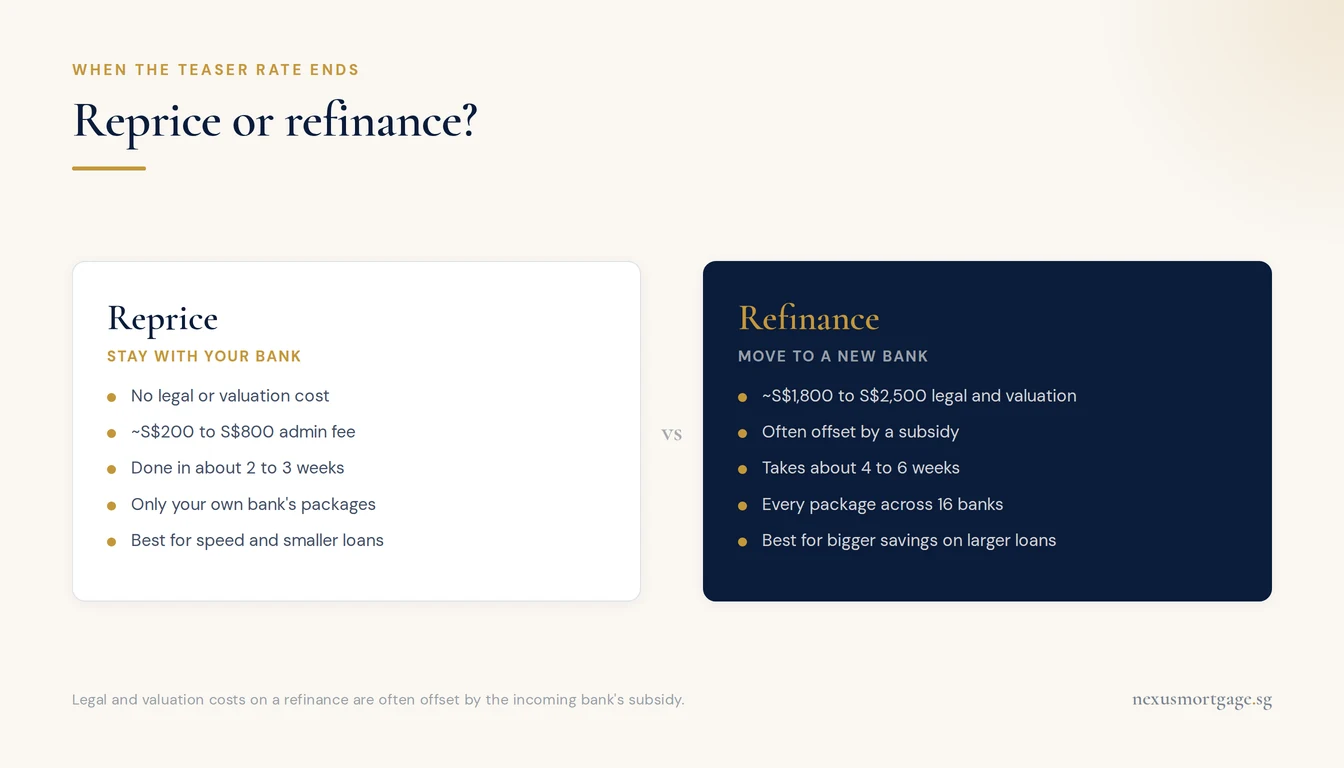
Repricing is cheaper and faster. Refinancing opens the whole market. Loan size usually decides it.
| Reprice | Refinance | |
|---|---|---|
| Lender | Same bank | New bank |
| Legal & valuation | None (usually) | ~S$1,800–2,500 |
| Typical fee | ~S$200–800 admin | Often offset by subsidy |
| Rate choice | Your bank only | All 16 banks |
| Timeline | ~2–3 weeks | ~4–6 weeks |
| Best for | Speed, smaller loans | Bigger savings, larger loans |
When Each One Wins
Reprice when: your bank's new package is close to the best in market; your outstanding loan is smaller (so the legal cost of switching is hard to recover); you value speed and simplicity; or you want to stay for relationship or convenience reasons.
Refinance when: another bank is clearly cheaper by ~0.3% or more; your loan is large enough that the saving dwarfs the switching cost; or you want a subsidy, a longer tenure, or to unlock equity at the same time. The honest move is to compare both on the same day — which is exactly what a broker does for free.
Timing and the Lock-In Trap
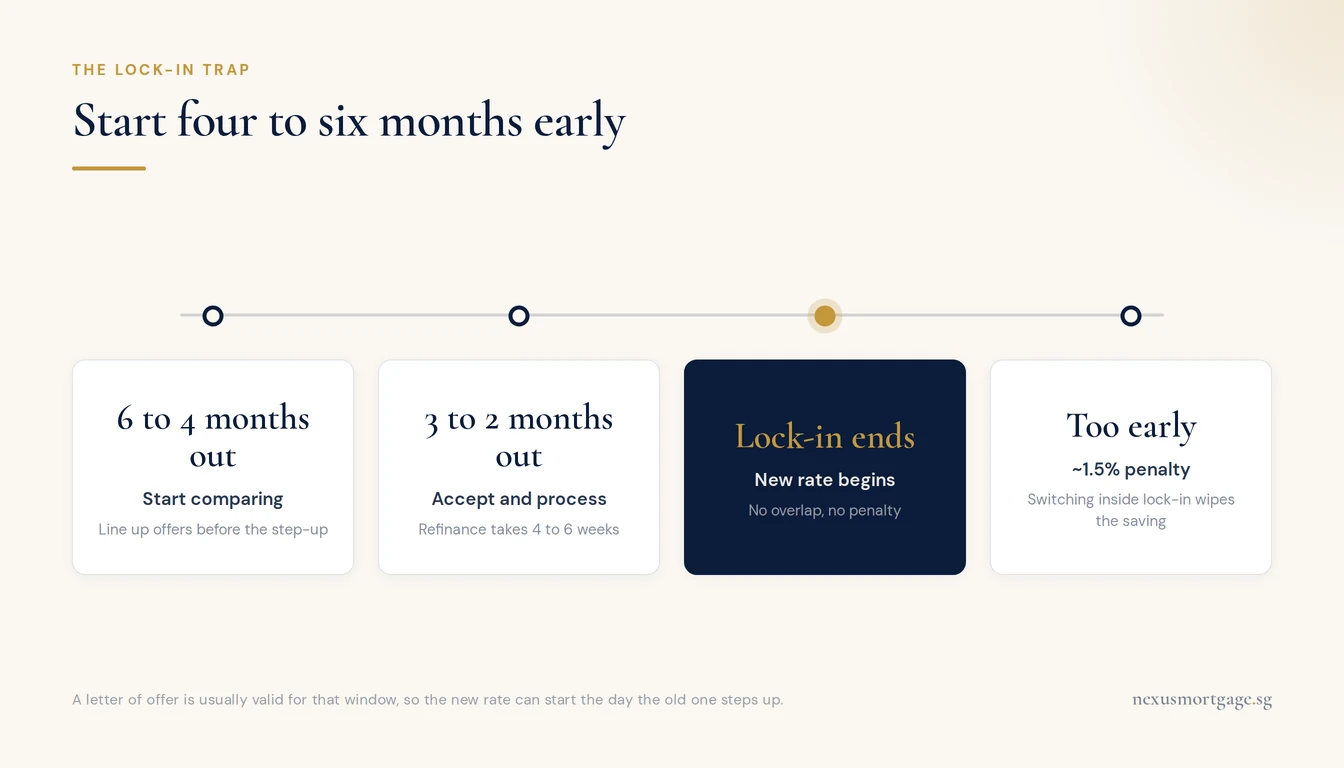
Start too late and you pay the step-up rate. Start too early and you pay the penalty.
Start reviewing about 4–6 months before your lock-in ends — a bank's letter of offer is usually valid for that window, so you can line up the new rate to start the day your old one steps up. Switch inside your lock-in and you typically pay a prepayment penalty of around 1.5% of the outstanding loan, which usually wipes out the saving. One relief: refinancing an owner-occupied home is generally exempt from the 55% TDSR limit, so you can usually switch even if your debt ratios are tight. See our full when-to-refinance guide for the timing playbook.
Frequently Asked Questions
What is the difference between repricing and refinancing?
Repricing means switching to a new package with your existing bank, with little or no legal work and a small admin fee. Refinancing means moving to a different bank, which needs a conveyancing lawyer and valuation but opens up the whole market and any new-loan subsidy. Repricing is faster and cheaper; refinancing usually saves more on larger loans.
Is repricing cheaper than refinancing?
Upfront, yes — repricing typically costs only a small admin fee (around S$200–800) with no legal or valuation cost, while refinancing runs roughly S$1,800–2,500 before any subsidy. But refinancing gives access to lower market rates and legal subsidies, so on a larger loan the total saving after costs is often bigger. Compare both after costs, not just the fee.
Can I refinance while still in my lock-in period?
You can, but you will usually pay a prepayment penalty of around 1.5% of the outstanding loan, which typically erases the saving. The better move is to start comparing 4–6 months before your lock-in ends and time the new package to begin as the lock-in expires.
Does TDSR apply when I reprice or refinance?
For an owner-occupied home, refinancing is generally exempt from the 55% TDSR limit, so you can usually switch even if your ratios are tight. Repricing with your own bank normally does not trigger a fresh TDSR assessment either. Investment properties can still be subject to TDSR unless transitional conditions are met.
Not Sure Whether to Reprice or Refinance?
We compare your bank's repricing offer against all 16 banks on the same day, run the break-even after costs, and tell you which nets out cheaper — free.
Get My Free Mortgage Report →Prefer to talk it through? WhatsApp Dan Ler at +65 8752 0859 — free, independent, banks pay our fee.

About the author — Dan Ler has advised on Singapore home loans since 2017 at Nexus Mortgage SG, an independent brokerage comparing 16+ MAS-regulated lenders. Banks pay Nexus on disbursement, so there is no cost to the borrower.
Further reading
- When to refinance your home loan — lock-in expiry, notice periods and the break-cost math
- Switching an HDB loan to a bank loan — the one-way door, and the LTV and tenure rules that apply
- FDR, FHR and DMR pegs explained — board-rate pegs and why they behave differently from SORA
- Singapore mortgage rate outlook — where rates are heading and what it means for your next repricing
- Live SORA rate today — the 1M and 3M compounded SORA feed that prices floating packages
Nexus Mortgage SG is an independent Singapore mortgage advisory. General information, not financial advice. Fees, subsidies and rates are indicative and change; confirm with the lender. As of 6 July 2026.