Singapore Stamp Duty in 2026: BSD, ABSD and a Calculator That Does the Math

Two stamp duties hit a property purchase in Singapore. Buyer's Stamp Duty (BSD) is paid by everyone, on a sliding scale up to 6% on a home (5% on commercial). Additional Buyer's Stamp Duty (ABSD) is an extra charge on residential property that depends on who you are and how many homes you already own: a Singapore Citizen pays 0% on a first home, a PR pays 5%, a foreigner pays 60%. Both fall due within 14 days, in cash up front, and neither can be added to your loan. Use the calculator below to get your number.
The Calculator: BSD + ABSD
Enter the price and your profile. It applies the current 2026 BSD bands and ABSD rates and shows the total. Everything updates as you type.
Estimate for planning. Confirm the exact figure at IRAS e-Stamping; duty is rounded down to the nearest dollar.
Buyer's Stamp Duty: Everyone Pays It
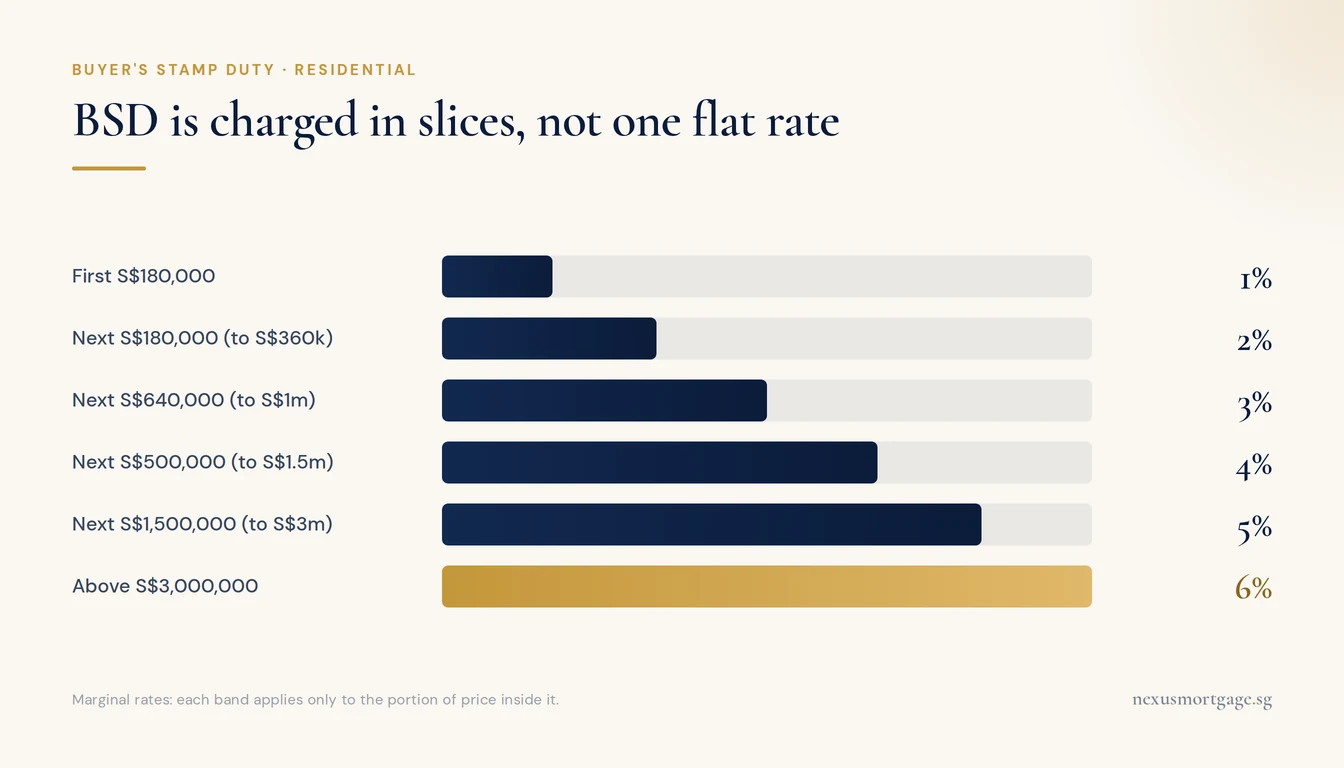
Only the slice above S$3m is taxed at 6%. On a S$2m purchase the blended rate lands near 3.5%, not 5%.
BSD is the base tax on any property purchase, paid by every buyer regardless of citizenship or how many properties they own. It is worked out on the purchase price or the market value, whichever is higher, on a sliding scale. For residential property the bands in 2026 are:
| Portion of price | Residential BSD |
|---|---|
| First S$180,000 | 1% |
| Next S$180,000 (up to S$360k) | 2% |
| Next S$640,000 (up to S$1m) | 3% |
| Next S$500,000 (up to S$1.5m) | 4% |
| Next S$1,500,000 (up to S$3m) | 5% |
| Above S$3,000,000 | 6% |
Source: IRAS — Buyer's Stamp Duty (BSD), bands effective 15 February 2023.
Non-residential property (offices, shops, industrial) uses the same first four bands but tops out at 5% on everything above S$1.5m, with no 6% tier. As quick reference points on a home: BSD is about S$24,600 on a S$1m purchase, S$44,600 on S$1.5m, and S$69,600 on S$2m. The calculator above does the band-by-band sum for you.
ABSD: Depends on Who You Are
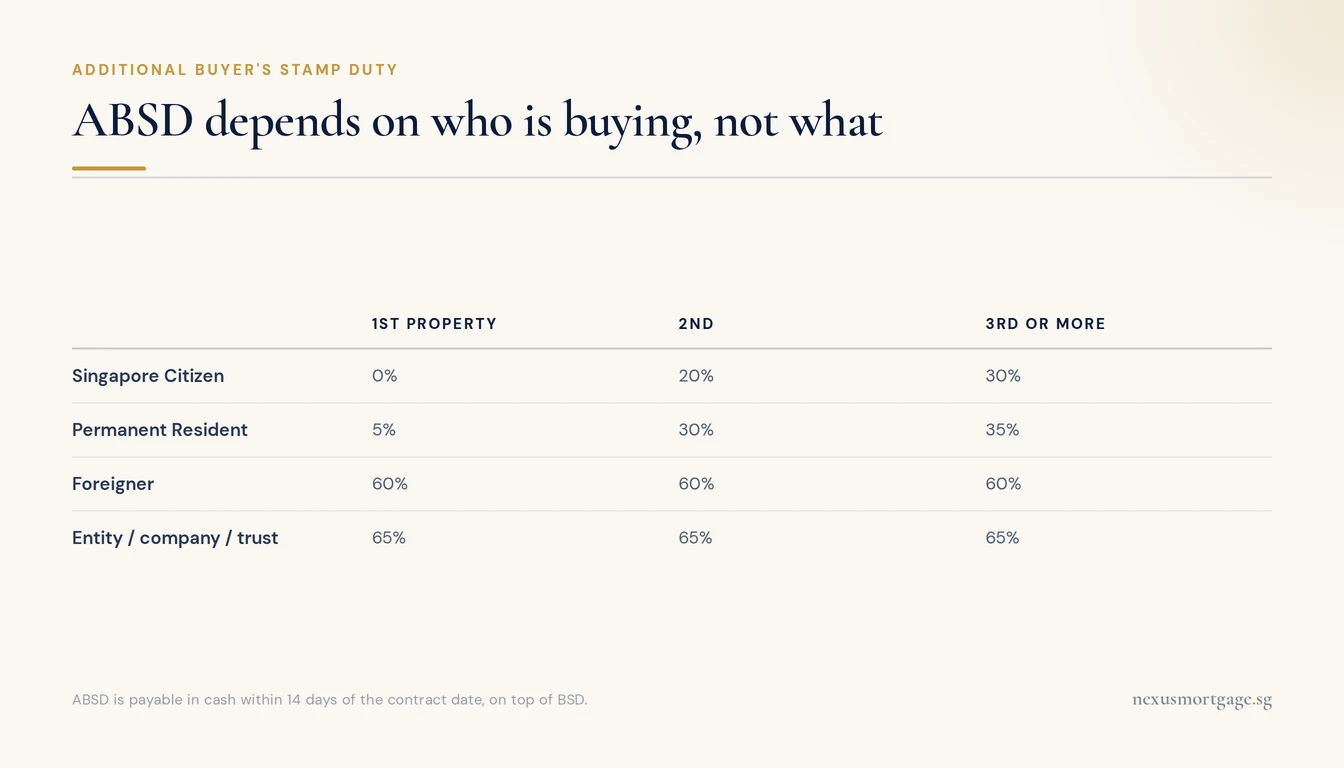
Residency and property count set the rate. The property itself makes no difference.
Additional Buyer's Stamp Duty sits on top of BSD and only applies to residential property. The rate depends on your profile and how many residential properties you will hold after the purchase. These are the ABSD rates in force since 27 April 2023, unchanged as of June 2026:
| Buyer | 1st property | 2nd | 3rd or more |
|---|---|---|---|
| Singapore Citizen | 0% | 20% | 30% |
| Permanent Resident | 5% | 30% | 35% |
| Foreigner | 60% on any residential purchase | ||
| Entity / company / trust | 65% | ||
Source: IRAS — Additional Buyer's Stamp Duty (ABSD), rates effective 27 April 2023.
The jump from a first to a second home is steep. A Citizen pays nothing on their first but 20% on their second, so on a S$2m second home that is S$400,000 of ABSD on its own, before BSD. That single number is why so much Singapore property planning, from decoupling to buying under one name, is really about managing ABSD. If you are weighing a second property, read our guide on how to legally reduce ABSD before you commit. Buying as a foreigner or PR? A foreigner pays 60% ABSD and a PR 5% — see our foreigner & PR private property financing guide, including the US and EFTA exemptions that drop it to the citizen rate.
Three Worked Examples
Same S$2,000,000 home, three very different buyers:
| Buyer | BSD | ABSD | Total stamp duty |
|---|---|---|---|
| Citizen, first home | S$69,600 | S$0 | S$69,600 |
| Citizen, second home (20%) | S$69,600 | S$400,000 | S$469,600 |
| Foreigner (60%) | S$69,600 | S$1,200,000 | S$1,269,600 |
The BSD is identical in all three. ABSD is what moves the total from S$69,600 to over S$1.2m. For a PR buying a first home at S$2m, ABSD is 5%, so S$100,000 on top of the S$69,600 BSD.
When and How You Pay
Stamp duty is due within 14 days of signing the document in Singapore, or 30 days if it is signed overseas, through IRAS e-Stamping. On a resale that is from the Option exercise or the Sale and Purchase Agreement; on a new launch it is usually within 14 days of exercising the Option to Purchase. Miss the window and IRAS charges a penalty, so it is one of the first cheques to line up after you commit.
The two duties are funded differently. Buyer's Stamp Duty can be paid directly from your CPF Ordinary Account, arranged through your conveyancing lawyer, so you do not need to front it in cash. Additional Buyer's Stamp Duty must be paid in cash — CPF cannot fund it, though you may apply for a remission if you qualify. Both are due within 14 days of signing, and stamp duty cannot be added to your loan.
ABSD Remissions Worth Knowing
A few reliefs can wipe out or refund ABSD. The two that come up most:
- Married couples. A couple where at least one spouse is a Singapore Citizen can buy their first matrimonial home with no ABSD charged upfront, even if the other spouse is a PR. It is a remission given at the point of stamping, not a pay-then-refund.
- The sell-first refund. A Citizen married couple who buy a second home and then sell their first within six months of buying it (or of completion, for a new launch) can claim back the ABSD they paid on the second. The catch is cashflow: you front the ABSD, then wait for the refund, so you need the cash in hand first.
Both have conditions, and they are exactly the kind of thing worth confirming before you rely on them. The full ABSD rules and remission forms are on the IRAS ABSD page.
Selling Too Soon? Seller's Stamp Duty
BSD and ABSD are what you pay to buy. There is a third duty that bites if you sell a home too quickly: Seller's Stamp Duty. It is there to discourage short-term flipping, and the rules tightened on 4 July 2025.
For any residential property bought on or after 4 July 2025, SSD applies if you sell within four years, charged on the higher of the sale price or market value:
| Sold within | SSD rate |
|---|---|
| 1st year of holding | 16% |
| 2nd year | 12% |
| 3rd year | 8% |
| 4th year | 4% |
| More than 4 years | 0% |
Source: IRAS — Seller's Stamp Duty (Residential), four-year holding period effective 4 July 2025.
If you bought before 4 July 2025, the older rule applies to your sale: a three-year window at 12%, 8% and 4%, then nothing. Either way, SSD only hits a sale made inside the holding period, so an owner-occupier who stays past it pays nothing. It matters most to buyers who might need to exit early. For HDB flats it rarely bites, because the five-year Minimum Occupation Period already runs past the SSD window. Industrial property has its own separate SSD; this guide covers residential. For the full breakdown — how the holding period is counted, the exemptions, and worked examples — see our guide to the 4 July 2025 SSD reset.
Why It Matters for Your Loan Budget
Here is the part people miss. Stamp duty is not part of your loan. The bank lends up to 75% of the price; your 25% downpayment is separate; and stamp duty sits on top of all of it, in cash. On a S$2m first home, that is your S$500,000 downpayment plus another S$69,600 in BSD you need in cash within two weeks of committing.
So when you work out what you can actually afford, the price you can borrow against is not the price you need cash for. Size the loan and the cash separately. We build the full cash picture, loan, downpayment, BSD, ABSD and legal fees, into the Singapore Mortgage Free Report, and the affordability check shows the loan side against the MAS 4% stress floor. If a second property is on the table, the decoupling guide and the ABSD guide cover the legal ways to cut the ABSD line.
Frequently Asked Questions
BSD is paid on every property purchase, on a sliding scale based on the price or market value, whichever is higher. For residential property it runs 1% on the first S$180,000, 2% on the next S$180,000, 3% on the next S$640,000, 4% on the next S$500,000 (up to S$1.5m), 5% on the next S$1.5m (up to S$3m), and 6% above S$3m. Non-residential property uses the same bands but tops out at 5%. As quick reference points: BSD is about S$24,600 on a S$1m home, S$44,600 on S$1.5m, and S$69,600 on S$2m.
Additional Buyer's Stamp Duty is an extra tax on residential property, charged on top of BSD. It depends on your profile and how many residential properties you will own after the purchase. Singapore Citizens pay 0% on a first home, 20% on a second and 30% on a third or more. Permanent Residents pay 5%, 30% and 35%. Foreigners pay 60% on any residential purchase, and most entities such as companies and trusts pay 65%. ABSD does not apply to non-residential property.
No. A Singapore Citizen buying their first residential property pays 0% ABSD, so only BSD applies. ABSD starts from the second residential property: 20% on the second and 30% on the third or more. What counts is the total number of residential properties you hold, so if you already own one, your next purchase is treated as a second.
It depends which duty. Buyer's Stamp Duty (BSD) can be paid directly from your CPF Ordinary Account; your conveyancing lawyer arranges it, so you do not need to front it in cash. Additional Buyer's Stamp Duty (ABSD) must be paid in cash, because CPF cannot fund it, though you may be able to apply for an ABSD remission, such as the married-couple remission, if you qualify. Either duty is due within 14 days of signing through IRAS e-Stamping, and neither can be added to your bank loan.
Stamp duty is due within 14 days of signing the document in Singapore, or 30 days if it is signed overseas, through IRAS e-Stamping. For a new launch that is usually within 14 days of exercising the Option to Purchase. Pay it late and IRAS charges a penalty, so it is one of the first cheques to line up after you commit.
Yes. A married couple where at least one spouse is a Singapore Citizen can buy their first matrimonial home with no ABSD charged upfront, even if the other spouse is a PR. There is also a refund route: a Citizen couple who buy a second home and sell their first within six months of the purchase (or of completion for a new launch) can claim back the ABSD paid on the second. Conditions apply, so confirm eligibility before relying on it.
Yes, if you sell soon after buying. Seller's Stamp Duty (SSD) applies to residential property sold within the holding period. For homes bought on or after 4 July 2025 the window is four years, at 16%, 12%, 8% and 4% for years one to four, then 0%. For homes bought before that date the older three-year window applies, at 12%, 8% and 4%. SSD is charged on the higher of the sale price or market value, so an owner who holds past the window pays nothing.
Know the Stamp Duty — Then Size the Loan Right
Stamp duty is cash on top of your downpayment. Nexus Mortgage SG maps the full upfront picture — loan, downpayment, BSD, ABSD and legal fees — against the MAS 4% stress floor, comparing 16+ banks at zero cost to you.
Check What I Can Afford →Prefer a personal review? WhatsApp Dan Ler at +65 8752 0859 for a free assessment. Banks pay our fee — you pay nothing.
Or download the full breakdown: Singapore Mortgage Free Report — 16-bank rate comparison, TDSR/MSR stress test and the full upfront-cost list including stamp duty, in one PDF.

About the author — Dan Ler has advised on Singapore home loans since 2017 at Nexus Mortgage SG, an independent brokerage comparing 16+ MAS-regulated lenders across residential, commercial and new-launch financing. Banks pay Nexus on disbursement, so there is no cost to the borrower.
Further reading
- How to avoid ABSD on a second property — real case study — the legal route, the IRAS 99-1 line, and when decoupling does and does not work
- Decoupling property in Singapore: cost, process and tax — BSD on the share bought over, CPF refund with accrued interest, and the TDSR check on the receiving spouse
- Seller's Stamp Duty and the holding-period reset — when the SSD clock restarts and what it costs
- Joint tenancy vs tenancy-in-common — how the ownership structure you pick at purchase changes your options later
- Mortgage calculators — affordability, repayment, refinance savings and cash-out tools
Nexus Mortgage SG is an independent Singapore mortgage advisory. This article is general information, not financial, legal or tax advice. All Buyer's Stamp Duty and Additional Buyer's Stamp Duty rates and bands reflect IRAS positions current as of publication (BSD bands from 15 February 2023; ABSD rates from 27 April 2023) and can change at any time. The calculator gives an estimate for planning only; confirm the exact duty payable at IRAS e-Stamping, and check remission and refund eligibility with IRAS or a conveyancing lawyer before relying on it. Loan, LTV, TDSR and CPF figures are illustrative and reflect MAS and CPF positions as of publication. Sources: IRAS Buyer's Stamp Duty, IRAS Additional Buyer's Stamp Duty, MAS Notice 645 (TDSR), CPF Home Ownership.