Caveat Loan Singapore 2026: Fast, Property-Secured Business Financing

When a business owns property and needs cash quickly — faster than a bank can move — a caveat loan is one of the few tools that fits. It is a short-term private loan secured against a property you already own, arranged in days rather than weeks. It is also more expensive than a bank loan and carries real risk, so it pays to understand exactly how it works before you use one.
What a Caveat Loan Is
A caveat loan is a short-term loan secured against a property you already own. The lender protects its position by lodging a caveat — a legal notice recorded against the property title — which announces the lender's interest and stops the owner from selling or refinancing without settling the loan first. Because the property usually still has a bank mortgage on it, a caveat loan typically sits behind that mortgage as a second charge, letting you draw on the equity you have built up. Learn more about how a caveat is lodged on property from SingaporeLegalAdvice.
How It Works
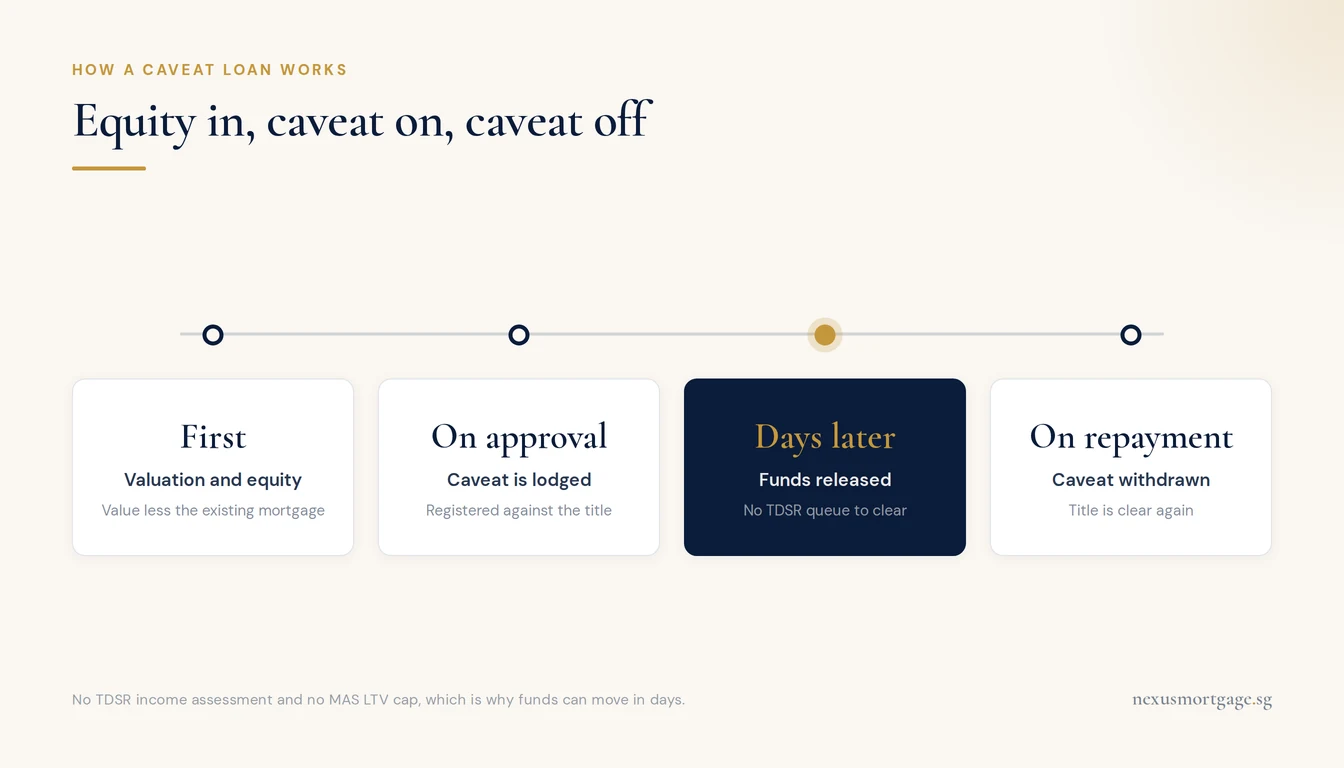
No TDSR queue and no LTV cap, which is exactly why it costs more.
The mechanics are simpler than a mortgage:
- Valuation and equity. The lender looks at the property's value and how much is still owed on the existing mortgage. The gap — your equity — is what a caveat loan can lend against.
- The caveat is lodged. On approval, the lender registers a caveat against the title. From that point you cannot complete a sale or refinance without the lender's consent and repayment.
- Funds are released. Because there is no TDSR income assessment or MAS LTV cap to work through, funds can be disbursed in days.
- Repay and withdraw. When the loan is repaid, the caveat is withdrawn and the title is clear again. If you sell the property, the loan is settled from the sale proceeds first.
Who It Is For
Caveat loans are a business and corporate financing tool, not a first port of call for a homeowner. They suit a company that owns property and needs to move fast:
- Working capital under a deadline — a supplier payment, payroll gap or a time-limited opportunity.
- Bridging a purchase or a slow bank drawdown, where the timing gap is short.
- When a bank has declined or is too slow — the borrower has equity but not the income documentation, credit history or time for a full bank process.
If your need is longer-term and you can wait, a bank facility is almost always cheaper. A caveat loan earns its keep on speed and access, not price.
Caveat Loan vs a Bank Cash-Out
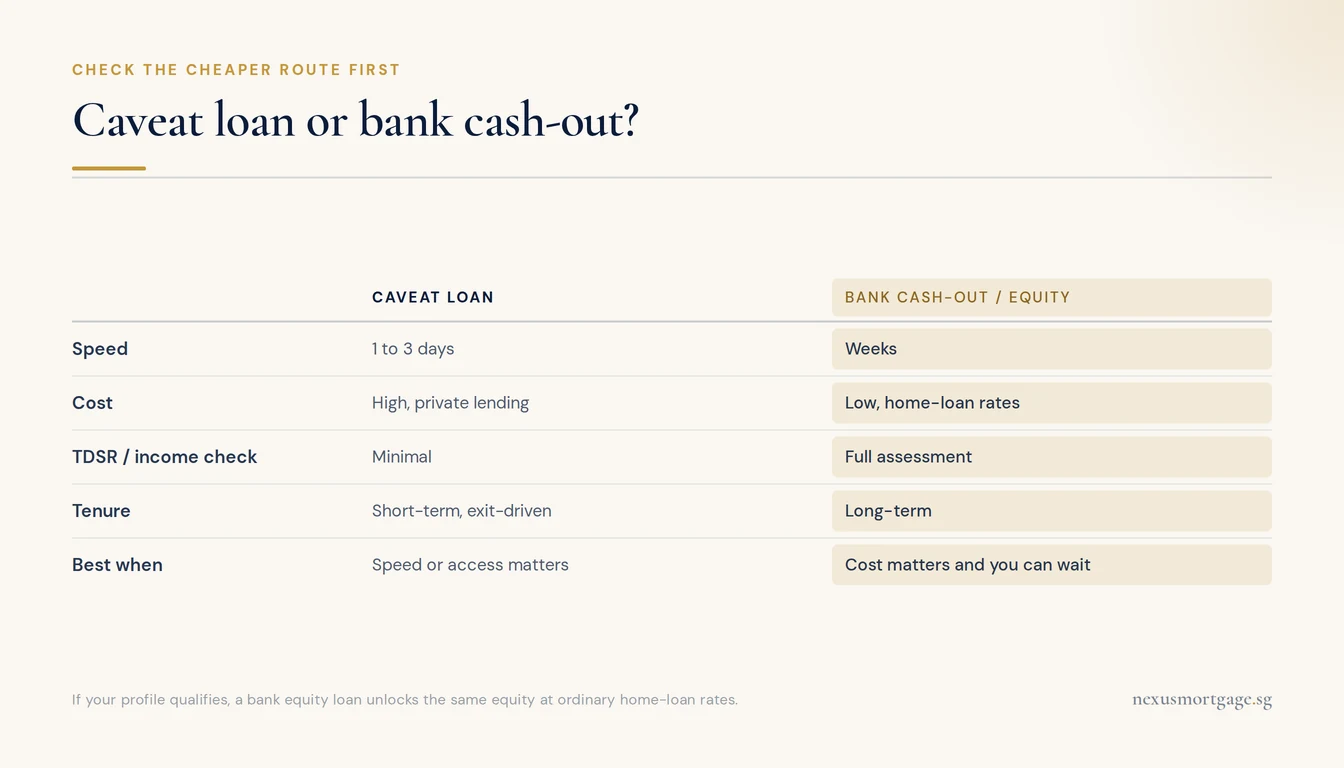
Always price the bank route first. Speed is the only thing a caveat loan wins on.
Before taking a caveat loan, always check the cheaper route first. If your profile qualifies, a bank cash-out refinance or equity term loan unlocks the same property equity at ordinary home-loan rates — a fraction of a private lender's cost. The trade-off:
| Caveat Loan | Bank Cash-Out / Equity | |
|---|---|---|
| Speed | 1–3 days | Weeks |
| Cost | High (private) | Low (home-loan rates) |
| TDSR / income check | Minimal | Full assessment |
| Tenure | Short-term | Long-term |
| Best when | Speed / access matters | Cost matters, can wait |
Cost, Tenure and Quantum
Because a caveat loan is private lending, it is priced above bank mortgage rates to reflect the speed, the lighter checks and the risk the lender takes on a second charge. Terms are set case by case: the amount depends on the equity available after the existing mortgage, and the tenure is deliberately short, structured around a clear repayment or exit. Rather than a fixed rate card, caveat facilities are quoted on the specific property, equity and timeline — so the right first step is a conversation and an indicative quote, not a headline number.
The Legal Side: Who Can Lend
This is the part that matters most, and where a lot of online information is loose. Singapore's Moneylenders Act draws a firm line by who is borrowing:
- Lending to companies, LLPs and accredited investors falls under the “excluded moneylender” category and sits outside the Moneylenders Act — Parliament treats these as sophisticated borrowers who do not need consumer protection. This is the lane Nexus operates in for property-secured caveat financing.
- Lending to individual consumers is regulated and must go through a licensed moneylender or a bank. An individual homeowner wanting cash against their property should look at a bank cash-out or equity term loan first.
So a caveat loan through Nexus is structured for business and corporate borrowers. If you are unsure which category you fall into, we will tell you plainly — and point you to the right, compliant option. Reference: MinLaw's guide to borrowing.
The Risks to Weigh
- Cost. It is materially more expensive than a bank loan. Only use it when the speed or access is worth the premium.
- The caveat locks the property. You cannot sell or refinance until the loan is repaid; on a sale, the loan is settled from the proceeds first.
- Short tenure needs a real exit. Go in with a clear repayment plan — incoming receivables, a completing sale, or a bank facility taking over — not just hope.
- Your property is on the line. As with any secured loan, default puts the asset at risk. Borrow only what the exit can comfortably repay.
Frequently Asked Questions
What is a caveat loan in Singapore?
A caveat loan is a short-term private loan secured against a property you already own. The lender lodges a caveat — a legal notice on the property title — recording their interest and preventing you from selling or refinancing the property without repaying them first. It usually sits as a second charge behind your existing mortgage, letting a borrower tap the property's equity quickly. It is a private financing arrangement, not a bank mortgage, so it is not bound by MAS TDSR or LTV limits.
How fast can a caveat loan be approved?
Much faster than a bank loan — often within one to a few working days, because the assessment focuses on the value and equity of the property rather than a full income and credit review. That speed is the main reason businesses use them: to meet a deadline, a supplier payment or a time-sensitive opportunity that a bank's weeks-long process would miss.
Is a caveat loan cheaper than a bank loan?
No. A caveat loan is priced well above a bank mortgage, reflecting the speed, flexibility and higher risk the private lender takes. If you qualify for a bank cash-out refinance or equity term loan — typically at home-loan rates — that is far cheaper and usually the better first option. A caveat loan makes sense when speed, eligibility, or a short bridging need outweighs the higher cost. We will always tell you if a cheaper bank route fits first.
Can an individual take a caveat loan, or only a company?
This is the key legal point. Lending to companies, LLPs and accredited investors falls under the 'excluded moneylender' category and sits outside the Moneylenders Act. Lending to individual consumers is regulated and must be done through a licensed moneylender (or a bank). Nexus arranges property-secured caveat financing for business and corporate borrowers on that basis. Individual borrowers seeking property-secured cash should generally look at a bank cash-out refinance or equity term loan first.
What happens to the caveat when I repay?
Once the loan is fully repaid, the lender withdraws the caveat, and the property title is clear again to sell or refinance. While the caveat is in place, you cannot complete a sale or a refinance without settling the loan — if you sell, the repayment comes out of the sale proceeds first. That is why caveat loans are structured as short-term facilities with a clear exit.
Need Fast, Property-Secured Business Financing?
Nexus arranges caveat and property-secured facilities for business borrowers — and we will first check whether a cheaper bank cash-out or equity loan fits, so you do not overpay for speed you do not need.
WhatsApp Dan Ler →Or explore the cheaper bank route first: Equity / Cash-Out Loan.

About the author — Dan Ler advises on Singapore home and property financing at Nexus Mortgage SG, an independent brokerage comparing 16+ MAS-regulated lenders, and arranges property-secured facilities for business borrowers.
Further reading
- Bridging loans — covering the gap between selling one property and completing the next
- Cash-out refinancing explained — borrowing against equity you already own, and the CPF charge that reduces it
- Commercial property loans — LTV, tenure and how commercial lending differs from residential
- TDSR and MSR explained — the 55% and 30% ceilings and how the MAS stress floor is applied
- Cash-out and equity loans — up to 75% LTV with a mortgage, 55% fully paid, higher on commercial
Nexus Mortgage SG is an independent Singapore mortgage advisory. This article is general information, not financial or legal advice, and is not an offer of credit. A caveat loan is a private lending arrangement; terms, rates and eligibility are assessed case by case and confirmed in writing. Nexus arranges property-secured caveat financing for corporate / business borrowers on an excluded-moneylender basis under the Moneylenders Act; individual consumers should borrow only from a bank or a licensed moneylender. Secured borrowing puts your property at risk if you default. As of 14 July 2026. Sources: SingaporeLegalAdvice — lodging a caveat, Ministry of Law (Registry of Moneylenders).