Bridging Loans in Singapore: How Upgraders Cover the Cash Gap
A bridging loan is a short-term loan that covers the cash you need for your next home before the money from selling your current one comes in. The bank advances part of your expected sale proceeds, you use it for the downpayment, and you repay it in full when the sale completes. Tenure is usually up to six months, interest runs higher than a home loan (recently around 3% to 4% a year) but only on the bridged amount for those few months, and a genuine six-month bridge does not count towards your TDSR. It is mainly an upgrader's tool, for an HDB or resale condo move where your cash is locked in the old place.
What a Bridging Loan Actually Does
Picture the classic upgrader. You are selling a flat and buying a condo, but the timing never lines up perfectly. The condo wants its downpayment now, and the cash for it is sitting inside a flat you have not been paid for yet. That gap, between paying for the new place and receiving money for the old one, is exactly what a bridging loan fills.
The bank lends you part of the net proceeds it expects you to receive from your sale, so you can put down the deposit on the new home today. The moment your sale completes, those proceeds repay the bridge in full. You have borrowed the money for weeks or a few months, not years.
How It Works, Step by Step
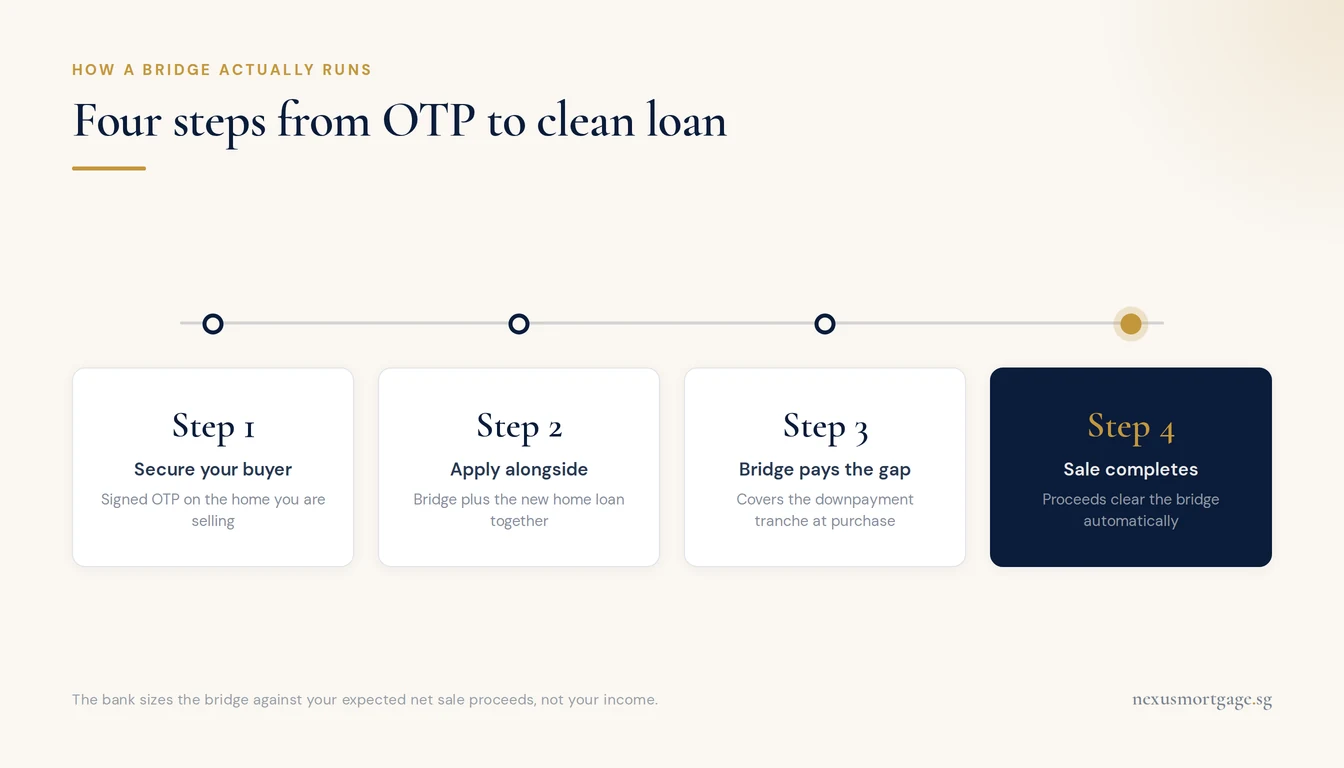
The bridge is sized against your expected sale proceeds, which is why the OTP comes first.
In practice a typical bridge runs like this:
- You secure a buyer for your current home and get a signed Option to Purchase. Most banks need this as proof of where the repayment is coming from.
- You apply for the bridging loan alongside the home loan for your new property. The bank sizes the bridge against your expected net sale proceeds.
- At your new purchase, the bridge pays the downpayment tranche that would otherwise have come from your sale.
- Your sale completes, the proceeds land, and the bank uses them to clear the bridging loan. You are left with just the long-term home loan on the new place.
You only ever pay interest for the window the bridge is open, which is why the high headline rate matters less than it first looks.
The TDSR Advantage Most People Miss
Here is the part that makes a bridging loan useful rather than just convenient. A genuine bridging loan that is repaid within six months is excluded from your Total Debt Servicing Ratio. Because it is short-term and backed by your incoming sale proceeds, MAS rules let banks leave it out of the 55% TDSR limit.
That matters because the bridge then does not shrink the home loan you can take on the new property. If it were counted, the extra monthly commitment could push you over TDSR and cut your loan. Left out, your borrowing power on the new home stays intact. Some banks still run their own checks, so confirm the treatment with your banker, but the six-month rule is the basis. For how the ratio works in full, see our guide to TDSR and MSR.
What It Costs
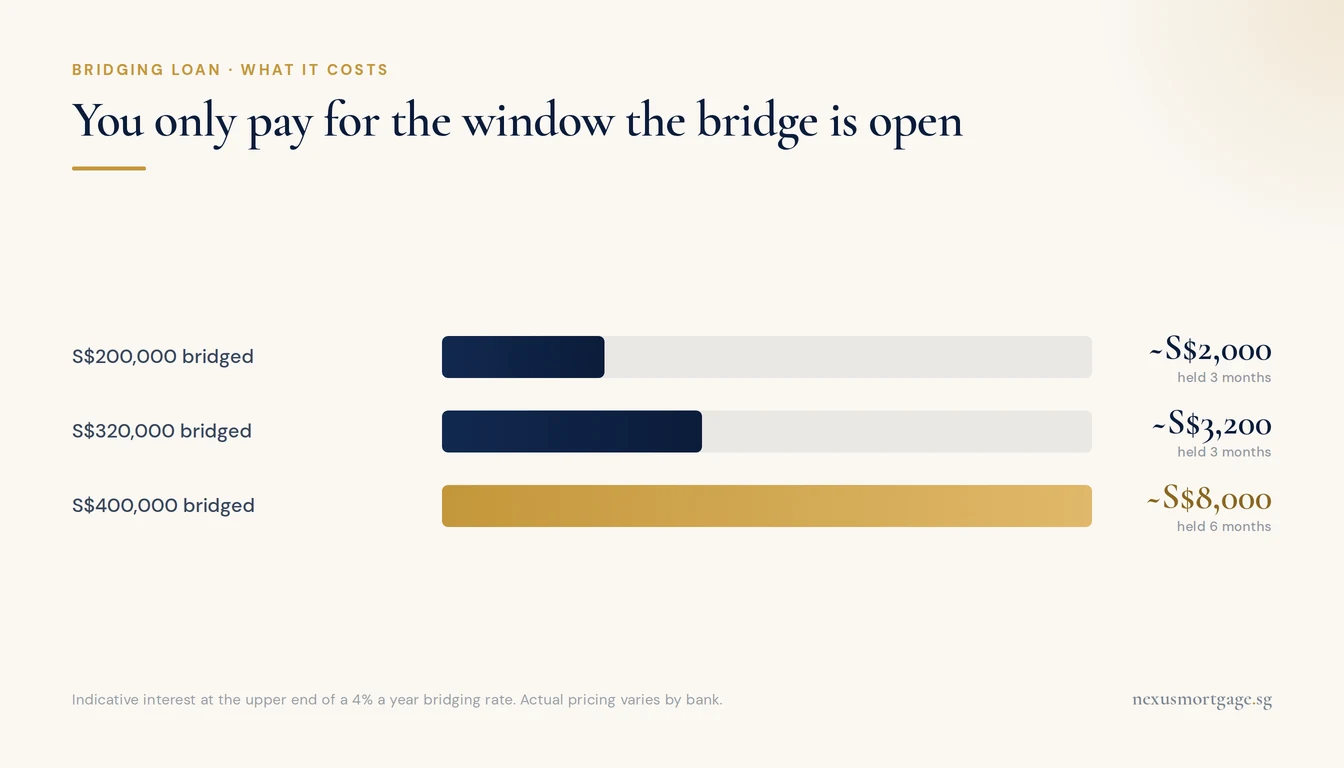
The headline rate looks high until you notice it only runs for the weeks the bridge is open.
Bridging interest is higher than a normal home loan, recently around 3% to 4% a year. The number looks steep until you remember you pay it only on the bridged amount, and only for the months you use it.
| Bridged amount | Held for | Rough interest at 4% a year (upper end) |
|---|---|---|
| S$200,000 | 3 months | ~S$2,000 |
| S$320,000 | 3 months | ~S$3,200 |
| S$400,000 | 6 months | ~S$8,000 |
On top of interest there may be a small legal fee. The real cost to watch is the deadline: if your sale falls through or drags past six months, the bank can convert the outstanding bridge into a personal loan at a much higher rate, often above 10% a year. The fix is simple in principle, keep the sale firm and the timeline tight.
Worked Example: HDB Flat to Condo
Say you are buying a S$1,600,000 resale condominium and selling your HDB flat to fund it. On a first bank loan the bank lends 75%, so S$1,200,000, and you need 25%, or S$400,000, as downpayment: 5% (S$80,000) in cash when you exercise the Option to Purchase, and 20% (S$320,000) in cash or CPF at the Sale and Purchase Agreement.
The problem is that S$320,000. It is meant to come from your flat sale, which has not completed. A bridging loan advances roughly that amount against your expected proceeds, so you can pay the second tranche on time. When the flat sale completes a couple of months later, the proceeds clear the bridge. Hold S$320,000 for three months at 4% and the interest is about S$3,200, the price of moving in one clean motion instead of selling, renting, then buying again. Note that stamp duty sits on top of all this in cash; our Singapore stamp duty guide has the calculator for that.
Do You Actually Need One?
Not every move needs a bridge. The alternatives worth weighing:
- Sell first, then buy. No bridging interest at all, but you may need to rent in between and you carry the risk of prices moving while you wait. Cleaner on paper, more disruptive in life.
- Buy a new launch instead. A building-under-construction purchase uses the progressive payment scheme, so the big payments spread over years and you rarely need a bridge. New-launch buyers finance on floating-rate progressive disbursement, not bridging.
- Cash or CPF on hand. If you have enough liquid outside the sale, you may not need to borrow the gap at all.
For most HDB upgraders moving to a completed condo, the bridge is the smoother route: you buy and move once, and pay only a few months of interest. The call usually comes down to rent saved versus interest paid. Our HDB-to-condo upgrade case study walks through the full timing, CPF refund and LTV picture.
Frequently Asked Questions
A bridging loan is a short-term loan that covers the cash you need for your next home before the money from selling your current one arrives. The bank advances part of your expected net sale proceeds so you can pay the new property's downpayment, and you repay it in full once your sale completes. Tenure is usually up to six months.
Interest is higher than a normal home loan, recently around 3% to 4% a year, but you pay it only on the bridged amount for the few months you use it. On S$320,000 bridged for three months at 4%, that is about S$3,200 in interest, plus a small legal fee. If your sale drags past six months, the bank can convert the balance into a personal loan at a much higher rate, often above 10%.
A genuine bridging loan repaid within six months is excluded from your Total Debt Servicing Ratio, because it is short-term and backed by your incoming sale proceeds. That is one of its main advantages: it does not eat into the 55% TDSR limit on your new home loan. Some banks still run their own checks, so confirm the treatment with your banker.
Most banks require a signed Option to Purchase from your buyer before they release a bridging loan, because that is their proof of repayment. A few offer a capitalised bridge based on an indicative valuation before a sale, but the terms are tighter. In practice, line up the sale first.
Selling first avoids bridging interest entirely, but you may need interim rented housing and you carry the risk of prices moving while you wait. A bridging loan lets you buy and move in one motion and pay only a few months of interest. Which is cheaper depends on rent saved versus interest paid; for most upgraders the bridge is the smoother route.
Usually you do not need one. A building-under-construction purchase uses the progressive payment scheme, so the large outflows come over years rather than upfront. Bridging is mainly for completed-property purchases, such as an HDB or resale condo move, where you need the downpayment before your old place is sold.
Timing a Sale and a Purchase? Let's Map the Cashflow
Nexus Mortgage SG plans the bridge, the new home loan and the sale timeline together — comparing 16+ MAS-regulated banks at zero cost to you — so the downpayment is covered and your TDSR stays intact.
Check What I Can Afford →Prefer a personal review? WhatsApp Dan Ler at +65 8752 0859 for a free assessment. Banks pay our fee — you pay nothing.
Or download the full breakdown: Singapore Mortgage Free Report — 16-bank rate comparison, TDSR/MSR stress test and the full upfront-cost list, in one PDF.

About the author — Dan Ler has advised on Singapore home loans since 2017 at Nexus Mortgage SG, an independent brokerage comparing 16+ MAS-regulated lenders across residential, commercial and new-launch financing. Banks pay Nexus on disbursement, so there is no cost to the borrower.
Further reading
- Caveat loans in Singapore — short-term property-backed financing and when it is appropriate
- Cash-out refinancing explained — borrowing against equity you already own, and the CPF charge that reduces it
- Upgrading from HDB to a condo — sequencing the sale and purchase without triggering ABSD
- Seller's Stamp Duty and the holding-period reset — when the SSD clock restarts and what it costs
- Cash-out and equity loans — up to 75% LTV with a mortgage, 55% fully paid, higher on commercial
Nexus Mortgage SG is an independent Singapore mortgage advisory. This article is general information, not financial advice. Bridging loan tenure, interest rates and the TDSR treatment described reflect common bank practice and MAS positions as of publication and can change; individual bank terms and eligibility vary. The figures and worked example are illustrative only. Confirm current rates, eligibility and the exact TDSR treatment with your bank or a qualified advisor before relying on them. Source: MAS Notice 645 (TDSR).