The EHG Ceiling Stayed at S$9,000: What That Actually Costs You
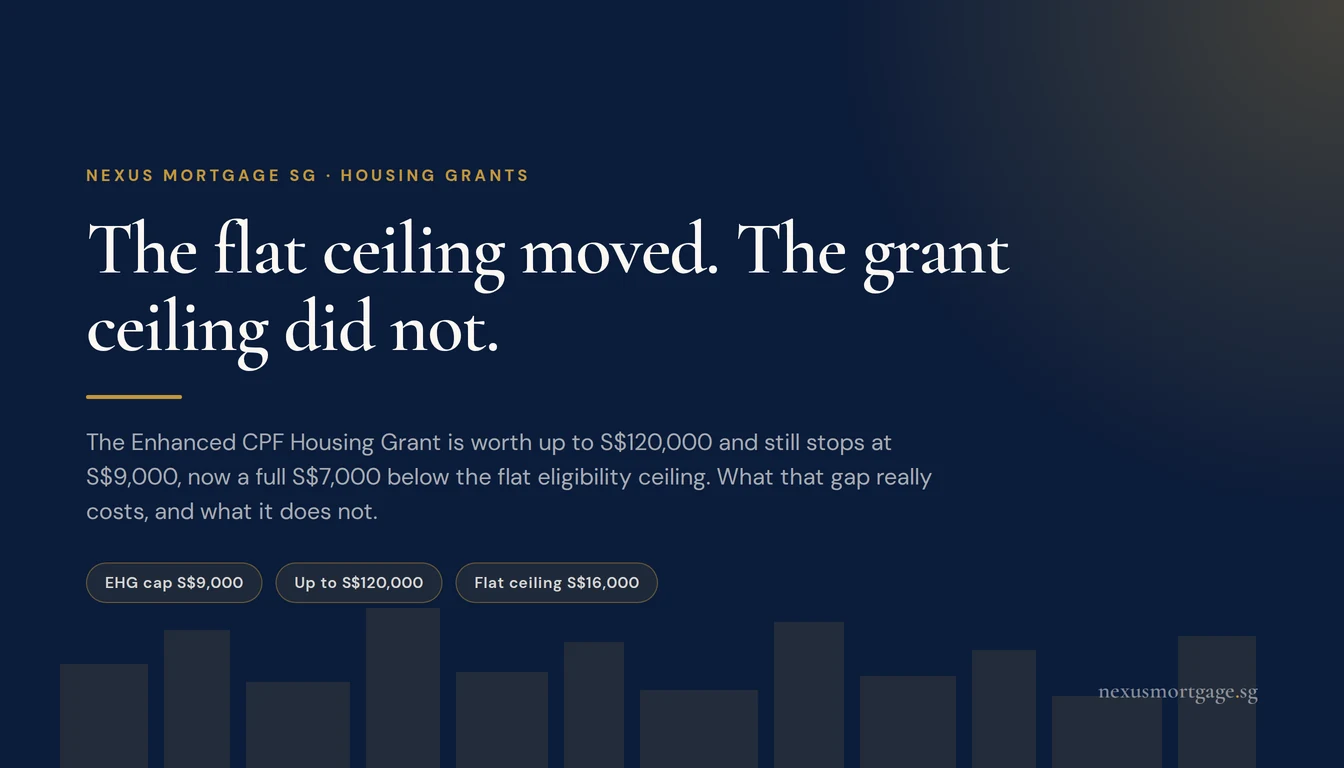
On 24 August 2026 the flat eligibility ceiling moved to S$16,000. The Enhanced CPF Housing Grant ceiling did not move. It is still S$9,000 for families and S$4,500 for singles, now a full S$7,000 below the flat ceiling. But the popular reading of that gap is wrong: crossing S$9,000 does not cost you S$120,000. The EHG is a staircase, and by the top bands it has already tapered to a small figure. The expensive stretch is the middle of the range. Above the ceiling you still keep the CPF Housing Grant, now good to S$16,000, and the Proximity Housing Grant, which has never had a ceiling at all.
What the EHG Is Actually Worth
The Enhanced CPF Housing Grant is the largest housing subsidy in Singapore. It is worth up to S$120,000 for a first-timer family and up to S$60,000 for a first-timer single, and unlike the other grants it applies everywhere: BTO or resale, any estate, any flat type.
It is tiered. The lower your assessed income, the larger the grant. The maximum goes to families at S$1,500 a month or below, and the amount steps down through S$500 income bands until it reaches zero above S$9,000.
A word of caution before you plan around a number. HDB publishes the maximum and the ceiling. Full band-by-band tables circulate widely on property sites, and they disagree with each other, sometimes by tens of thousands of dollars in the same band. We are not going to reprint one here and give it false authority. The figure that binds is the one printed on your HFE letter, and you should not commit to a purchase price on the strength of anything else.
| Families and joint singles | Singles (SSC Scheme) | |
|---|---|---|
| Maximum grant | S$120,000 | S$60,000 |
| Maximum applies at | S$1,500/month or below | S$750/month or below |
| Income ceiling | S$9,000 | S$4,500 |
| Moved on 24 Aug 2026? | No | No |
| Applies to | BTO and resale, all estates, all flat types | |
The Gap That Opened on 24 August
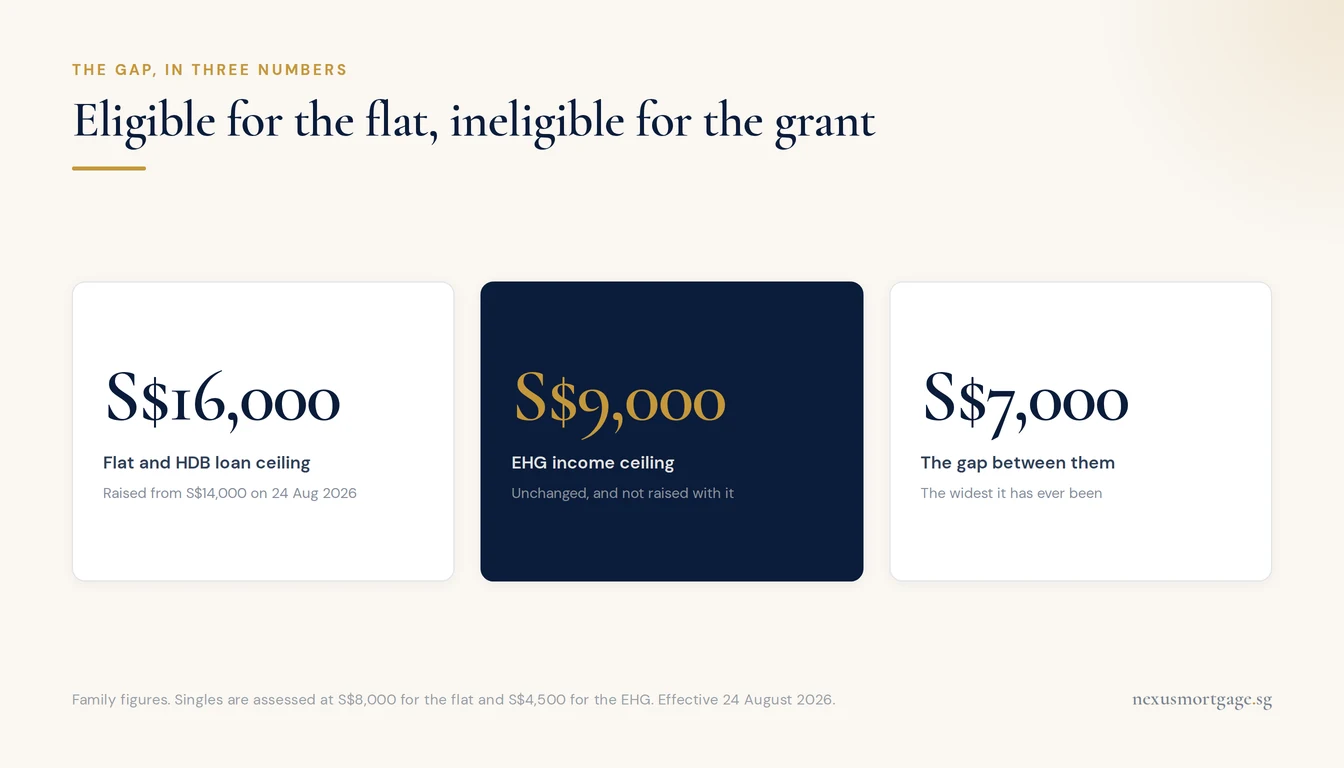
The households that gained eligibility gained no EHG with it.
Until last week the two ceilings were S$14,000 and S$9,000, a gap of S$5,000. The National Day Rally revision lifted the flat ceiling to S$16,000 and left the EHG ceiling alone, widening the gap to S$7,000.
Practically, that means the households who gained the most last week gained the least in subsidy. A couple on S$15,500 went from locked out of the subsidised route entirely to fully inside it: they can ballot for a BTO flat, take the 2.6% HDB concessionary loan and, if they buy resale, claim the CPF Housing Grant. What they cannot claim, and never could, is a single dollar of EHG.
That is not a criticism of the policy. The EHG is explicitly a means-tested subsidy aimed at lower-income households, and the flat ceiling is an eligibility test aimed at defining who the public housing market is for. They were never meant to be the same number. But the two get reported as one story, and the confusion is going to cost people who budget on the headline.
It Is a Staircase, Not a Cliff
Here is where most of the commentary goes wrong, and it goes wrong in the direction that makes people panic unnecessarily.
You will read that going S$1 over S$9,000 costs you S$120,000. It does not. The S$120,000 maximum belongs to households earning S$1,500 a month or less. By the time you reach the bands just under the ceiling, the grant has already stepped down a long way. Crossing the ceiling from the top band therefore costs you that small top-band amount, not the headline figure.
The steep part of the loss is in the middle. A household moving from around S$4,000 to around S$7,000 in assessed income gives up far more EHG, in absolute dollars, than a household moving from S$8,800 to S$9,100. If you are going to obsess over a band boundary, obsess over the ones in the middle of the range, because that is where the money is.
The corollary matters for anyone sitting near the ceiling: do not restructure your income to duck under S$9,000. At that end of the scale the grant you are chasing is small, and the cost of a delayed application, a missed sales exercise or a lower assessed income for TDSR purposes will usually exceed it.
How HDB Assesses Your Income
The assessment is not a snapshot of this month's payslip. HDB uses average gross monthly household income over the 12 months preceding your HFE application, counting every working applicant and essential occupier on the application.
- Gross, not net. Before tax, before CPF contributions.
- Variable pay counts. Commissions, allowances and bonuses are annualised and spread across the twelve months.
- Everyone on the application counts. Adding a parent as an essential occupier to satisfy a scheme requirement can add their income to the assessment.
- The window moves. Apply in March and the window is different from applying in September, sometimes materially so if a bonus sits near the boundary.
This is the same assessment that determines your flat eligibility, your HDB loan quantum and your grant band all at once, which is why the HFE letter is the single most important document in the process. It is also why applying before you understand your own trailing average is a mistake: the submission fixes the assessment.
The Part Nobody Prices In
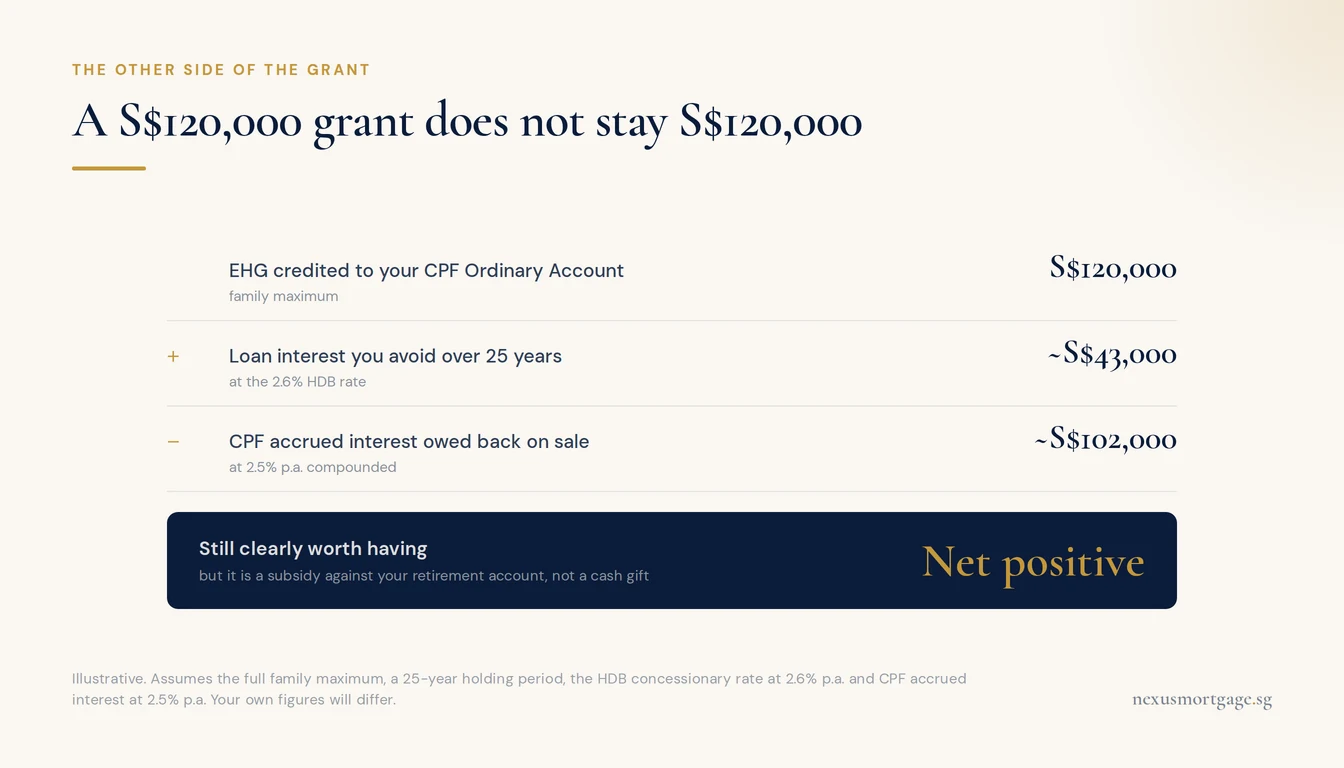
Grants are CPF monies. They come back with accrued interest when you sell.
The EHG is credited to your CPF Ordinary Account, not paid in cash. It is applied to the purchase, which reduces the loan you need, which reduces the interest you pay across the life of that loan. On the HDB concessionary loan at 2.6% over 25 years, S$120,000 of avoided borrowing is worth roughly S$43,000 in interest you never pay, on top of the S$120,000 itself.
So far, so good. Here is the other side.
Every dollar of CPF used for a property, grants included, has to be refunded to your CPF account with accrued interest at 2.5% p.a. when you sell. Compounded over 25 years, a S$120,000 grant carries roughly S$102,000 of accrued interest by the time you come to sell. That amount does not disappear, it returns to your own retirement account rather than your pocket, but it means the sale proceeds you actually walk away with are far smaller than the headline price minus the outstanding loan.
This surprises sellers constantly. Our guide to CPF accrued interest on a property sale works the arithmetic through with real numbers. The EHG is unambiguously worth having. It is just not the free money it reads as.
What You Still Get Above S$9,000
Losing EHG eligibility is not the same as losing grant eligibility. Two schemes remain in play, and for a resale buyer they are worth real money.
| Grant | Worth up to | Income ceiling | Notes |
|---|---|---|---|
| CPF Housing Grant | S$80,000 (2 to 4-room) S$50,000 (5-room and larger) | S$16,000 from 24 Aug 2026 | Resale only. First-timer families. |
| Proximity Housing Grant | S$30,000 (same flat) S$20,000 (within 4km) | None | Resale only. One-time per applicant. |
| Enhanced CPF Housing Grant | S$120,000 | S$9,000 | BTO and resale. Tiered. |
A first-timer family at S$15,000 buying a four-room resale flat near their parents can therefore still stack up to S$80,000 in CPF Housing Grant and up to S$30,000 in PHG. That is S$110,000, and it requires no EHG at all. It also requires buying resale rather than BTO, since the CPF Housing Grant and PHG are both resale-only schemes.
If your income is well above the ceiling, the calculus changes again and the bank loan becomes the whole game. That path is covered in buying resale above the income ceiling.
The Three Levers That Exist
You cannot negotiate a grant band. You can control three things around it.
- When you file. The trailing 12-month window is the only genuine variable. If a large bonus is about to roll out of the window, filing after it does is worth modelling. If one is about to roll in, filing before it does is worth modelling. This is arithmetic, not a loophole.
- Who is on the application. Adding an essential occupier to satisfy a scheme condition adds their income too. Sometimes that is unavoidable. Sometimes a different scheme achieves the same eligibility without the income drag.
- Which market you buy in. If you are above the EHG ceiling but under S$16,000, resale gives you access to two grants that BTO does not, plus no ballot and no three-to-five-year wait. For a lot of newly-eligible households, resale is quietly the better answer even though BTO got all the headlines.
What ties all three together is the same document. Get the HFE letter assessment right, get an In-Principle Approval from the banks alongside it, and you will know your real budget before you make an offer rather than after. We run the IPA across every lender at once, and there is no cost to you for it.
This article is general information for Singapore buyers. It is not financial advice. Grant quantums, income ceilings and HFE assessment are administered by HDB and CPF. Figures are current as at 28 August 2026 and reflect the income ceiling revision announced at the National Day Rally on 23 August 2026 and effective 24 August 2026. Interest and accrued-interest figures are illustrative, assume a 25-year holding period, and are not an offer of credit. We deliberately do not reproduce a band-by-band EHG table because published third-party tables conflict; confirm your own band, grant quantum and eligibility with HDB in writing. Sources: HDB: Buying a Flat, CPF: Home Ownership, Prime Minister's Office: National Day Rally 2026.

About the author — Dan Ler has advised on Singapore home loans since 2017 at Nexus Mortgage SG, an independent brokerage comparing 16+ MAS-regulated lenders. Nexus has facilitated 500+ home loans across HDB, EC, private condo and landed property segments. Banks pay Nexus on disbursement, so there is no cost to the borrower.