HDB Income Ceiling Raised to S$16,000: What It Actually Changes for Your Loan
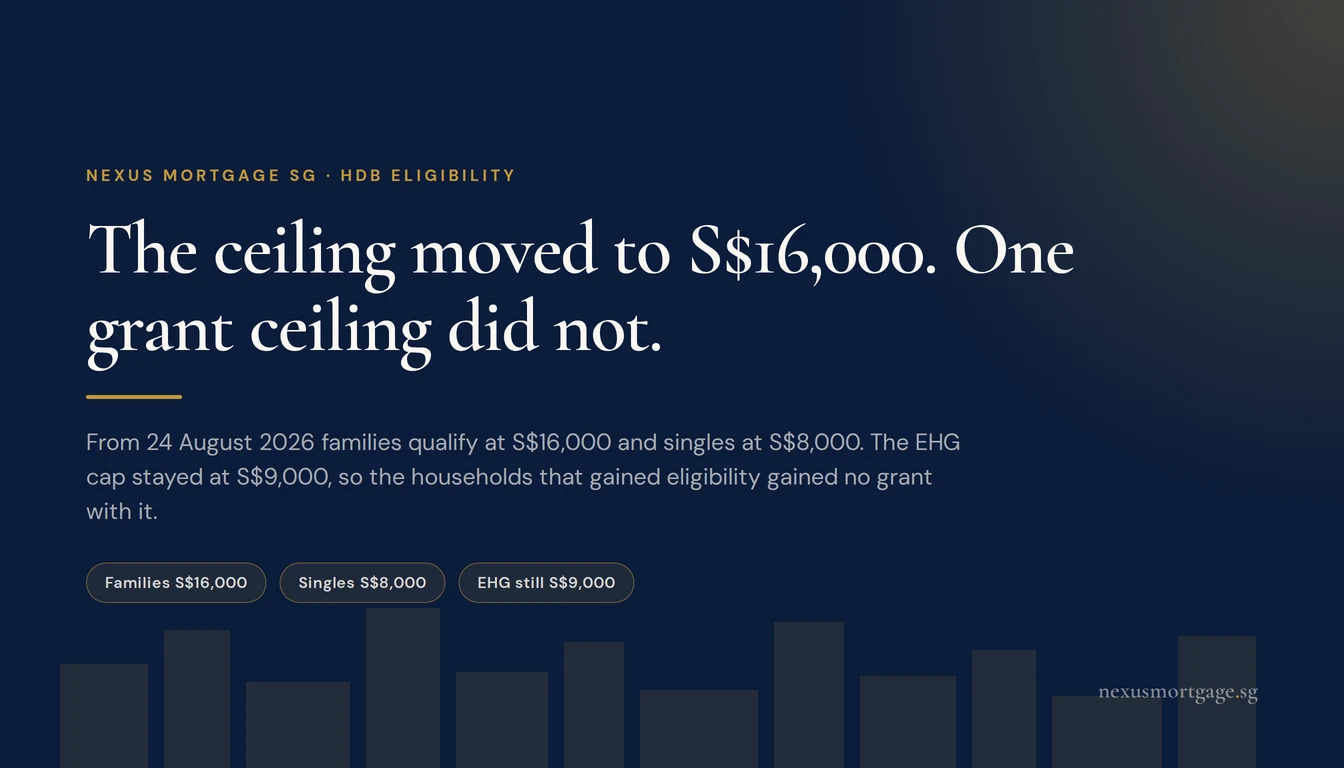
From 24 August 2026 the household income ceiling for a new subsidised HDB flat, the HDB concessionary loan and the CPF Housing Grant is S$16,000, up from S$14,000. Singles aged 35 and above move from S$7,000 to S$8,000. Executive Condominiums go from S$16,000 to S$18,000. It applies to HFE letters from that date. The catch that matters: the EHG ceiling did not move. It is still S$9,000. A household on S$15,500 now qualifies for the flat and the 2.6% loan, and gets no EHG whatsoever.
What Changed on 24 August 2026
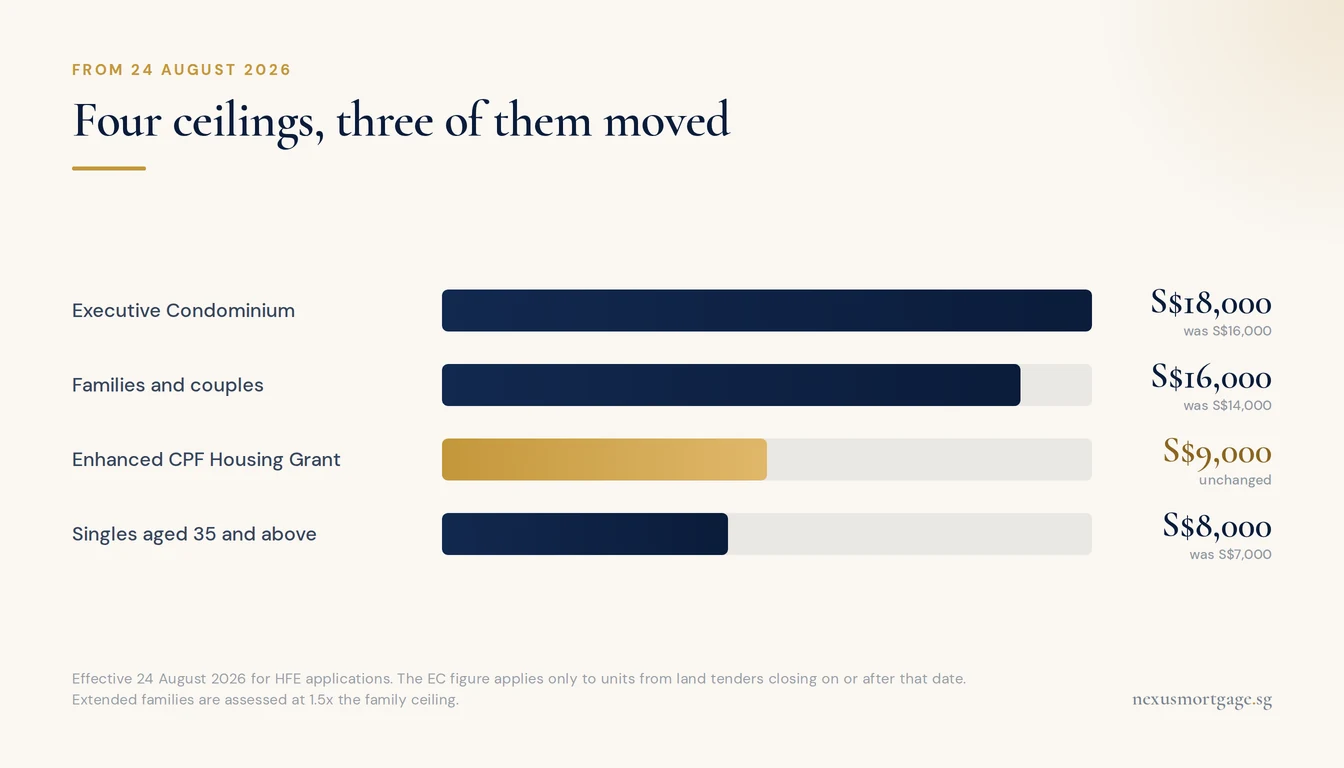
The EHG cap is now S$7,000 below the flat eligibility ceiling.
Prime Minister Lawrence Wong announced the revision at the National Day Rally on 23 August 2026. It took effect the following day. This is the first movement in the ceilings since 2019, seven years of wage growth catching up in one step.
| Ceiling | Before | From 24 Aug 2026 | What it gates |
|---|---|---|---|
| Families and couples | S$14,000 | S$16,000 | New subsidised flat, HDB concessionary loan, CPF Housing Grant |
| Singles aged 35+ | S$7,000 | S$8,000 | 2-room Flexi, Singles Grant, HDB loan |
| Extended / multi-generation | 1.5× the family ceiling | Multi-generation schemes, 3Gen flats | |
| Executive Condominium | S$16,000 | S$18,000 | New EC purchase from qualifying land tenders |
| Enhanced CPF Housing Grant | S$9,000 | S$9,000 (no change) | Up to S$120,000 for families |
Read that last row twice. It is the single most consequential line in the whole announcement and it is the one nobody leads with.
One point that gets muddled constantly: HDB resale flats have never had an income ceiling on the purchase itself. Any scheme-eligible household can buy a resale flat at any income. What the ceiling has always gated is the subsidised route, the concessionary loan and the grants. If you are above S$16,000, our guide to buying resale above the income ceiling covers the bank-loan path in full.
The HDB Loan Is the Real Prize
Most of the coverage has framed this as a BTO story. For anyone doing the financing, the more valuable half is the HDB concessionary loan, which is gated by the same ceiling.
At 2.6% p.a. the HDB loan is currently the most expensive money on the market. Bank fixed packages start from around 1.40% p.a. and three-month Compounded SORA is sitting near 1.14%, so on rate alone the bank wins by a wide margin. But the HDB loan carries four features no bank will match:
- Zero cash down. The full 25% downpayment can come from your CPF Ordinary Account. A bank loan forces a minimum 5% in hard cash.
- No lock-in and no penalty. You can refinance to a bank at any point, for any reason, without a break cost.
- No MAS 4% stress test. HDB uses its own eligibility computation instead.
- It is a one-way door you can walk through later. HDB to bank is allowed. Bank back to HDB is not.
That last point is why this ceiling change matters more than the headline suggests. A household newly inside the ceiling can take the HDB loan now, hold it while rates are uncertain, and refinance into a bank package the moment the numbers favour it. A household that never qualified never had that option at all. Our HDB loan versus bank loan comparison runs the full cost over a 25-year horizon.
One detail that trips people up: HDB does not compute your eligible loan amount at 2.6%. Since 30 September 2022 it uses the higher of 3% p.a. or the prevailing rate. The quantum you are offered is therefore deliberately conservative, and it will be smaller than a back-of-envelope calculation at 2.6% suggests.
What S$16,000 Actually Buys
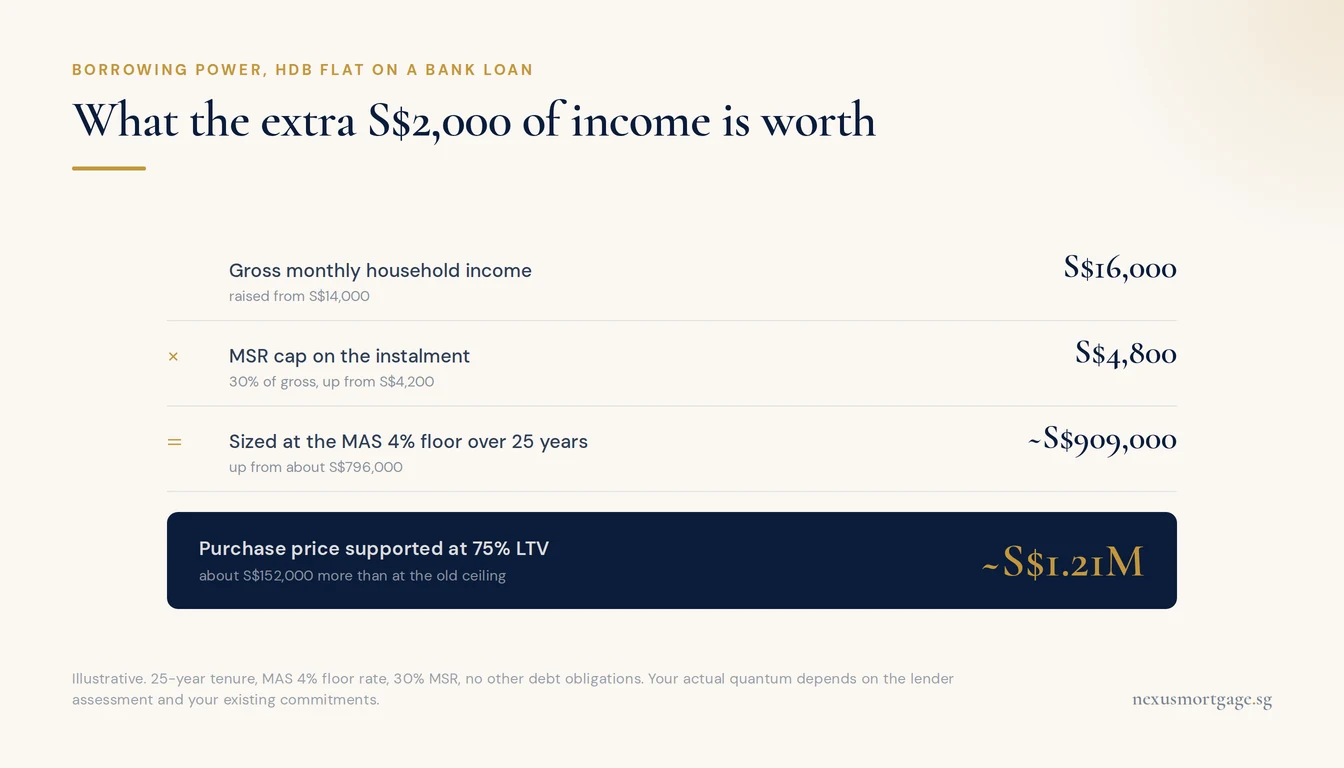
On BTO this rarely binds. On resale it moves what you can shop for.
Here is the part that decides what you can shop for. On any HDB flat or EC purchase, the binding constraint is the Mortgage Servicing Ratio, which caps your housing instalment at 30% of gross monthly income. TDSR at 55% also applies, but MSR almost always bites first.
Banks size the loan by stress-testing that instalment at the MAS 4% floor rate, not at the rate you actually pay. Over a 25-year tenure, the arithmetic runs like this.
| At S$14,000 (old) | At S$16,000 (new) | Change | |
|---|---|---|---|
| MSR cap (30% of gross) | S$4,200/mo | S$4,800/mo | +S$600/mo |
| Loan supported at 4% over 25 yrs | ~S$796,000 | ~S$909,000 | +S$114,000 |
| Purchase price at 75% LTV | ~S$1.06M | ~S$1.21M | +S$152,000 |
For singles, the S$7,000 to S$8,000 move takes the MSR cap from S$2,100 to S$2,400, worth roughly S$57,000 of extra loan and about S$76,000 of extra purchase price on the same assumptions.
Two warnings on those numbers. First, they assume no other debt at all. A S$1,200 car instalment removes roughly S$227,000 of borrowing capacity at the 4% floor. Second, the MSR cap is not the same as affordability. Borrowing to the regulatory limit at a 1.4% starting rate, on a loan sized at 4%, leaves you with a payment that will rise when the fixed period ends.
On the BTO side, none of this is likely to bind. A four-room BTO flat in a Standard project prices well below the S$1.2M figure, so a household at S$16,000 is limited by ballot luck, not by loan quantum. The borrowing-power maths matters far more for resale buyers, and it is one reason analysts expect the change to feed into resale prices in the better precincts.
The Grant Ceiling That Did Not Move
This is the trap, and it will catch people.
Singapore's housing grants are not one thing. They are three separate schemes with three separate income tests, and only two of them moved on 24 August 2026.
| Grant | Worth up to | Income ceiling | Moved on 24 Aug 2026? |
|---|---|---|---|
| Enhanced CPF Housing Grant (EHG) | S$120,000 families / S$60,000 singles | S$9,000 / S$4,500 | No |
| CPF Housing Grant (resale) | S$80,000 (2 to 4-room) / S$50,000 (5-room+) | S$16,000 | Yes, from S$14,000 |
| Proximity Housing Grant (PHG) | S$30,000 same flat / S$20,000 within 4km | None, and never had one | Not applicable |
The EHG is the big one. It is worth up to S$120,000 for a family, it is tiered so that lower income earns more, and it applies to BTO and resale alike. Its ceiling is S$9,000, it was not touched, and it is now a full S$7,000 below the flat eligibility ceiling.
So the household that gained the most on 24 August, the one earning S$15,500 that was locked out the week before, gains a BTO ballot, an HDB loan and possibly the CPF Housing Grant, and gains exactly zero EHG. If they had budgeted for a six-figure grant on the strength of the headline, the shortfall lands at completion, which is the worst possible time to discover it.
The full EHG taper is worth understanding before you plan around it. HDB publishes the maximum (S$120,000 for families at S$1,500 a month or below) and the ceiling (S$9,000), and assesses your band from average gross monthly household income over the preceding 12 months. Third-party tables of the intermediate bands circulate widely and disagree with each other, so do not build a budget on one. The figure that binds is the one printed on your HFE letter.
That 12-month averaging window is also the only real lever you have. Bonus timing, commission timing and whether a second applicant joins at all can move a household between bands. That is a tax and cashflow question worth putting to your accountant before you file, not after.
The EC Ceiling, and Its Date Trap
Executive Condominiums went from S$16,000 to S$18,000, and this one has a condition attached that is easy to miss.
The higher ceiling applies only to units in EC projects whose land tender closed on or after 24 August 2026. Balance units in ECs already launched or already built are still assessed at S$16,000. Since an EC site takes years to go from tender to launch, the practical effect is that the S$18,000 ceiling will not reach a showflat until well into 2027 and beyond.
If you are at S$17,000 today and hoping to buy an EC this year, the answer is still no. Note also that ECs are subject to the same 30% MSR as HDB flats, and to the EC Minimum Occupation Period rules, which were themselves reset in 2026.
What Did Not Change
The ceiling rise is an eligibility loosening. It is not a cooling-measure rollback, and reading it as one is how buyers get into trouble. Every restraint on the financing side stands exactly where it was:
- ABSD at the April 2023 schedule. Singapore Citizens pay 0% on a first residential property, 20% on a second, 30% on a third.
- Loan-to-value at 75% for a first bank-financed property, 45% for a second, 35% for a third, dropping to 55% where the tenure runs long or past age 65. HDB loans capped at 75% since August 2024.
- TDSR at 55% and MSR at 30%, both computed at the MAS 4% floor.
- Seller's Stamp Duty on the four-year holding window at the raised rates.
- Minimum Occupation Period unchanged, including the ten-year MOP with subsidy clawback on Prime projects.
Our consolidated cooling measures guide maps all of it in one place.
What to Do Before 25 September
If your household income sits between S$14,000 and S$16,000, or between S$7,000 and S$8,000 as a single, you have a dated window and a real deadline.
- Apply for the HFE letter now. All supporting documents must be in by 25 September 2026 to take part in the November BTO exercise. Processing runs several weeks, so late September is the hard stop, not the plan.
- Run the income assessment before you file. HDB averages the trailing 12 months. If a bonus lands inside that window and pushes you over S$16,000, you are outside again. Check the number before it is fixed by a submission.
- Do not assume EHG. Model your cash position with the grant at zero unless your assessed income is at or below S$9,000. If the deal only works with a grant you may not receive, it does not work.
- Get an In-Principle Approval in parallel. The HFE letter tells you what HDB will lend. An IPA tells you what a bank will lend, at what rate and on what tenure. You want both numbers in hand before you commit, not after. We run IPAs across every lender at once, at no cost to you.
- If you are eyeing resale instead of BTO, remember there is no ballot and no waiting list, and the CPF Housing Grant now reaches to S$16,000. For many households newly inside the ceiling, that is the faster route.
The November line-up is roughly 7,960 flats across Bedok, Geylang, Sembawang, Tengah, Toa Payoh and Yishun, with the Toa Payoh West project beside Caldecott MRT the one drawing the most attention. Prime classification there means a ten-year MOP and subsidy clawback on resale, which changes the financing calculus considerably against a Standard project in Yishun or Sembawang.
This article is general information for Singapore buyers and borrowers. It is not financial advice. Income ceilings, grant quantums and HFE assessment are administered by HDB and CPF; TDSR, MSR and LTV rules are administered by MAS. Figures reflect positions announced at the National Day Rally on 23 August 2026 and effective 24 August 2026, and are current as at 24 August 2026. Borrowing-power figures are illustrative, assume a 25-year tenure, no other debt obligations and the MAS 4% floor rate, and are not an offer of credit. Confirm your own eligibility, grant band and loan quantum with HDB and your lender in writing. Sources: Prime Minister's Office: National Day Rally 2026, HDB: Buying a Flat, MAS Notice 645 (TDSR), CPF: Home Ownership.

About the author — Dan Ler has advised on Singapore home loans since 2017 at Nexus Mortgage SG, an independent brokerage comparing 16+ MAS-regulated lenders. Nexus has facilitated 500+ home loans across HDB, EC, private condo and landed property segments. Banks pay Nexus on disbursement, so there is no cost to the borrower.