The MAS 4% Stress Test: How It Affects Your Home Loan in Singapore (2026)
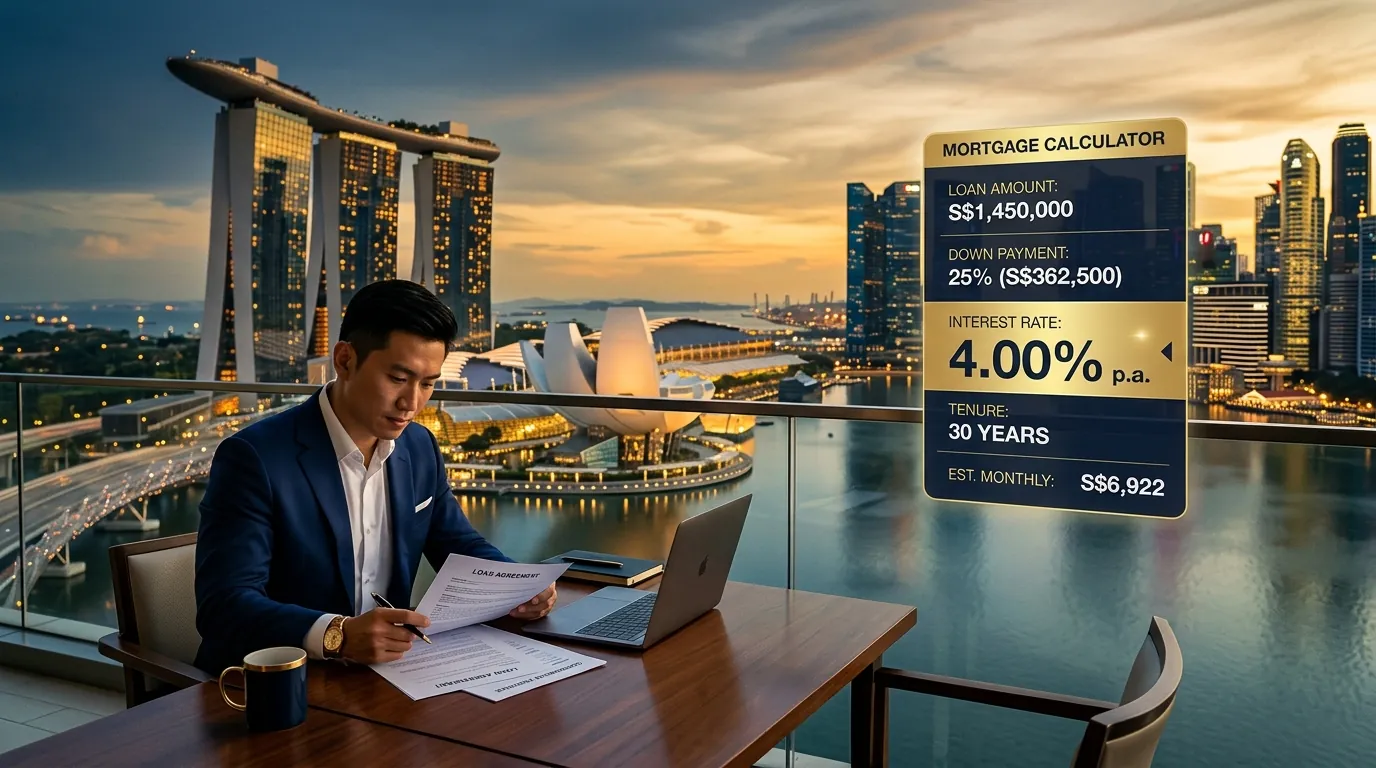
- Why the MAS 4% stress test sets your real budget
- What the MAS 4% stress test actually does
- TDSR vs MSR: which cap applies to you
- Worked example: S$8,000 monthly income
- Joint borrowers and the IWAA tenure cap
- How existing debts shrink your loan ceiling
- The stress test, LTV and cash on hand
- Where to go from here
- Common questions
Why the MAS 4% Stress Test Sets Your Real Budget
Almost every buyer I meet opens with the same question: "What's the cheapest home loan rate right now?" In April 2026 the rates do look good. Fixed packages start from 1.40% p.a. for jumbo loans, and most buyers lock in somewhere between 1.45% and 1.65% p.a. SORA-linked loans price around 1.55%–1.77% p.a. effective, tracking the 1.0201% three-month Compounded SORA plus a 0.20%–0.75% spread. You can compare every package on our current Singapore home loan rates page.
But it's the wrong question. No bank actually sizes your loan off the rate you take. Under rules from the Monetary Authority of Singapore, every regulated lender has to stress-test your repayment at a 4.00% p.a. floor before it approves a single dollar. So it's that 4% number, not your 1.45% headline rate, that decides the price tag you can afford.
Here's how the MAS 4% stress test works in 2026, how it ties into TDSR and MSR, what changes when you borrow jointly, and a worked example on a S$8,000 monthly income.
What the MAS 4% Stress Test Actually Does
The stress test is just a mandatory affordability sum. The bank works out your monthly repayment at whichever is higher: the contracted rate on your package, or 4.00% p.a. In April 2026, with packages running between 1.40% and 2.00% p.a., the 4% floor wins every time.
Think of it as two sets of books. In real life you repay the bank at 1.50% p.a. But the credit team approves you as if you were paying 4.00% p.a., and the gap between those two figures is your cushion if rates climb. MAS brought in the floor after the 2008–2014 rate cycles, when too many borrowers stretched into loans that would have crushed them once rates normalised.
Worked Example: S$700,000 Loan Over 30 Years
Take a S$700,000 home loan over a 30-year tenure. At a real rate of 1.50% p.a., the monthly instalment is roughly S$2,416. At the 4% stress floor, the same loan works out to S$3,341 a month, almost S$925 more. The bank uses that higher S$3,341 figure when it checks your TDSR and MSR. Your wallet only ever feels S$2,416, but the stricter number is what sets your eligibility.
Why Fixed-Rate Packages Still Pass
People often assume a fixed package priced below 4% somehow fails the test. It doesn't. The bank runs your eligibility off the 4% floor no matter which package you pick, so a 1.45% fixed-rate loan and a 1.85% SORA-linked loan hand you the same maximum loan quantum on the same income. The package sets your monthly cash flow. The stress test sets the ceiling. For a side-by-side on the two structures, see our fixed vs SORA comparison.
TDSR vs MSR: Which Cap Applies to You
Once the stress-tested repayment is calculated, the bank measures it against one or two ratio caps depending on the property type.
Total Debt Servicing Ratio (TDSR), All Property Types
The TDSR caps your total monthly debt at 55% of gross monthly income. "Total debt" here means the new stress-tested mortgage plus everything else you owe each month: car loans, renovation loans, education loans, personal loans, and 5% of any outstanding credit card balance. Variable income (commission, bonus, rental, self-employed earnings) gets a 30% haircut before it counts.
TDSR applies to bank loans on every residential property in Singapore, whether that's an HDB flat, an executive condominium, a private condo or a landed home. There's no exemption by quantum or property type. For a deeper walk-through on private property specifically, read TDSR for private property.
Mortgage Servicing Ratio (MSR), HDB and EC Only
The MSR is a stricter second cap, and it only applies to HDB flats and executive condominiums financed with a bank loan. It limits the mortgage repayment on its own, not your total debt, to 30% of gross monthly income, again worked out at the 4% stress rate.
HDB and EC buyers have to clear both TDSR and MSR. In practice MSR is almost always the one that bites, because 30% of income runs out long before 55% does. Buying a private condo or landed property? Then MSR doesn't apply at all, only TDSR. And the HDB concessionary loan (taken from HDB directly, not a bank) sits outside the MAS framework entirely. See HDB loan vs bank loan for the full comparison.
Worked Example: S$8,000 Monthly Income
To make the maths real, take a buyer earning S$8,000 a month gross, no other debt, applying for a 30-year tenure.
Buy a private condo and only TDSR applies. 55% of S$8,000 is S$4,400 in allowable monthly debt. At the 4% stress rate over 30 years, S$4,400 supports a maximum loan of roughly S$921,000. Add a 25% down payment (the LTV cap is 75% on a first property) and the buyer can aim for a purchase price near S$1.23 million.
Buy an HDB flat or EC and MSR binds instead. 30% of S$8,000 is S$2,400. At 4% over 30 years, S$2,400 a month supports about S$502,000. The S$4,400 of TDSR headroom is irrelevant, because MSR caps the mortgage servicing first.
Same buyer, same income, same stress rate. Yet the property class swings the loan ceiling by roughly S$420,000. That's why I tell HDB and EC buyers to think about affordability differently from condo buyers. Plug your own numbers into our TDSR/MSR affordability calculator to see the exact ceiling for your situation.
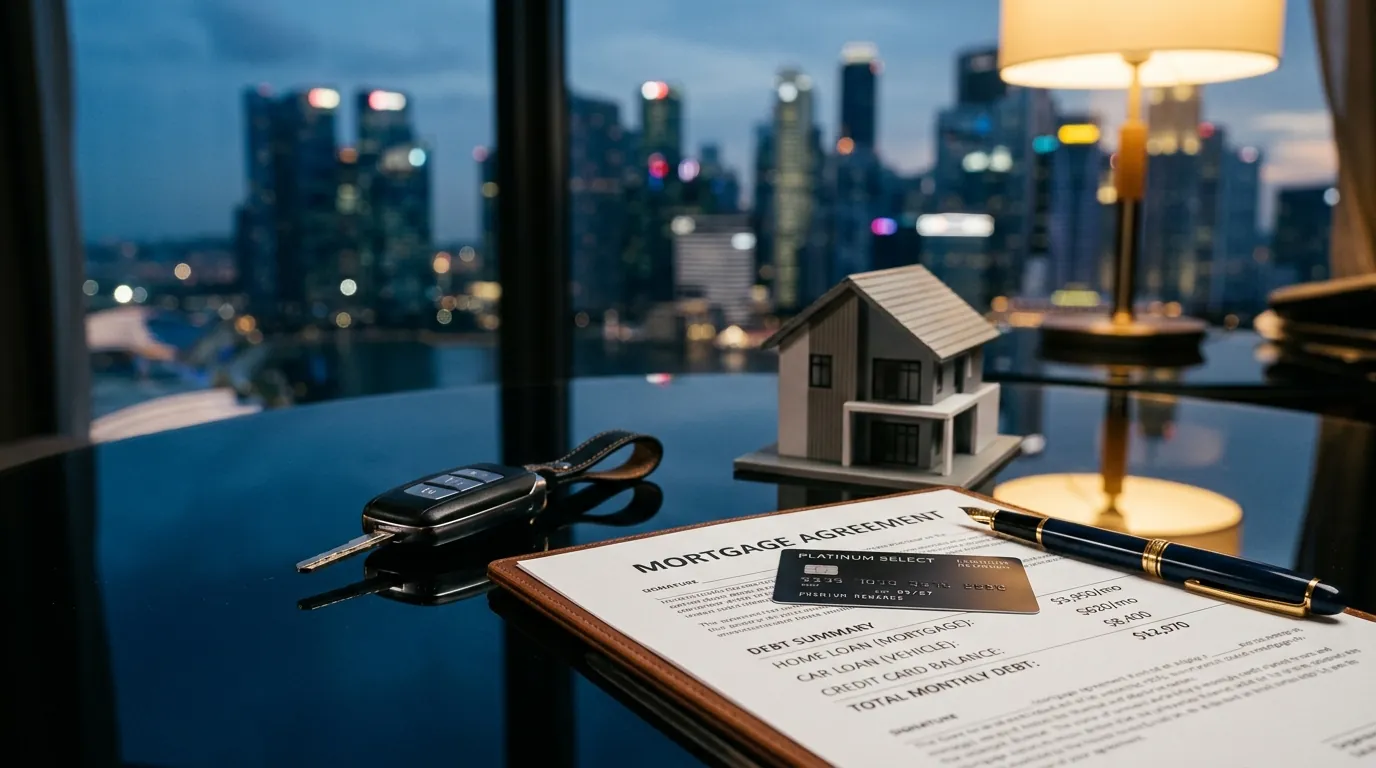
Car loans and unpaid credit card balances eat into your TDSR headroom before any mortgage is even counted. Clearing them is the quickest way to lift your loan ceiling.
Joint Borrowers and the IWAA Tenure Cap
When two or more applicants borrow together, the bank uses the income-weighted average age (IWAA) to set the maximum tenure. IWAA weights each applicant's age by their share of the total income, so a younger high earner pulls the average down further than a younger low earner does. Maximum tenure then works out to 65 minus IWAA for HDB bank loans and 75 minus IWAA for private property, capped at 25 years for HDB or 30 years for private either way.
Tenure matters because a longer tenure means a lower monthly repayment under the 4% stress test, and that means a higher allowable loan. So a married couple where one spouse is 45 and the other is 32 qualifies for noticeably more than a single 45-year-old on the same combined income. The younger co-borrower drags the IWAA down and stretches the tenure.
This is one of the things couples can work with on a purchase, alongside decoupling for second-property buyers staring at 20% to 30% ABSD.
How Existing Debts Shrink Your Loan Ceiling
Most people meet the stress test the hard way, through their existing debt. Every dollar you already owe each month eats straight into your TDSR headroom before the mortgage even gets a look-in.
Car Loans
Take a buyer earning S$10,000 a month with a S$1,200 car loan repayment. The TDSR ceiling is S$5,500. The car eats S$1,200 of that, leaving S$4,300 for the mortgage. At the 4% stress rate over 30 years, S$4,300 supports about S$900,000, against roughly S$1.15 million with no car. So the car has quietly cost the buyer S$250,000 of borrowing power, on top of the loan itself.
Credit Cards
Banks count 5% of any outstanding credit card balance as a monthly obligation, even if you clear it in full each month. A S$20,000 balance left sitting there adds S$1,000 to your assessed monthly debt. Pay it down before the bank pulls your credit bureau report.
Personal and Renovation Loans
Personal loan and renovation loan instalments count at the contracted monthly figure. If you're 12 to 18 months out from a purchase, it's worth pulling your own credit bureau record and having a look. Closing dormant facilities and clearing balances can move your ceiling by tens of thousands of dollars in approved quantum.
The Stress Test, LTV and Cash on Hand
The 4% stress test fixes your maximum loan, but two other rules decide how much cash and CPF you have to bring. Loan-to-value (LTV) on a first property is capped at 75%, dropping to 45% if you've a second outstanding loan and 35% on a third. At least 5% of the down payment has to be cash on the first property, and the rest can come from your CPF Ordinary Account if you're eligible. See using CPF OA for property for the full breakdown.
Then there's Additional Buyer's Stamp Duty (ABSD) on top of all that. A Singaporean pays 0% on a first property, 20% on the second and 30% on the third or more. Permanent Residents pay 5% / 30% / 35%, and foreigners pay 60% flat. ABSD is due in cash within 14 days of exercising the OTP, so it's real money on top of the down payment, not part of the loan. First-time HDB buyers should also read our first-time HDB buyer guide for grants and HFE timing.
Where to Go From Here
The 4% stress test, TDSR, MSR, IWAA tenure, LTV and ABSD all stack on top of one another. None of them is hard maths on its own, but together they decide whether the condo you viewed last weekend is realistic. Check your numbers before you fall for a unit, not after.
Three steps, less than ten minutes. Run the TDSR/MSR affordability calculator with your gross income and existing debts. Compare today's current Singapore home loan rates across fixed and SORA-linked packages. And if you already own, run the refinance savings calculator against your current rate to see whether it's worth moving. If you'd rather have it all in one place, the Singapore Mortgage Free Report walks through your TDSR/MSR check at the MAS 4% stress floor, the LTV and IWAA tenure trade-off (75% vs 55%) and a 16-bank rate comparison in a single PDF. Once your budget is set, the step-by-step home loan application guide takes you from HFE/IPA through to drawdown.
Frequently Asked Questions
The MAS 4% stress test requires every Singapore bank to assess your mortgage at whichever is higher: your actual contracted rate or 4.00% p.a. Even if your fixed rate is 1.50% p.a., the bank computes your TDSR and MSR using a 4% repayment to make sure you can still service the loan if rates rise.
The Total Debt Servicing Ratio (TDSR) cap is 55% of gross monthly income. It captures every monthly debt obligation: the new mortgage, car loans, renovation loans, personal loans, student loans and credit card minimum payments. TDSR applies to bank loans on all property types — HDB, EC, condo and landed.
The Mortgage Servicing Ratio (MSR) cap is 30% of gross monthly income. It applies only to HDB flats and Executive Condominiums financed with a bank loan. For HDB and EC buyers, MSR and TDSR must both be satisfied at the 4% stress rate.
Banks always compute TDSR and MSR on the 4% floor regardless of the package you take. So a 1.45% fixed rate gives you cheaper monthly cash flow, but your eligibility ceiling is the same as someone on a 1.85% SORA-linked loan. The stress test sets your borrowing ceiling; the package sets your cash repayment.
When two or more borrowers apply, the bank uses the income-weighted average age (IWAA) to set the maximum loan tenure. A younger co-borrower with material income pulls the average age down and lengthens the tenure, which lowers the monthly repayment under the 4% stress test and raises the loan you qualify for.
No. The MAS 4% stress test applies to bank loans only. HDB concessionary loans (taken directly from HDB at 2.6% p.a.) use HDB's own MSR computation and are not subject to the MAS 4% floor.
See Your Stress-Tested Loan Ceiling in 60 Seconds
The Nexus affordability calculator applies the MAS 4% floor, your TDSR and MSR caps, IWAA tenure and existing debts in one go.
Open the Affordability Calculator →Prefer a personal review? WhatsApp Dan Ler at +65 8752 0859 for a free portfolio assessment across 16+ MAS-regulated banks. Banks pay our fee — you pay nothing.
Or read first: Singapore Mortgage Free Report — the full TDSR/MSR + IWAA + LTV workbook with a 16-bank rate comparison in one PDF.

About the author — Dan Ler has advised on Singapore home loans since 2017 at Nexus Mortgage SG, an independent brokerage comparing 16+ MAS-regulated lenders. Nexus is paid by the bank on disbursement, so there is no cost to the borrower.
Further reading
- TDSR and MSR explained — the 55% and 30% ceilings and how the MAS stress floor is applied
- TDSR when you are self-employed — how variable income is haircut and what documents change the outcome
- How to apply for a home loan — documents, IPA and the order the steps actually happen in
- Fixed vs floating home loans — how to choose when the rate outlook is uncertain
- Affordability check — what you can borrow at the MAS stress floor
Nexus Mortgage SG is an independent Singapore mortgage advisory. This article is general information, not financial advice. Figures are illustrative and reflect conditions as of April 2026; MAS rules can change. For official guidance see MAS: TDSR for Property Loans, HDB: HFE Letter and CPF: Using Your Savings for Housing.