EC MOP Doubled to 10 Years: What May 2026's Executive Condo Reset Means for Your Mortgage
- What MND just changed on 8 May 2026
- Why the reset, and the price story behind it
- 10-year MOP: what it really costs upgraders
- 90% first-timer quota: who actually wins
- DPS scrapped: cashflow and stress-test impact
- Pre-rule vs new-rule ECs: the choice
- EC financing in the new regime
- Three moves to make this month
- Common questions
What MND Just Changed on 8 May 2026
On Friday 8 May 2026, the Ministry of National Development announced the biggest rework of Executive Condominium rules in over a decade. There are four parts to it. All of them are aimed at first-time families, and all of them kick in from the next Government Land Sales tender onwards. Channel News Asia's full coverage of the EC reset has the policy text. Below is what actually matters for your mortgage.
- The MOP doubles from 5 to 10 years. New EC buyers cannot rent out the whole unit, buy another residential property, or sell to Singaporeans/PRs until 10 years after key collection.
- Full privatisation is pushed from 10 to 15 years. Foreign and corporate buyers stay locked out for an extra 5 years, which narrows the resale pool late in the cycle.
- The first-timer quota rises from 70% to 90%, and the priority window stretches from 1 month to 2 years. Second-timers get the leftover 10% only after the priority window closes.
- The Deferred Payment Scheme is abolished. All EC buyers must use the Normal Payment Scheme, which means progressive payments tied to construction milestones. There is no 20%-now-80%-at-TOP option anymore.
The rules apply to EC GLS sites with tender closing on or after 8 May 2026. Five upcoming projects keep the old rules: Senja Close, Sembawang Road, Miltonia Close, and the two Woodlands Drive 17 sites. Their tenders closed between Aug 2025 and Apr 2026.
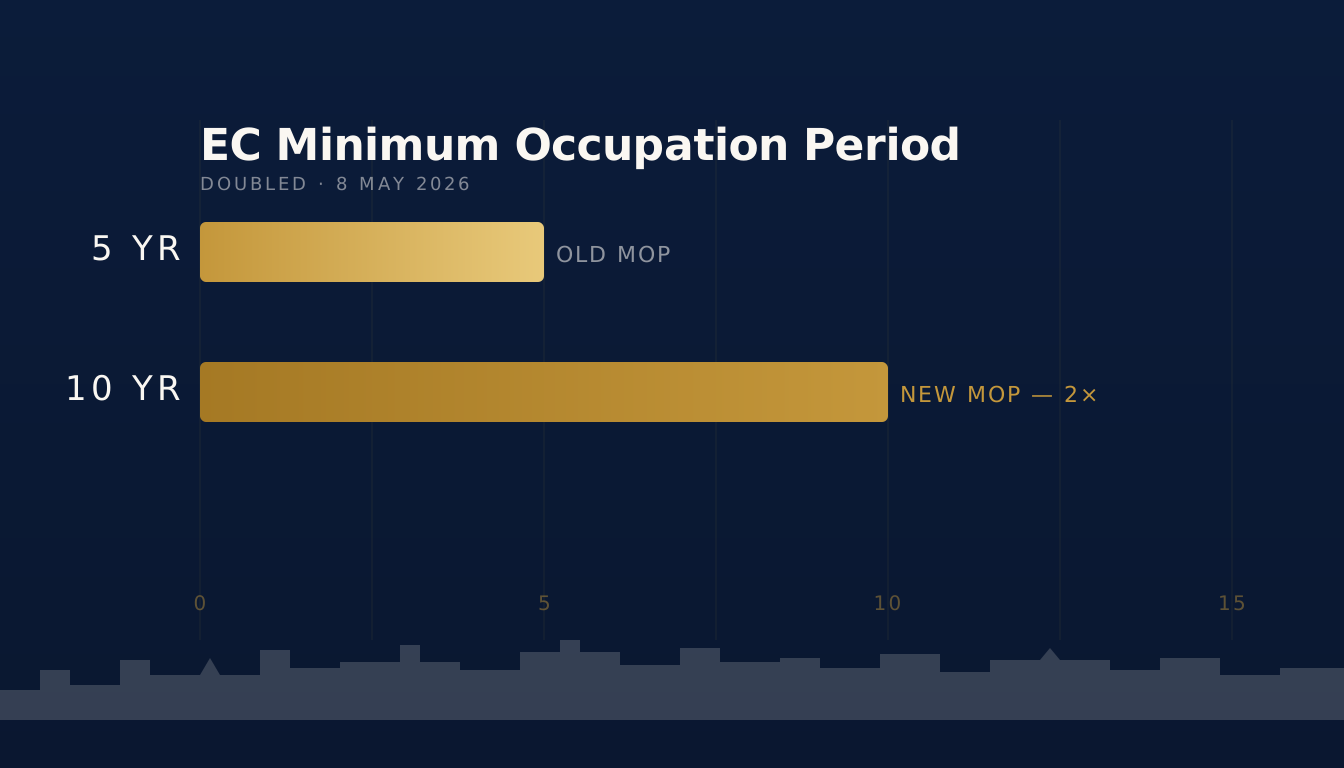
The MOP doubles from 5 to 10 years, the single biggest change in EC liquidity since the scheme launched in 1995.
Why the Reset, and the Price Story Behind It
Two numbers explain why MND moved. EC psf prices have more than doubled in a decade. Median new-EC psf hit S$1,843 between January and April 2026, against S$782 in 2016, per PropNex Research and URA. A 1,000 sqft EC now clears S$1.85 million.
The buyer mix shifted with prices. In 2020, half of EC buyers were first-timers. By 2024-2025 that had fallen to 30-40%, with second-timers crowding out first-time families. From 2021-2025, about 75% of post-MOP ECs were flipped within 5 years of MOP, up from 45% in the prior cycle. At that point the EC was being treated less like a home and more like a trade.
So the response goes at the structure: lengthen the MOP, extend privatisation, ring-fence the launch quota, and remove the DPS premium. Minister Chee Hong Tat said openly that he hopes the changes lead to "developers reducing their bids and the prices for their ECs." NUS Professor Sing Tien Foo expects the rules to stabilise the EC market over 3-5 years, with no sharp price rise if income growth holds. In the near term, expect a buying flurry on the five pre-rule projects.
10-Year MOP: What It Really Costs Upgraders
The MOP isn't a tax. Think of it as a clock you can't restart. Doubling it from 5 to 10 years changes three things at once.
- Resale liquidity takes the hit. No selling to Singaporeans or PRs for 10 years, and no foreigner or corporate buyers for 15. The natural exit at year 5, and the 75% flip rate behind it, is gone.
- Second-property timing moves out. You cannot buy another residential property during the MOP. If your plan was "EC first, private later," the runway just doubled. That changes the ABSD sums completely, and it may push some buyers toward a private condo from day one. Our condo and private property loan guide walks through the alternative.
- Rental options shrink. Whole-unit rental is locked for 10 years as well. Room rental is still allowed under HDB rules, but any cashflow plan built around full-unit yield needs a redraw.
Put a face on it. A 35-year-old buying a new-rule EC cannot sell or buy a second property until age 45. If your plan includes a second residential investment in your early 40s, an EC is no longer the obvious choice. I tell clients in that position to run the numbers against a private condo first, using our TDSR/MSR affordability calculator, before committing.
90% First-Timer Quota: Who Actually Wins

90% of units reserved for first-timers in launch month, with the priority window extended to 2 years, which tips the odds firmly toward first-time buyers.
Under the old 70/30 split, second-timer demand often cleared by lunchtime on launch day. Under 90/10 plus a 2-year priority window, second-timers are now at a real disadvantage.
| Buyer Type | Pre-8 May 2026 | Post-8 May 2026 |
|---|---|---|
| First-timer launch quota | 70% | 90% |
| Priority window | 1 month | 2 years |
| Second-timer access | From month 2 | From year 3 |
| Resale levy (second-timer) | Applies | Applies |
For first-time families, balloting odds improve a lot. Put the 90% reservation together with the S$18,000 income ceiling (raised from S$16,000 on 24 August 2026, for units at land tenders closing on or after that date) and the up-to-S$30,000 CPF Housing Grant, and the EC goes back to being what it was meant to be: a step up for first-time buyers. Second-timers have a harder call to make. The 5 pre-rule projects are the last realistic shot at an EC under the old quota.
DPS Scrapped: Cashflow and Stress-Test Impact
DPS let buyers pay 20% upfront and the remaining 80% at TOP. It came with two catches.
- It carried a 2-3% premium. DPS units were priced higher to compensate developers for the deferred cashflow. That premium is now gone for everyone.
- It opened a stress-test gap. DPS pushed back the loan documentation moment, and TDSR could shift between booking and TOP. Removing DPS forces a full MAS Notice 645 assessment up front against the 4% floor. Our MAS 4% stress test guide covers the math.
The net effect: a lower headline price, since the DPS premium is gone, but the cash flows out earlier through progressive payments. For most buyers it comes out roughly even. It's the same money, staged against construction milestones instead of landing as one lump at TOP.
Pre-Rule vs New-Rule ECs: The Choice
For the next 12-18 months, Singapore EC buyers have a real choice to make. Five projects keep the old 5-year MOP and 10-year privatisation rules. Everything launching after them runs on the new rules.
| Dimension | Pre-rule (5 projects) | New-rule (post-8 May) |
|---|---|---|
| MOP | 5 years | 10 years |
| Full privatisation | Year 10 | Year 15 |
| First-timer quota | 70% / 1 month | 90% / 2 years |
| DPS available? | No (already removed) | No |
| Likely launch price psf | S$1,800-1,900 | Uncertain — MND wants lower bids |
| Best fit | Buyers who want resale flexibility at year 5 or a faster second-property runway | First-timers with a 10-year horizon who want the easier ballot |
Expect buyers to rush the pre-rule projects before the window closes. New-rule launches will probably come with softer land bids, since developers have to price in the longer hold. Property analysts cited in Straits Times broadly agree on the same path: a near-term demand spike, then moderation over the longer term.
EC Financing in the New Regime
EC loans are bank loans, not HDB concessionary loans, and that part hasn't changed. Here is what is worth re-running.
1. LTV and Down Payment
First-property bank loan: max 75% LTV, 25% down (5% cash + 20% cash/CPF). On a S$1.85M EC: roughly S$92,500 cash + S$370,000 cash or CPF across the booking and signing stages, before any construction-linked progressive draws.
2. TDSR/MSR Both Apply
ECs sit under both the 55% TDSR and the 30% MSR (Mortgage Servicing Ratio) caps, and the 30% MSR usually binds first. Use today's actual rates plus the 4% stress-test floor on whichever of the two is larger. Our TDSR vs MSR breakdown walks through it.
3. Today's Bank Rates
Fixed packages start from around 1.40% p.a., and 1M SORA-pegged floating starts from ~1.14% (1M SORA + 0% spread, trending up) for qualifying loan sizes. Both sit well below the 2.6% HDB concessionary rate, though that's academic here, since ECs aren't HDB-loan-eligible anyway. You can see a live comparison on our current rates page.
4. CPF Housing Grant
First-timer EC buyers can claim up to S$30,000 in CPF Housing Grants. This offsets your initial outlay; it does not change your loan eligibility. The rules are at the CPF Home Ownership portal.
5. Progressive Payment Cashflow
With DPS gone, model the full Normal Payment Scheme drawdown: foundation, structure, walls, roof, ceiling, doors, carpark and road, TOP, then CSC. Your monthly mortgage scales up with each disbursement. There's a full cashflow walk-through and a downloadable schedule inside the Singapore Mortgage Free Report.
Three Moves to Make This Month
- If you're chasing a pre-rule EC, get an In-Principle Approval within 14 days. Pre-rule launches will be ballot-heavy, and banks honour IPAs for 30 days.
- If you're a second-timer, rerun the EC versus private condo comparison. With the 90/10 quota and 2-year priority, the EC route just got a lot harder, so a private condo may now be the cleaner path.
- If you're a first-timer with EC-level income, stress-test yourself against the 10-year MOP first. No whole-unit rental, no second property, and no resale until 2036. Size the loan with that in mind.
- And get the detail in writing. Download the Singapore Mortgage Free Report. It has the BUC purchase timeline (10 milestones, useful for the EC purchase route), TDSR/MSR at the MAS 4% stress floor, a 16-bank rate comparison, your upfront-cost breakdown (BSD/ABSD/legal) and the LTV/IWAA tenure trade-off, all in one PDF.
Frequently Asked Questions
MND announced four changes on 8 May 2026: the Minimum Occupation Period for new ECs is doubled from 5 to 10 years; full privatisation moves from 10 to 15 years; the first-timer quota in the first month of launch rises from 70% to 90% and the priority window extends to 2 years; and the Deferred Payment Scheme is abolished. Rules apply to all EC GLS sites with tender closing dates on or after 8 May 2026.
No. The new measures apply only to ECs from Government Land Sales sites with tender closing dates on or after 8 May 2026. Existing EC owners and the five upcoming projects at Senja Close, Sembawang Road, Miltonia Close, and the two Woodlands Drive 17 sites keep the old 5-year MOP and 10-year privatisation rules.
DPS let buyers pay 20% upfront and 80% only at TOP, but came with a 2-3% price premium. MND removed it so all buyers use the Normal Payment Scheme with progressive payments tied to construction milestones. This removes the price premium, surfaces true affordability earlier, and reduces the chance of default at TOP if rates or income shift.
For a first-property bank loan: 25% down (5% cash + 20% cash/CPF) on the booking and signing stages, then progressive payments through construction. On a S$1.85 million 1,000 sqft EC unit at S$1,843 psf, that's roughly S$92,500 cash plus S$370,000 cash or CPF before the loan disburses. Stamp duty (BSD up to ~S$64,600) is paid within 14 days of OTP exercise.
Minister Chee Hong Tat said MND hopes the changes will lead developers to reduce land bids and EC prices. NUS Professor Sing Tien Foo expects new rules to stabilise the EC market over the next 3-5 years, with no sharp price rise if economic and income growth remain stable. Near-term demand may rise as first-time buyers front-run the priority window, but the longer MOP and DPS removal curb speculation.
Pre-rule ECs (5 upcoming projects with tenders that closed Aug 2025-Apr 2026) keep the 5-year MOP and 10-year privatisation, which preserves resale liquidity and second-property flexibility earlier. New-rule ECs lock you in for 10 years before resale or buying another residential property, but face a 90%/10% first-timer/second-timer quota that dramatically improves first-timer odds. The right choice depends on your hold horizon, second-property plans and ABSD strategy.
Free, Independent Second Opinion on Your EC Mortgage
EC, private condo or HDB — we compare 16+ MAS-regulated banks at zero cost. Pre-rule project shortlist, new-rule cashflow modelling, ABSD timing — in one call.
Run My EC Numbers →Prefer a personal review? WhatsApp Dan Ler at +65 8752 0859 for a free portfolio assessment. Banks pay our fee — you pay nothing.
Or grab the full playbook: Singapore Mortgage Free Report — BUC purchase timeline, TDSR/MSR worksheet, upfront-cost breakdown, 16-bank rate comparison and lock-in expiry playbook in one PDF.

About the author — Dan Ler has advised on Singapore home loans since 2017 at Nexus Mortgage SG, an independent brokerage comparing 16+ MAS-regulated lenders. Nexus has facilitated 500+ home loans across HDB, EC, private condo and landed property segments. Banks pay Nexus on disbursement, so there is no cost to the borrower.
Further reading
- Decoupling property in Singapore: cost, process and tax — BSD on the share bought over, CPF refund with accrued interest, and the TDSR check on the receiving spouse
- How to avoid ABSD on a second property — real case study — the legal route, the IRAS 99-1 line, and when decoupling does and does not work
- Upgrading from HDB to a condo — sequencing the sale and purchase without triggering ABSD
- TDSR and MSR explained — the 55% and 30% ceilings and how the MAS stress floor is applied
- Free Singapore mortgage report — Dan's full written breakdown with a 16-bank comparison
- The S$16,000 HDB income ceiling: what the 24 August 2026 revision unlocks, and the borrowing-power math behind it
Nexus Mortgage SG is an independent Singapore mortgage advisory. This article is general information, not financial advice. Figures are illustrative and reflect MND, URA, MAS and IRAS positions as of 9 May 2026; rules and bank rates can change. Sources: CNA EC reset coverage, MND, MAS Notice 645 (TDSR), IRAS ABSD, CPF Home Ownership, URA.