Singapore Property Cooling Measures in 2026: Every Rule That Affects Your Purchase

Property cooling measures are government rules — stamp duties, loan limits, debt ratios and holding periods — designed to keep Singapore housing prices stable and purchases prudent. Singapore's property market runs on a stack of rules that arrived one announcement at a time — ABSD hikes, LTV cuts, stress-test floors, seller's stamp duty resets, wait-out periods. Each has its own article on this site; this page is the consolidated map, current as of August 2026, with links into the detail wherever you need the working.
The 2026 Map: What Applies to Whom
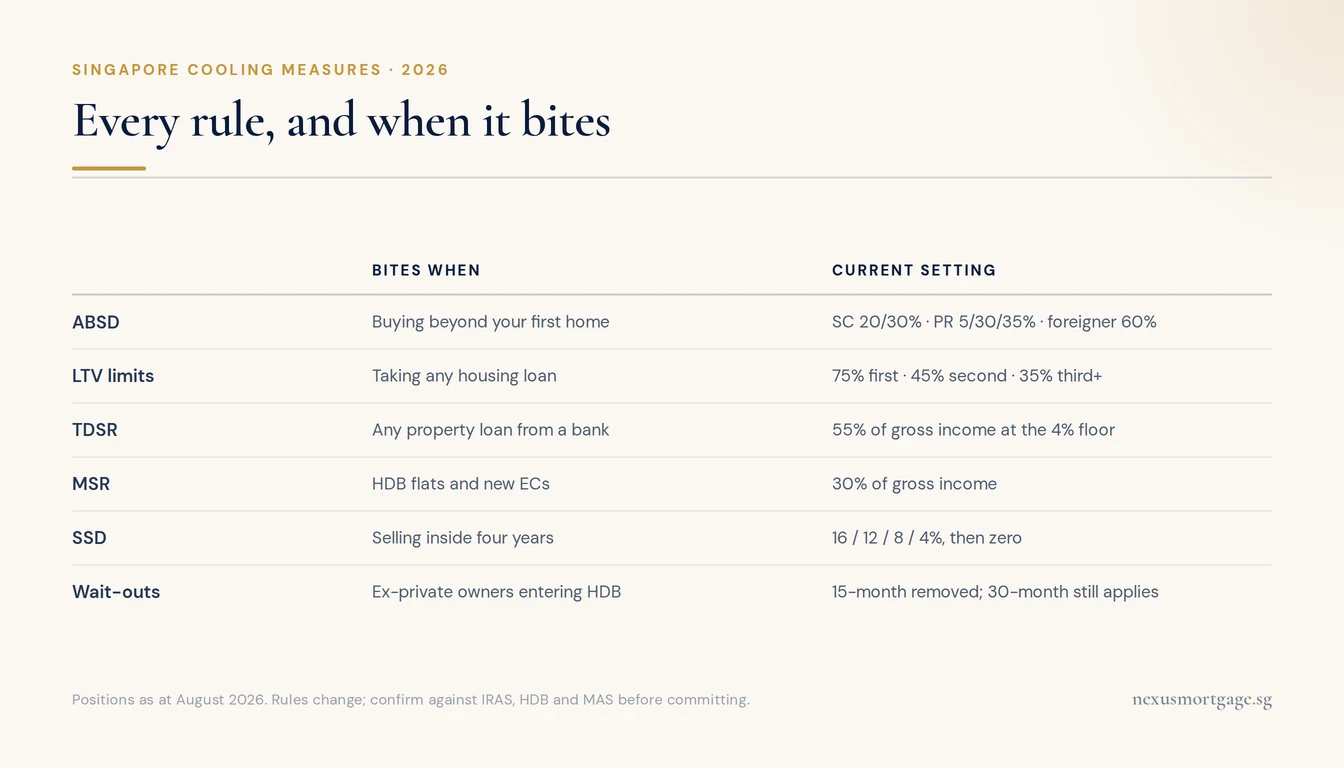
Six rules. Most buyers only ever meet three of them.
| Rule | Bites when… | Current setting |
|---|---|---|
| ABSD | Buying any residential property beyond your first (or as PR / foreigner) | SC 2nd 20%, 3rd+ 30% · PR 5/30/35% · foreigner 60% |
| LTV limits | Taking any housing loan | 75% first loan · 45% second · 35% third+ |
| TDSR | Any property loan from a bank | 55% of gross income at the 4% stress floor |
| MSR | HDB flats and new ECs | 30% of gross income |
| SSD | Selling residential property bought on/after 4 Jul 2025 | 16/12/8/4% across a 4-year holding period |
| Wait-outs | Ex-private owners entering HDB | 15-month wait REMOVED 28 Jul 2026; 30-month stays for BTO, grants and HDB loans |
ABSD: the Biggest Number on the Invoice
Additional Buyer's Stamp Duty, at the rates set on 27 April 2023, is the single largest cooling lever. On top of ordinary Buyer's Stamp Duty:
- Singapore Citizens: 0% on the first residential property, 20% on the second, 30% on the third and beyond.
- PRs: 5% on the first, 30% on the second, 35% after that.
- Foreigners: 60% flat — though nationals of the US, Switzerland, Norway, Iceland and Liechtenstein get citizen treatment under free trade agreements (full breakdown).
ABSD is payable in cash — CPF cannot fund it — which is why sequencing matters so much: married SC couples replacing their sole matrimonial home can have remission applied upfront at e-Stamping, and upgraders who sell before buying avoid the charge entirely. The legal decoupling route and its real costs are covered in the decoupling guide and the ABSD case study.
LTV, Cash-Down and Loan Tenure Caps
- First housing loan: up to 75% of price or valuation (whichever is lower), with 5% cash minimum. The 75% only holds if the tenure stays within 30 years for private (25 for HDB) and the loan ends by age 65 — breach either and it drops to 55%.
- Second loan: 45%, with 25% hard cash down. Third and beyond: 35%. The same tenure/age triggers cut these to 25% and 15%. Worked numbers in the second-property LTV guide.
- HDB concessionary loans: capped at 75% since 20 August 2024, aligned with bank loans.
TDSR, MSR and the 4% Stress Floor
Every bank property loan is tested at the MAS medium-term rate floor of 4%, regardless of the actual package rate. Your total monthly debt obligations at that stressed rate must stay within 55% of gross income (TDSR); for HDB flats and new ECs, the housing instalment alone must also fit within 30% (MSR). Variable and rental income is counted at a haircut, which is what catches commission earners and landlords who pass the calculator at face value. Two practical reliefs sit inside the framework: owner-occupiers refinancing their own home are exempt from the TDSR test on that refinance, and borrowers can pledge or show liquid assets to lift their assessable income when the ratio runs tight. The full mechanics, including what happens to borderline cases, are in TDSR and MSR explained and the stress-test guide — or just run your own numbers in the free report calculator, which applies the floor for you.
SSD: the Four-Year Exit Tax
Seller's Stamp Duty was reset on 4 July 2025: residential property bought on or after that date and sold within four years pays 16% in year one, 12% in year two, 8% in year three and 4% in year four. Purchases before the reset keep the old three-year 12/8/4% schedule. The reset exists to kill the sub-sale flip trade; the details and edge cases are in the SSD reset explainer.
Wait-Out Periods After Selling Private
The freshest change on this page: on 28 July 2026, MND removed the 15-month wait-out period, so private property owners and ex-owners can buy a non-subsidised HDB resale flat immediately after selling. The separate 30-month wait still gates the subsidised routes — BTO flats, CPF housing grants, new ECs, and resale flats financed with an HDB loan — and buyers who still hold private property must dispose of it within 6 months of completing. The financing consequences (bank loan as the only route for 30 months) are worked through in the wait-out removal guide.
Timeline: How We Got Here
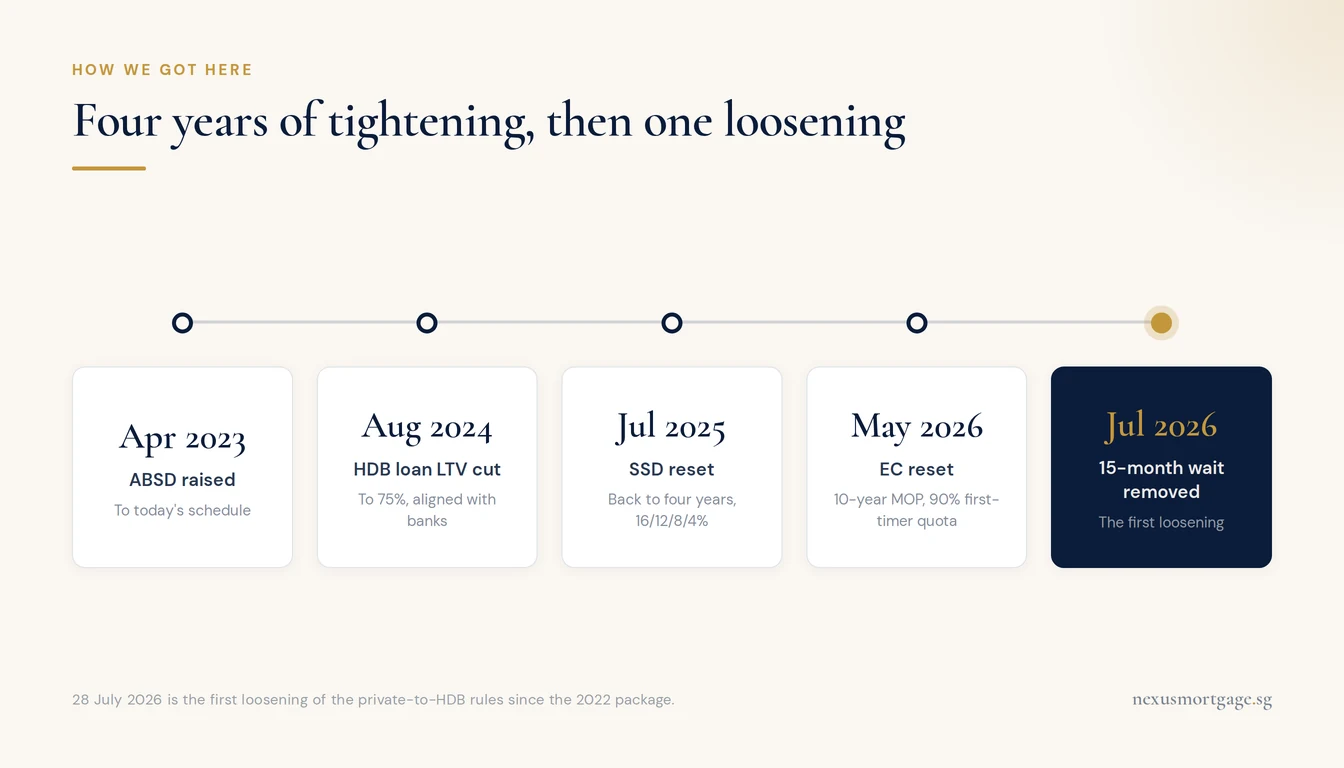
Four years of tightening, then the first loosening in July 2026.
| Date | Measure |
|---|---|
| 30 Sep 2022 | Interest-rate floors for loan assessment; 15-month wait-out introduced for ex-private owners buying HDB resale |
| 27 Apr 2023 | ABSD raised to today's schedule (SC 2nd 20%, foreigner 60%) |
| 20 Aug 2024 | HDB loan LTV cut to 75%, aligned with bank loans |
| 4 Jul 2025 | SSD reset: four-year holding period, 16/12/8/4% |
| 8 May 2026 | EC reset: 10-year MOP, 90% first-timer quota, DPS scrapped (detail) |
| 28 Jul 2026 | 15-month wait-out removed — first loosening move of the cycle |
Read the direction, not just the rules: 2022–2025 tightened, mid-2026 loosened for the first time. Policy follows prices, and prices have flattened.
Frequently Asked Questions
The friendly end of the stack: 0% ABSD, 75% LTV (within the tenure and age-65 caps), TDSR 55% at the 4% floor, MSR 30% if the property is an HDB flat or new EC, and SSD only if you sell within four years of buying. Ordinary BSD applies to everyone.
No. ABSD is payable in cash; CPF cannot fund it. BSD, by contrast, can be settled directly from CPF OA through your conveyancing law firm. Sequencing the sale and purchase, or qualifying for the married-couple remission, is how buyers legally avoid fronting ABSD at all.
Yes — two moves in the loosening direction: the May 2026 EC reset (which restructured rather than tightened), and the 28 July 2026 removal of the 15-month wait-out period for private owners buying HDB resale. The core ABSD, LTV, TDSR and SSD settings are unchanged.
Banks must assess residential loans at a floor of 4% regardless of the package rate. A loan that fits at an advertised 1.4% must still pass TDSR and MSR at 4%. That is why calculators that use the advertised rate overstate what you can borrow.
Largely no: ABSD, SSD (residential schedule) and MSR do not apply to commercial and industrial assets, which is one reason SME owners can gear them harder — see the industrial equity term loan case study. TDSR still applies to individuals borrowing personally.
Which Rules Actually Bite on Your Purchase?
Profile, property count, citizenship, tenure — the stack lands differently on every buyer. We run your exact numbers across 16+ MAS-regulated banks, free.
Run My Numbers Free →Prefer a personal walk-through? WhatsApp Dan Ler at +65 8752 0859. Banks pay our fee — you pay nothing.

About the author — Dan Ler has advised on Singapore home loans since 2017 at Nexus Mortgage SG, an independent brokerage comparing 16+ MAS-regulated lenders. Nexus has facilitated 500+ home loans across HDB, EC, private condo and landed property segments. Banks pay Nexus on disbursement, so there is no cost to the borrower.
Further reading
- Stamp duty in Singapore: BSD, ABSD and the calculator — the full duty math this page summarises
- Second property LTV, cash and TDSR — the 45%/35% ladder with worked examples
- The SSD 2025 reset — who the four-year schedule catches
- 15-month wait-out removed — the July 2026 loosening and its financing catch
- Free Singapore mortgage report — your numbers against every rule on this page, in one PDF
Nexus Mortgage SG is an independent Singapore mortgage advisory. This article is general information, not financial advice. Rates and rules reflect IRAS, MAS, MND and HDB positions as of 20 August 2026 and can change with a single press release. Sources: IRAS property stamp duty, MAS Notice 645 (TDSR), MND, HDB, URA.