How an SME Funded a S$11.6M Project With a S$4M Equity Term Loan on Its Industrial Property

This is a real Nexus case. The client's name and identifying details are changed, and figures are rounded, but the structure and numbers are as executed.
The Situation: a S$11.6M Win With a S$4M Hole in It
John runs an established SME. Earlier this year the company secured its largest contract to date: a S$11.6 million project. Wins like that are what a business spends years building toward, and they come with a catch that never makes the announcement: the company has to fund mobilisation before the project pays a cent.
The immediate gap was equipment. To deliver on schedule, the company needed roughly S$4 million of equipment funding, and it needed the money on the project's timeline, not the bank's. Progress payments would eventually cover it many times over. Eventually is the problem: a main contractor does not wait for your financing to clear, and a project award can be re-tendered if the winner cannot mobilise.
S$4 million is an awkward number for an SME. It is far beyond what unsecured working-capital facilities will stretch to, and splitting it across hire-purchase lines for each machine is slow, piecemeal and expensive. The company needed one clean facility, at a sensible cost, quickly.
The Asset Most SMEs Forget They Own
The answer was sitting under the company the whole time: its own premises. The business operates out of an industrial property it owns, and the bank's valuation came in at S$5.8 million. Years of paying down the property and a firm industrial market had built up substantial equity that was doing nothing except housing the machines.
Property equity is the cheapest large-quantum capital most SMEs will ever have access to. Most never touch it, because nobody told them they could.
An equity term loan (also called a commercial cash-out or equity release) mortgages the property to the bank and returns a lump sum of its paid-up value as cash. Unlike residential cash-out, which comes with usage restrictions, equity unlocked from a commercial or industrial property held by an operating company can be deployed for genuine business purposes: equipment, mobilisation, working capital, expansion. We covered the product mechanics in our cash-out guide and on the equity loan page; this case is what it looks like in the wild.
The Structure: S$4M at 69% of Valuation
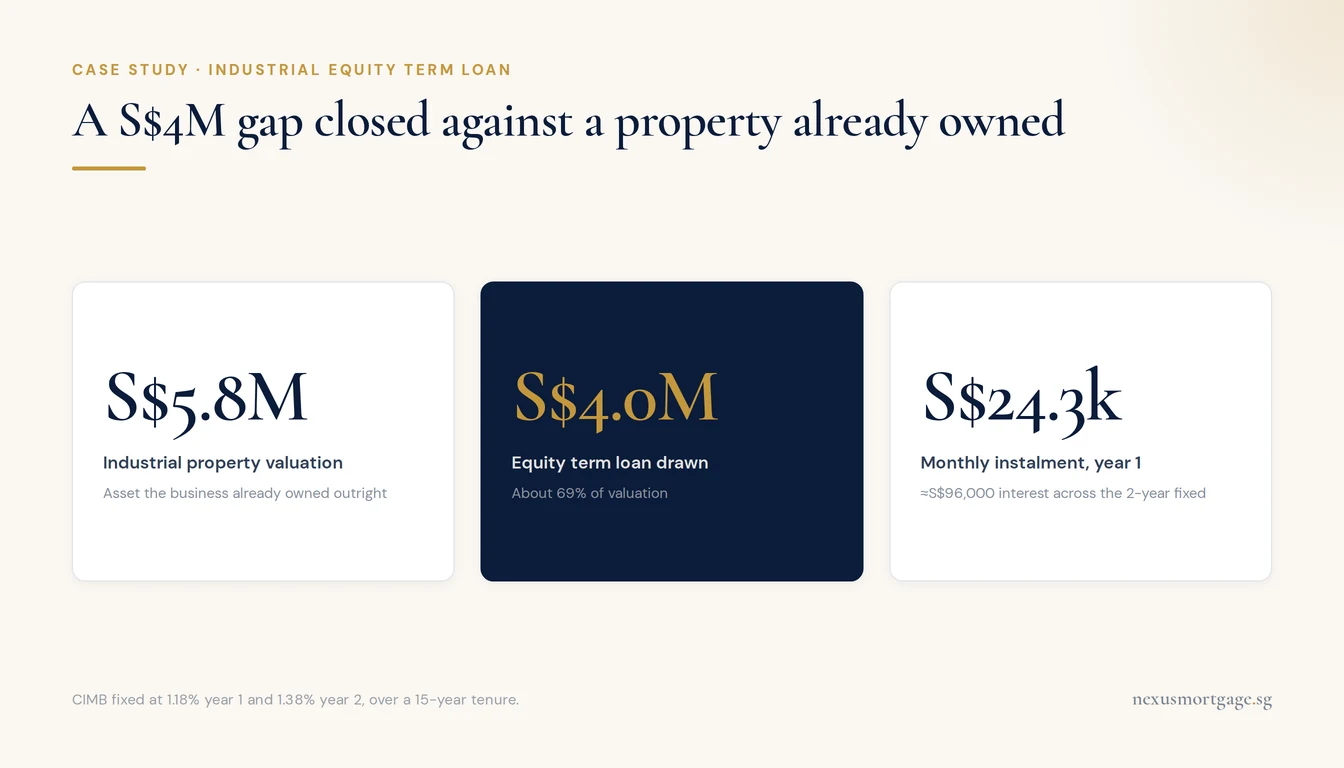
The asset was already owned. Nothing new was pledged and nothing was sold.
| Item | Figure |
|---|---|
| Industrial property valuation | S$5,800,000 |
| Equity term loan taken | S$4,000,000 |
| Loan against valuation | ≈ 69% |
| Loan tenure | 15 years |
| Rate secured | CIMB fixed — 1.18% year 1, 1.38% year 2 |
| Monthly instalment, year 1 (1.18%) | ≈ S$24,260 |
| Monthly instalment, year 2 (1.38%) | ≈ S$24,590 |
| Interest cost over the 2-year fixed period | ≈ S$96,000 (principal down to ≈ S$3.51M) |
| Use of funds | Equipment funding for the S$11.6M project |
| Security | Mortgage over the company's industrial property |
The pricing came in at 1.18% fixed in year one and 1.38% fixed in year two with CIMB. Read that against what SMEs usually pay for money: unsecured working-capital lines run high-single-digit effective rates, and even hire purchase sits well above this. Real-estate security is what buys a S$4M facility at close to home-loan pricing. On these terms the interest cost across the entire two-year fixed period is about S$96,000 — while the facility unlocked delivery of a S$11.6M contract. After the fixed period, the loan reprices; that is a diarised review date, and we rerun the market for the reprice-or-refinance call when it comes.
The 15-year tenure is the other lever. Stretching a S$4M facility over 15 years keeps the instalment near S$24k a month instead of the S$70k+ a 5-year equipment facility would demand — roughly S$24,260 in year one and S$24,590 in year two, with the principal already down to about S$3.51M by the end of the fixed period. Nothing stops the company repaying faster once progress payments land. Long tenure for breathing room, early repayment for economy.
Two deliberate choices in that structure are worth pointing out:
- The company did not max out the property. Banks will commonly lend up to around 70–80% of a commercial or industrial valuation. Taking S$4M against S$5.8M left headroom, which keeps the covenant position comfortable and preserves the option of a further facility later in the project cycle.
- Term loan, not a patchwork. One secured facility funded the entire equipment package. Compare that against negotiating five or six separate hire-purchase agreements while a mobilisation clock runs.
Secured pricing is the other half of the story. A term loan mortgaged on industrial property prices off commercial property lending benchmarks, a different planet from unsecured SME lending. On S$4 million, the rate difference between secured and unsecured funding is not a rounding error; it is six figures a year.
The Alternatives, Compared Honestly
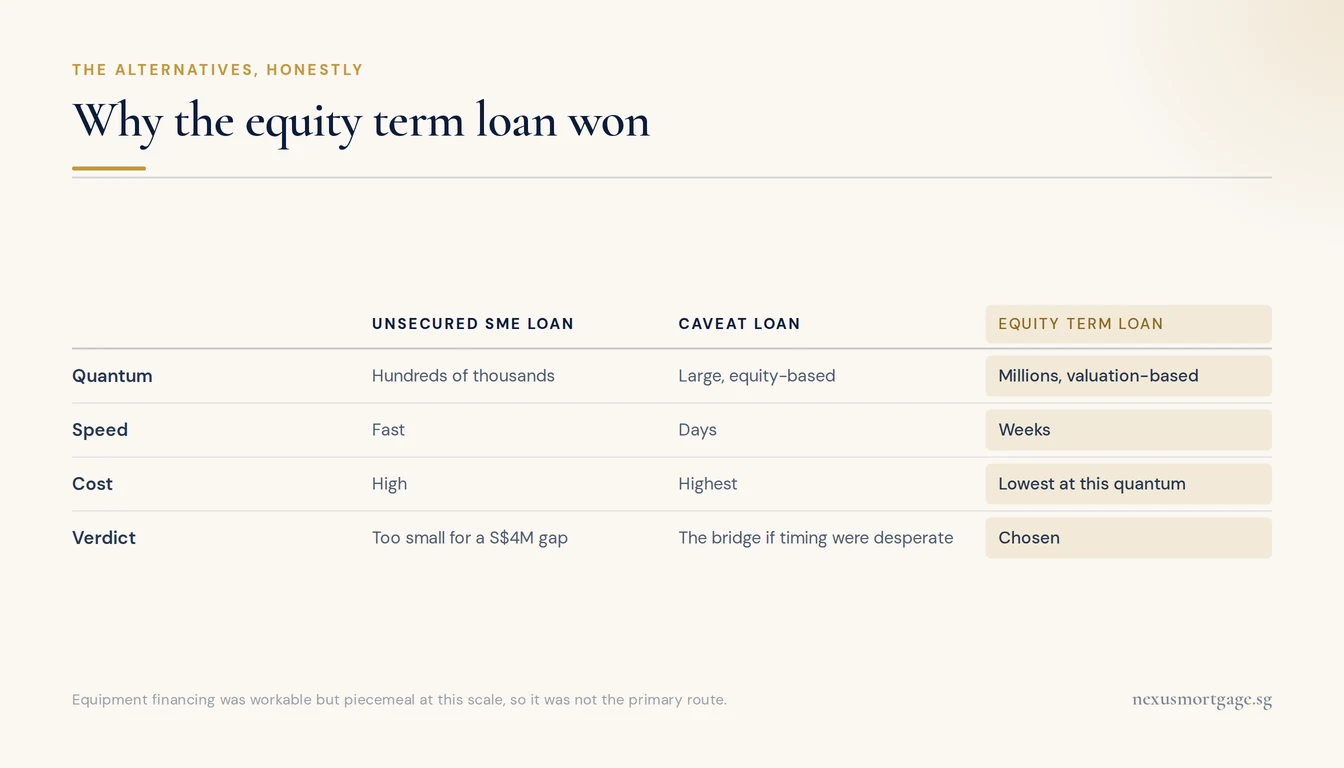
At S$4M the unsecured route was never large enough, and the caveat route was never cheap enough.
| Route | Quantum | Speed | Cost | Verdict here |
|---|---|---|---|---|
| Unsecured SME working-capital loan | Usually capped in the hundreds of thousands | Fast | High | Too small for a S$4M gap |
| Equipment financing / hire purchase | Per-asset | Moderate, per agreement | Moderate | Workable but piecemeal at this scale |
| Caveat loan | Large, equity-based | Days | Highest | The bridge if timing had been desperate |
| Equity term loan on own property | Millions, valuation-based | Weeks | Lowest at this quantum | Chosen |
The honest note on timing: an equity term loan is not instant money. Valuation, credit assessment, letter of offer and legal work take weeks. In this case the project timeline allowed it. When it does not, a short caveat loan can bridge to the cheaper term facility, and we structure exactly that when the mobilisation clock is brutal.
What the Bank Actually Assessed
- The security. An owner-occupied industrial property with a clean title and a S$5.8M valuation. This is what anchors the quantum and the pricing.
- The repayment source. The S$11.6M award letter mattered enormously. A funding request that traces to a signed contract with progress payments reads as growth, not distress.
- The company's track record. Financials, existing facilities and conduct. An established operator asking to fund delivery of a won project is the profile banks want.
- The directors. Personal guarantees from directors are standard on SME secured facilities. Corporate borrowing at this scale is never fully divorced from the people behind the company.
Note what is not on that list: the personal TDSR maths that governs residential borrowing. A corporate facility secured on commercial property is assessed on the business case. That is exactly why the structure works for owners whose personal debt ratios are already committed to home mortgages.
Lessons for Other Business Owners
- Price your property equity into your growth plans. If your company owns its premises, you are sitting on the cheapest S$1M–S$5M+ of capital you will ever raise. Know your current valuation before you need it.
- Start the facility before the invoices arrive. The process takes weeks. The moment a large tender looks winnable is the moment to get indicative terms.
- Do not max the LTV. Leaving headroom kept this client's options open for the next phase, and banks read restraint as strength.
- Match the tool to the timeline. Term loan when weeks are available, caveat bridge when they are not, and sometimes both in sequence.
- Get the structure brokered. Commercial equity pricing and appetite vary widely between banks, far more than residential. We run the comparison across lenders at no cost to you — and if you want the full picture of your borrowing position first, the Singapore Mortgage Free Report is the place to start.
Frequently Asked Questions
A secured term loan that unlocks the paid-up value of a property the company already owns. The bank takes a mortgage over the property and disburses a lump sum, which the business can use for working capital, equipment, expansion or project funding. Because it is secured on a hard asset, the quantum is larger and the pricing lower than unsecured SME facilities.
Banks commonly lend up to around 70–80% of current valuation, less any outstanding loan. In this case the company took S$4M against a S$5.8M valuation, about 69%. The final quantum depends on the bank's valuation, the company's financials and the purpose of funds.
Yes. Unlike residential cash-out, which is restricted, equity unlocked from a commercial or industrial property held by an operating company can generally be deployed for business needs: equipment, project mobilisation, working capital or expansion. Banks will ask for the purpose and may want supporting documents such as the project award letter.
Substantially, and the quantum is far larger. Unsecured SME facilities are typically capped in the hundreds of thousands with short tenures and high effective rates. A secured equity term loan prices off commercial property lending benchmarks, runs longer tenures, and reaches millions because the bank holds real-estate security.
In this case, on a 15-year tenure at CIMB's fixed 1.18% (year 1) and 1.38% (year 2): about S$24,260 a month in year one and S$24,590 in year two, with roughly S$96,000 of total interest across the two-year fixed period. Commercial pricing is negotiated per deal — bank, borrower financials and asset all move it — so treat these as one real data point, not a rate card.
Typically several weeks end to end: indicative terms, valuation, credit assessment, letter of offer, then legal work and disbursement. If the project clock is tighter than that, a caveat loan can bridge to the term facility.
Sitting on Equity Your Business Could Deploy?
If your company owns its premises — industrial, office or shophouse — we will tell you what a bank would lend against it and at what pricing, across multiple lenders, free.
WhatsApp Dan About Your Property →Or call it in: +65 8752 0859. Banks pay our fee — you pay nothing.
Planning your personal borrowing too? Grab the Singapore Mortgage Free Report — 16-bank comparison, TDSR/MSR worksheet and upfront-cost breakdown in one PDF.

About the author — Dan Ler has advised on Singapore home loans since 2017 at Nexus Mortgage SG, an independent brokerage comparing 16+ MAS-regulated lenders. Nexus has facilitated 500+ home loans across HDB, EC, private condo and landed property segments. Banks pay Nexus on disbursement, so there is no cost to the borrower.
Further reading
- Commercial property loans in Singapore — buying, refinancing and gearing commercial and industrial assets
- Caveat loans for SMEs — the fast, property-backed bridge when the timeline is days, not weeks
- Cash-out refinancing explained — unlocking equity from property you already own
- Equity / cash-out loan page — quick estimate of what your property could release
- Free Singapore mortgage report — Dan's full written breakdown with a 16-bank comparison
Nexus Mortgage SG is an independent Singapore mortgage advisory. This article describes a real client engagement with identifying details changed and figures rounded; it is general information, not financial advice. Commercial lending terms vary by bank, borrower and asset. Positions as of 14 August 2026. Sources: MAS, IRAS property stamp duty, URA, JTC (industrial property).