FDR, FHR & DMR: Singapore's Fixed-Deposit Home Loan Pegs, Explained

Not every floating home loan is pegged to SORA. Many are pegged to a bank's own fixed-deposit rate — you will see these marketed as FHR, FDR, FDMR, FDPR or DMR. They look stable and attractive, but they behave very differently from a market-linked SORA loan. Here is what each label means and the trade-off you are actually accepting.
What a "Peg" Is
A floating home loan rate is built as a reference rate plus a bank spread. The reference (the "peg") is the part that moves. Your rate = peg + spread, and only the peg changes over time. So the whole question of "is my floating loan safe" comes down to what the peg is and who controls it.
The Two Families: SORA vs Board
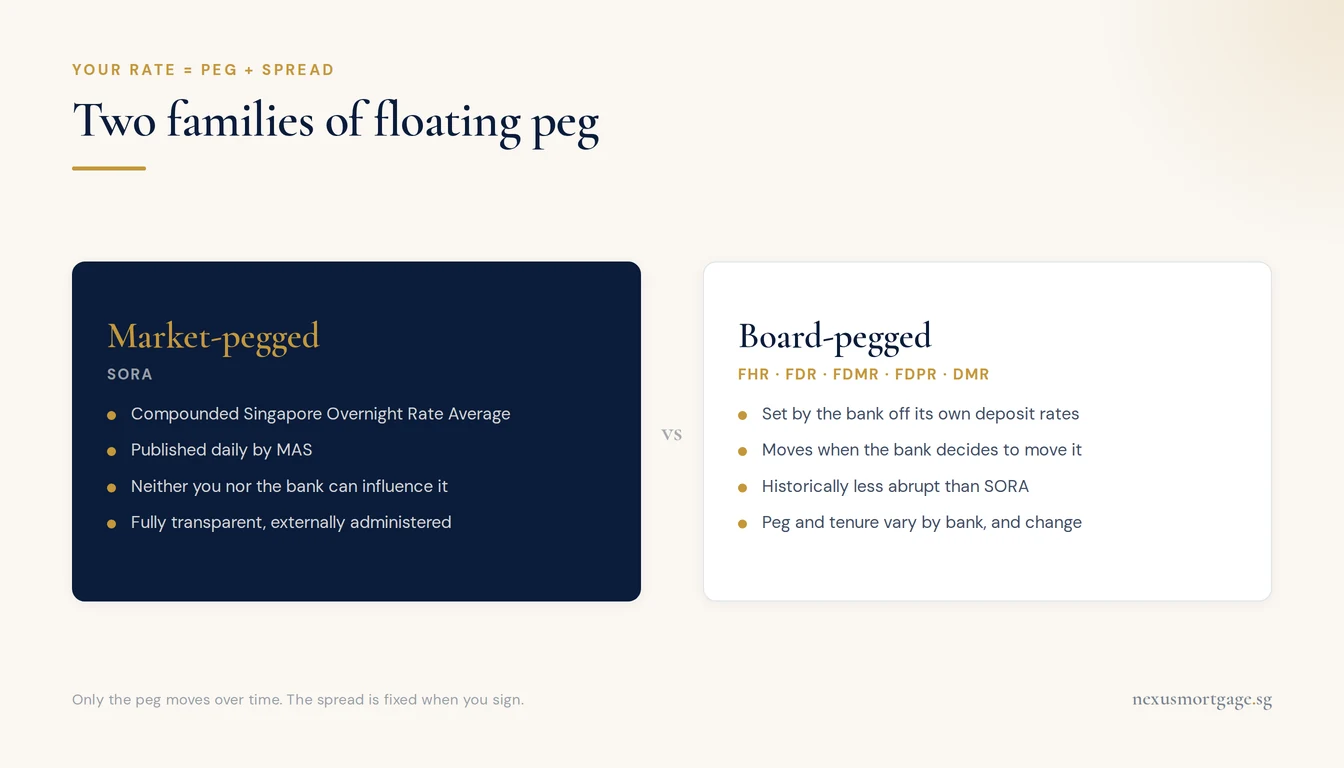
Every acronym on your loan document belongs to one of these two columns.
Singapore floating loans split into two camps:
- Market-pegged (SORA) — pegged to the compounded Singapore Overnight Rate Average, published daily by the Monetary Authority of Singapore and administered transparently. Neither you nor the bank can influence it.
- Board / fixed-deposit-pegged — pegged to a rate the bank itself sets: either an internal "board rate" or one of its fixed-deposit rates. FHR, FDR, FDMR, FDPR and DMR all belong here.
FHR — Fixed Home Rate (DBS)
FHR is DBS's Fixed Home Rate, a board rate pegged to its own SGD fixed-deposit rates. You will see it written as FHR6 or similar, where the number is the fixed-deposit tenure it tracks (e.g. the 6-month FD rate). Your loan is priced as FHR plus a spread. It is a floating rate — it can move — but historically it has moved less abruptly than market SORA.
FDR / FDMR / FDPR (OCBC, UOB, Maybank)
Other banks use their own fixed-deposit pegs under different names. FDR (Fixed Deposit Rate) is the generic term; banks peg to a chosen FD tenure — 6, 8, 18, 24 or 36 months. Maybank's FDMR (Fixed Deposit Mortgage Rate) launched in December 2016. FDPR and DMR (Deposit Mortgage Rate) are the same idea under other labels: a deposit rate the lender defines, plus a spread. The exact peg and tenure vary by bank and change over time — check the current live rates.
The Stability Trade-Off
Fixed-deposit pegs have one genuine appeal: they are usually the least volatile reference rates, because banks tend to adjust their fixed-deposit rates last, even in choppy markets. In a rising-rate environment an FD peg can lag — and lag in your favour.
The catch is control and transparency. The bank sets the peg and can change it at its discretion, unlike SORA, which is published daily by MAS and the Association of Banks in Singapore and cannot be moved by any single lender. A bank can raise its FD peg even when market rates are flat. So "stable" cuts both ways: you are trading the transparency of a market rate for a rate your own lender controls. Read the peg's revision history before you commit, not just the headline spread.
SORA or FD-Pegged: How to Choose
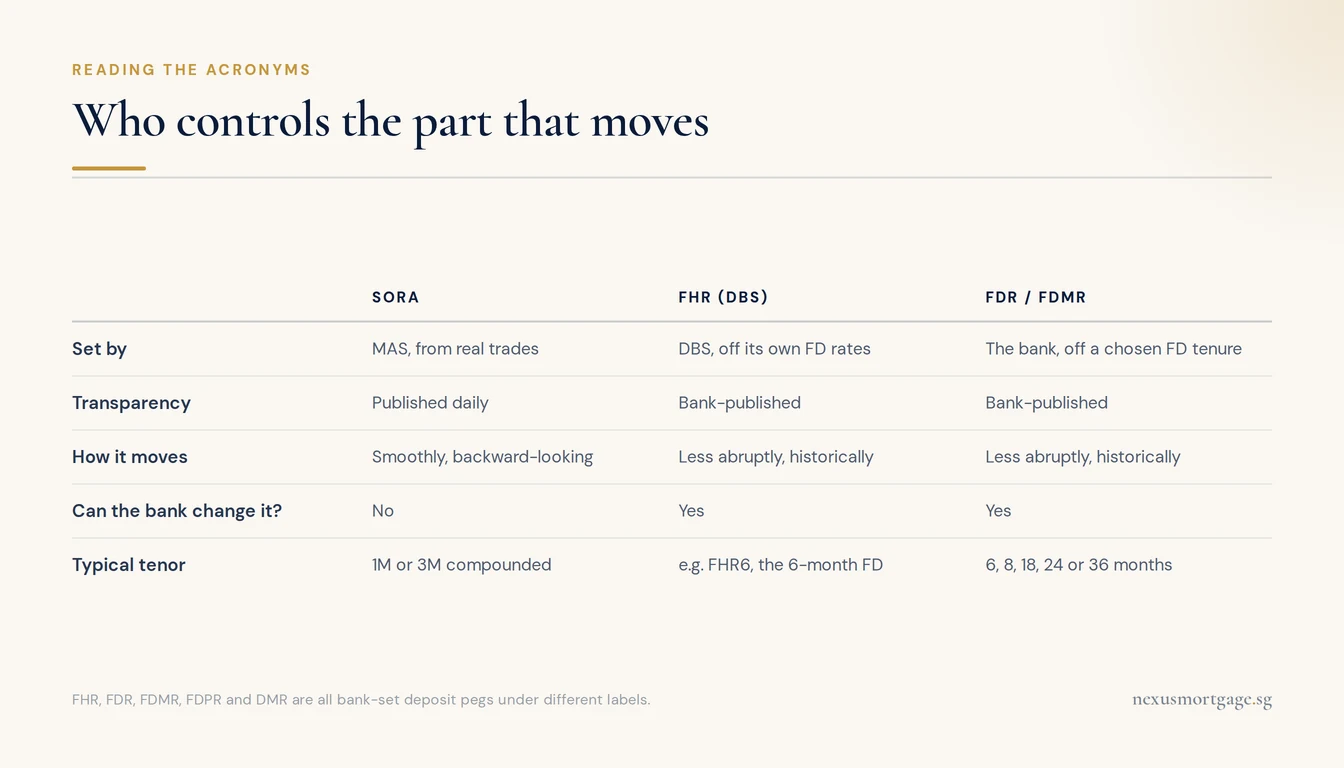
The real question is not the current number. It is who is allowed to change it.
There is no universal winner. SORA is transparent and moves with the market — better when you want to ride rate cuts and trust a published benchmark. An FD peg can feel steadier and lag rises, but you accept that the bank controls it. In practice the decision often comes down to the total rate (peg + spread) and the conversion terms, not the label. We compare both across all 16 banks so you are choosing on the real all-in cost. See also fixed vs floating.
Frequently Asked Questions
What is FHR in a Singapore home loan?
FHR (Fixed Home Rate) is DBS's board rate, pegged to its own SGD fixed-deposit rates. You often see it as FHR6, tracking the 6-month fixed-deposit rate. Your loan is priced as FHR plus a spread. It is a floating rate that can change, but it has historically moved less sharply than market SORA.
What is the difference between FDR and SORA home loans?
SORA is a transparent market benchmark published daily by MAS and cannot be influenced by any single bank. An FDR (fixed-deposit-rate) peg is set by the bank itself, based on its own fixed-deposit rates. FD pegs tend to be less volatile, but the bank controls them and can revise them at its discretion, so they are less transparent than SORA.
Are fixed-deposit-pegged home loans better?
Not universally. They are usually the least volatile peg because banks adjust fixed-deposit rates last, which can help in a rising market. The downside is that the bank sets and can change the peg, unlike SORA. The right choice depends on the total rate (peg plus spread), the revision history of the peg, and the conversion terms — compare the all-in cost, not the label.
What does DMR mean?
DMR (Deposit Mortgage Rate) is a home-loan peg based on a deposit rate the lender defines, plus a spread. It is the same family as FHR, FDR, FDMR and FDPR — a bank-set fixed-deposit-style peg rather than a market benchmark like SORA. Maybank's version, FDMR, launched in December 2016.
Confused by FHR, FDR and DMR?
We translate every bank's peg into a single all-in rate you can actually compare, across all 16 lenders — free.
Get My Free Mortgage Report →Prefer to talk it through? WhatsApp Dan Ler at +65 8752 0859 — free, independent, banks pay our fee.

About the author — Dan Ler has advised on Singapore home loans since 2017 at Nexus Mortgage SG, an independent brokerage comparing 16+ MAS-regulated lenders. Banks pay Nexus on disbursement, so there is no cost to the borrower.
Further reading
- Fixed vs floating home loans — how to choose when the rate outlook is uncertain
- Singapore mortgage rate outlook — where rates are heading and what it means for your next repricing
- Repricing vs refinancing — staying with your bank versus moving, and when each one wins
- Current Singapore home loan rates — fixed and floating packages compared across banks
- Live SORA rate today — the 1M and 3M compounded SORA feed that prices floating packages
Nexus Mortgage SG is an independent Singapore mortgage advisory. General information, not financial advice. Peg names, tenures and spreads vary by bank and change; confirm current terms with the lender. As of 8 July 2026. Reference: peg explainers, MAS/ABS SORA.