Fixed vs Floating Home Loan in Singapore: How to Choose

A fixed package locks your rate for the lock-in period (usually 1 to 3 years), so the payment never moves. A floating package tracks 3-month Compounded SORA plus a bank spread, so it falls when rates fall, rises when they rise, and often lets you reprice for free. Neither is “better”: fixed buys certainty, floating buys flexibility and usually a lower starting rate when SORA is low, as it is in 2026. The right one depends on your budget, your view on rates, and how long you will hold the loan.
What “Fixed” and “Floating” Actually Mean
A fixed-rate package locks your interest rate for a set period, usually one, two or three years. Whatever happens to the wider rate market in that window, your rate and your monthly instalment do not change. When the fixed period ends, the loan reverts to a floating rate.
A floating-rate package is priced as 3-month Compounded SORA plus a fixed spread. SORA is a transparent benchmark published by MAS; the spread (commonly around 0.2% to 0.8%) is set by the bank and locked at signing. The SORA part refreshes every three months, so your rate moves with it. SIBOR has been phased out, so SORA is the floating benchmark today.
The Real Differences Beyond the Rate
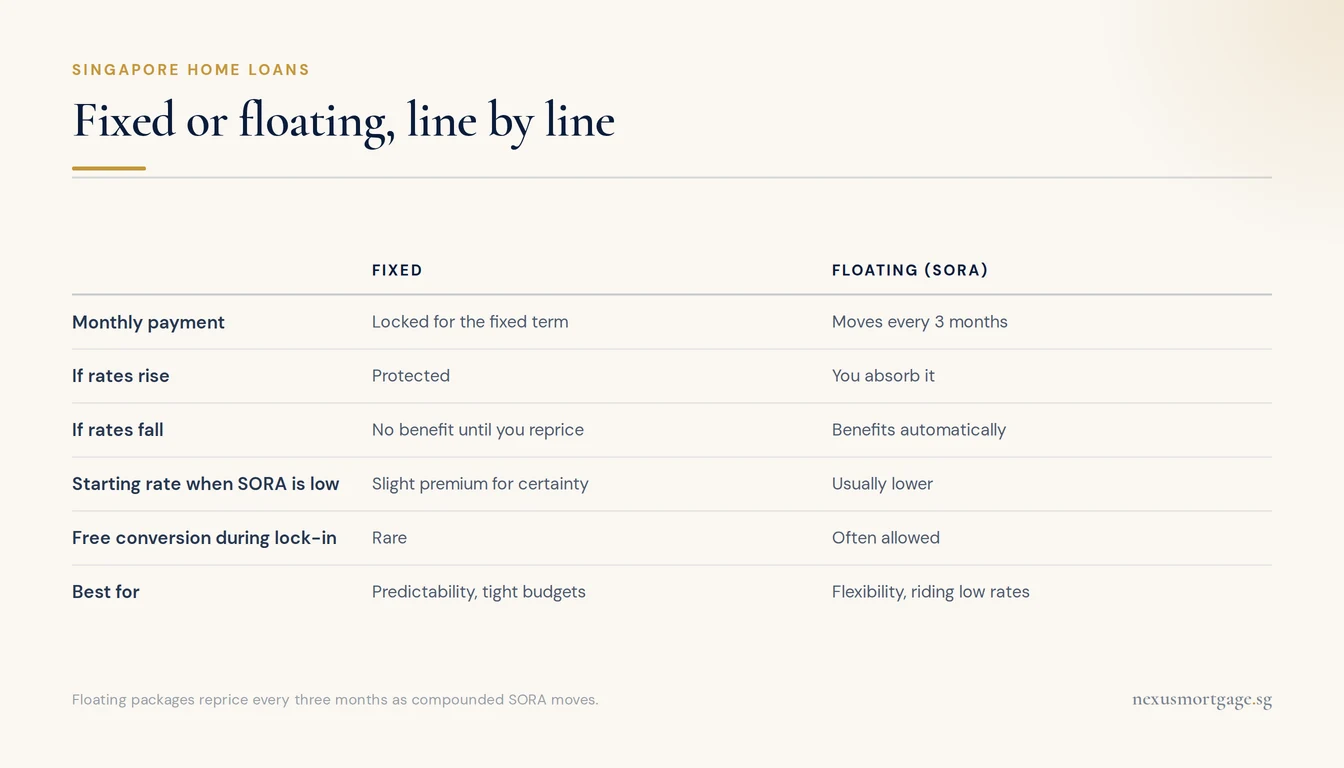
The rate gap is the smallest difference between them. Everything else on this card matters more.
People compare the headline rate and stop there. The features around it matter just as much:
| Fixed | Floating (SORA) | |
|---|---|---|
| Monthly payment | Locked for the fixed term | Moves every 3 months with SORA |
| Protects you if rates rise | Yes | No |
| Benefits if rates fall | No (until you reprice) | Yes, automatically |
| Starting rate when SORA is low | Slight premium for certainty | Usually lower |
| Free conversion / repricing | Rare during lock-in | Often allowed |
| Best for | Predictability, tight budgets | Flexibility, riding low rates |
Both usually carry a lock-in of around two years, and breaking it early costs roughly 1.5% of the outstanding loan. So the choice is not just today's rate, it is which trade-off you want to live with for the next couple of years.
When Fixed Wins
Pick fixed when certainty is worth more to you than chasing the lowest possible rate:
- Your monthly budget is tight and a payment rise would hurt. A locked instalment lets you plan with confidence.
- You think rates are more likely to rise than fall over your fixed term.
- You want to set the loan and forget it for a year or two, without watching SORA.
- You simply value peace of mind, and the small premium over floating is a price you are happy to pay for it.
When Floating Wins
Pick floating when you can absorb some movement and want flexibility:
- Your cashflow can handle the instalment moving up or down a little each quarter.
- SORA is low or flat, so you start cheaper and ride it down if rates ease.
- You want flexibility: many floating packages allow a free conversion, and they are easier to exit if you plan to sell or refinance.
- You will be repricing anyway in a year or two, so a lower start now beats a fixed premium.
Where Rates Sit in 2026
As of 2026, 3-month Compounded SORA is low, around 1%, so floating packages start cheaper than they did through the high-rate years, and fixed packages have come down with them. The gap between a good fixed and a good floating package is narrow right now. When the gap is that small, the decision is less about chasing 0.1% and more about which risk you would rather hold: a locked payment, or a lower start that can move. For the live numbers, see our current rates page and the guide to Singapore home loan rates.
A Simple Way to Decide
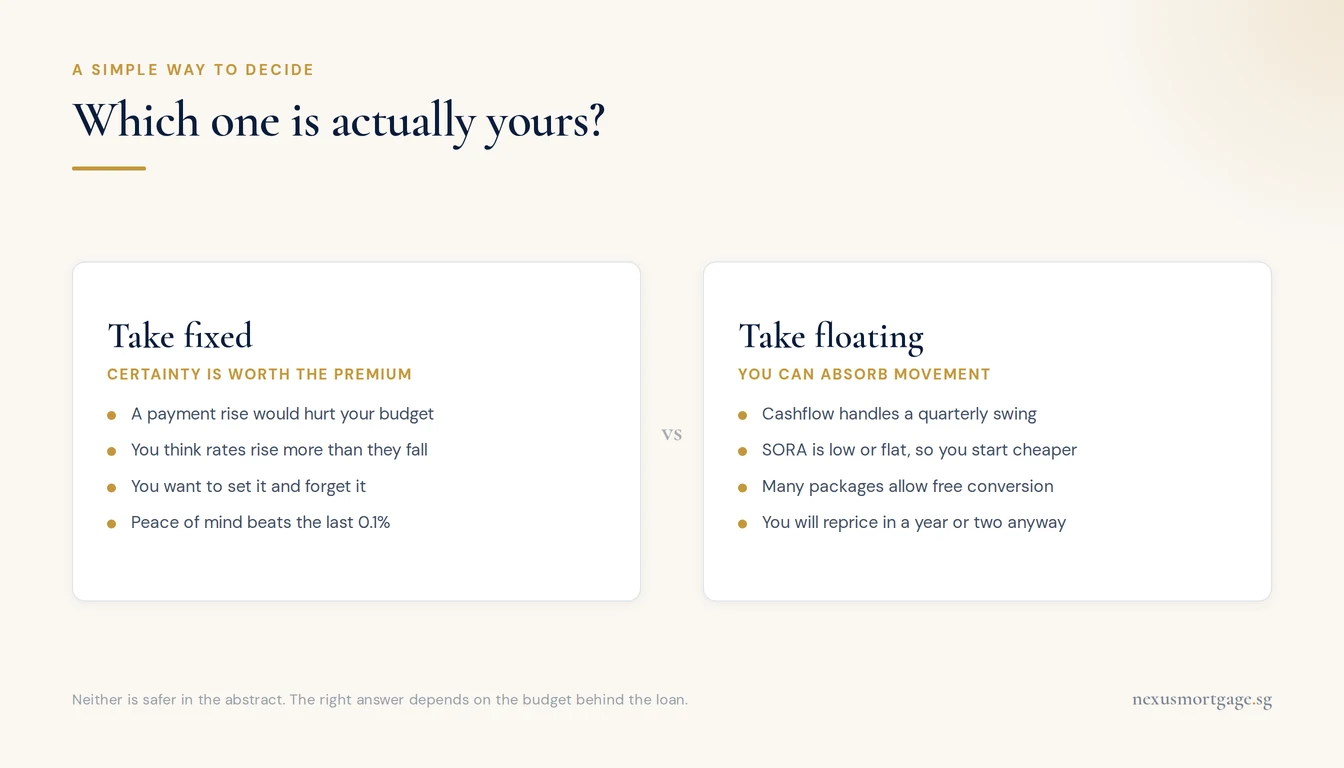
The question is not which rate is lower today. It is which one your budget can live with.
Four questions settle it for most people:
- How tight is your monthly budget? Tighter means fixed.
- Could you absorb a higher instalment if SORA rose? If not, fixed.
- How long before you sell or refinance? Shorter favours floating with free conversion; you will move before any rate cycle bites.
- Do you want to manage it, or set and forget? Set-and-forget leans fixed.
Then compare on total cost over your holding period, not the first-year teaser: the spread or reversion rate, the lock-in, free conversion and any subsidy clawback all change the real cost. Work your number with our affordability calculator, and when your lock-in is near its end, read when to refinance. The best package is the one that is cheapest over your timeline, not the lowest rate in the ad.
Frequently Asked Questions
Neither is universally better. A fixed rate locks your monthly payment for the lock-in period, which protects you if rates rise and suits a tight or fixed budget. A floating rate tracks 3-month Compounded SORA plus a spread, so it usually starts lower when SORA is low (as in 2026) and often allows free conversion, but the payment can move. The right choice depends on your budget, your view on rates, and how long you will hold the loan.
To 3-month Compounded SORA, a transparent benchmark administered by MAS, plus a fixed spread the bank sets (commonly around 0.2% to 0.8%). The spread is locked at signing; the SORA part is refreshed every three months, so your rate moves with it. SIBOR has been discontinued, so SORA is now the standard floating benchmark.
Yes. You reprice (stay with the same bank, switch package) or refinance (move to a new bank), usually once the lock-in ends, which is typically two years. Some floating packages also allow one free conversion during the lock-in. Breaking a lock-in early generally costs about 1.5% of the outstanding loan, so most people switch at the lock-in expiry.
No. When SORA is low, as it is in 2026, floating packages often start cheaper, but fixed packages can be competitive and they protect you if rates climb. The label does not decide the cost; compare the actual packages, their spreads and lock-in terms over your holding period.
Most Singapore fixed packages run one to three years. Two years is the common choice: long enough for payment certainty, short enough to reprice into a better deal afterwards. Match the fixed term to how long you expect rates to stay elevated, not to the longest lock-in on offer.
The package reverts to a higher floating or board rate, often 3.5% to 4.5% or more. That is when repricing or refinancing saves the most. Start comparing packages three to four months before your lock-in expires so you can move the moment it ends, instead of sitting on the reverted rate.
Not Sure Which Package Fits? Get a Straight Answer
Nexus Mortgage SG compares fixed and floating packages across 16+ MAS-regulated banks at no cost to you, and models them against your actual budget and holding plan — so you pick on total cost, not the headline rate.
Check What I Can Afford →Prefer a personal review? WhatsApp Dan Ler at +65 8752 0859 for a free assessment. Banks pay our fee — you pay nothing.
Or download the full breakdown: Singapore Mortgage Free Report — 16-bank fixed vs floating comparison, lock-in and reversion terms, and a TDSR/MSR stress test, in one PDF.

About the author — Dan Ler has advised on Singapore home loans since 2017 at Nexus Mortgage SG, an independent brokerage comparing 16+ MAS-regulated lenders across residential, commercial and new-launch financing. Banks pay Nexus on disbursement, so there is no cost to the borrower.
Further reading
- FDR, FHR and DMR pegs explained — board-rate pegs and why they behave differently from SORA
- Singapore mortgage rate outlook — where rates are heading and what it means for your next repricing
- When to refinance your home loan — lock-in expiry, notice periods and the break-cost math
- The MAS stress test in 2026 — the floor rate banks use to size your loan, not the rate you actually pay
- Live SORA rate today — the 1M and 3M compounded SORA feed that prices floating packages
Nexus Mortgage SG is an independent Singapore mortgage advisory. This article is general information, not financial advice. Rate types, spreads, lock-in and conversion terms vary by bank and change over time; SORA is administered by MAS and moves with the market. The figures here are illustrative as of publication — confirm current packages and terms with your bank or a qualified advisor before deciding. Source: MAS — SORA.