Singapore Mortgage Rate Outlook 2026: Where SORA and Fixed Rates Sit Now

Two years ago Singapore home-loan rates sat above 3%. In mid-2026 they are near their lowest in years. This is where the key reference rates are today, what actually moves them, and what the banks are telling clients to expect — without pretending anyone can call the exact path.
Where Rates Are Today
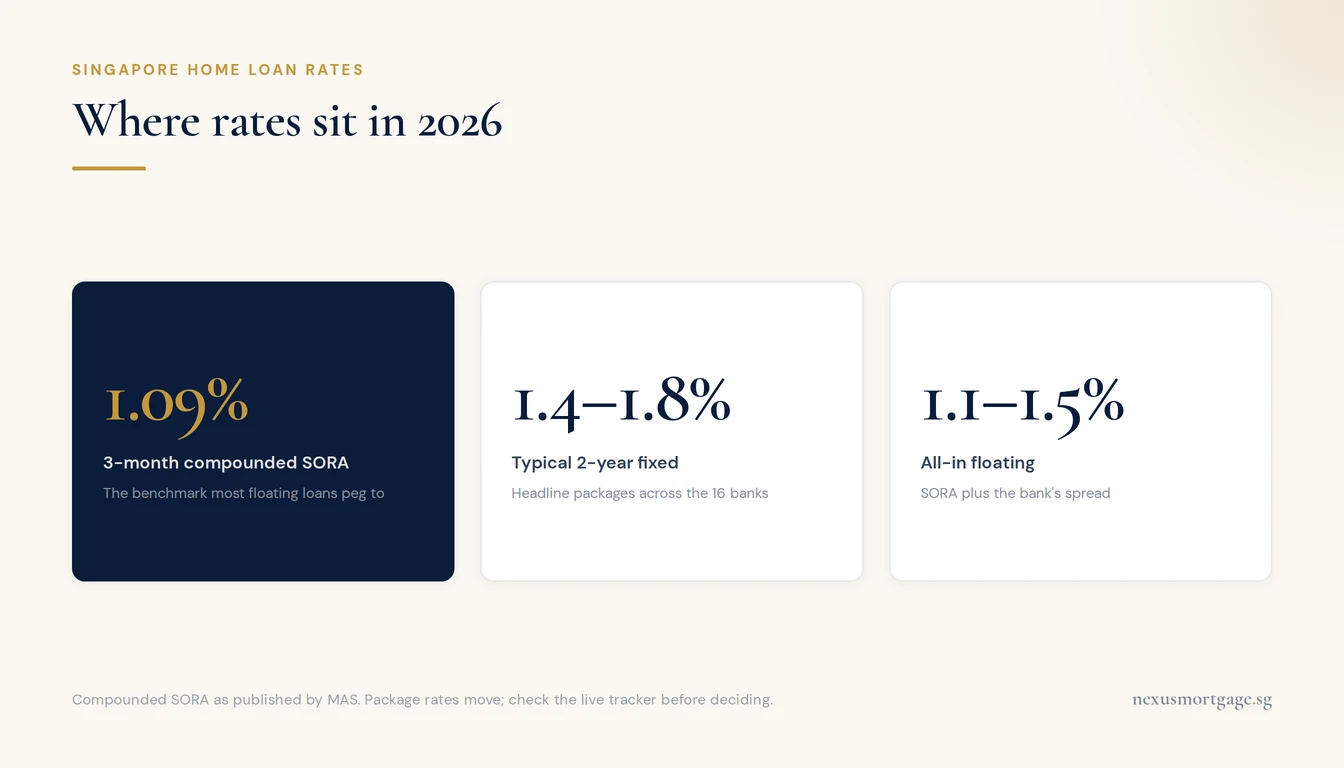
Rates near their lowest in years, but the spread between banks is where the saving sits.
As of 2026-07-02, compounded SORA — the benchmark most Singapore floating loans are pegged to — sits around 1.09% (3-month) and 1.13% (1-month). That has pulled headline packages down to roughly:
For the live figure, our SORA tracker updates from the MAS feed, and the rates page shows current packages across 16 banks.
What Actually Drives Your Rate
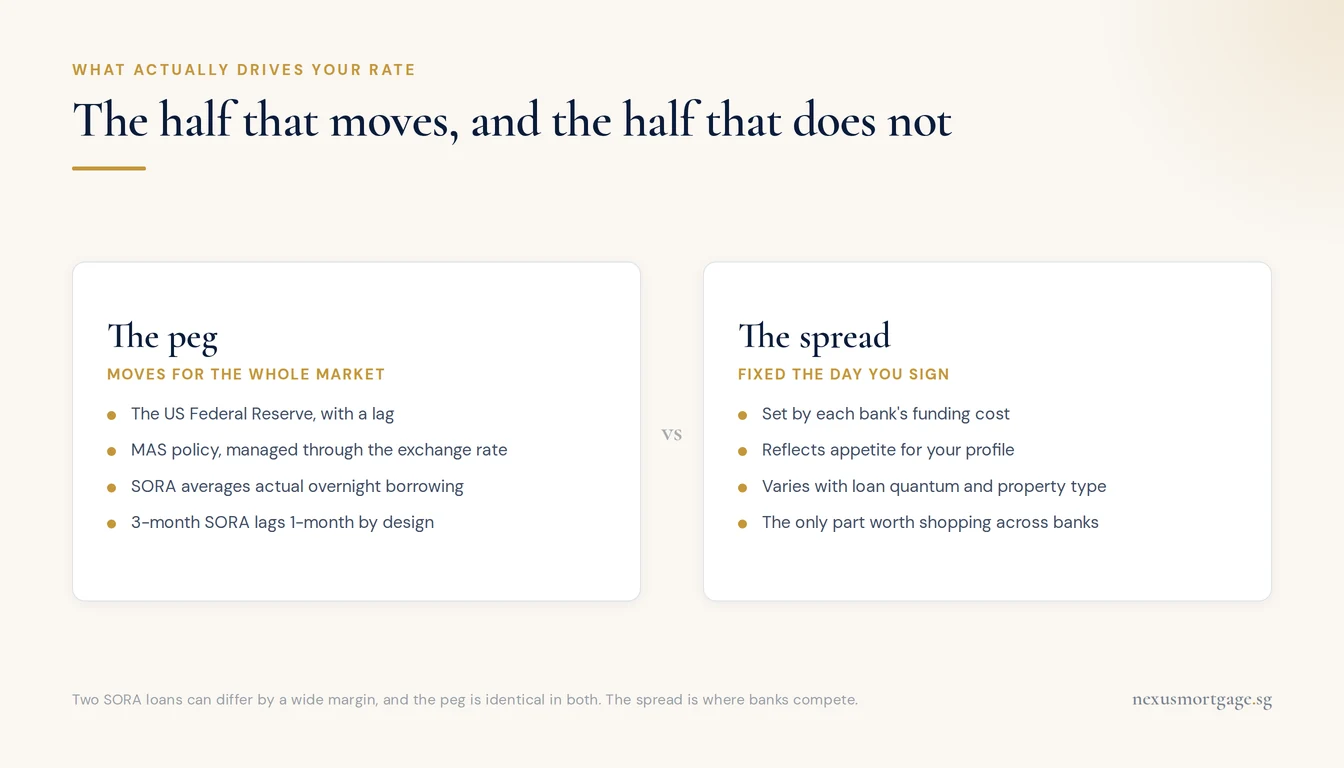
You cannot shop the peg. You can absolutely shop the spread.
Your Singapore mortgage rate is not set by any one thing. The main levers:
- The US Federal Reserve. SORA broadly tracks US rates because of how capital flows and the Singapore dollar are managed. When the Fed cuts, SORA usually drifts down with a lag.
- MAS policy and the Singapore dollar. MAS manages policy through the exchange rate, not an interest rate. A stronger-SGD stance tends to pull local rates down relative to the US.
- SORA mechanics. SORA is a backward-looking average of actual overnight borrowing, so it moves smoothly rather than jumping — 3-month SORA lags 1-month.
- Bank spreads and funding. On top of the peg, each bank adds a spread that reflects its own funding cost and appetite — which is why two SORA loans can differ.
What the Banks Are Forecasting
Published 2026 research from the local banks broadly expects SORA to have bottomed near 1% and to drift modestly higher later in the year, rather than returning to the 3%+ levels of 2024–25. To give a sense of the range (these are the banks' views, not ours):
- UOB has pointed to SORA bottoming around 1% in 2026 before rebounding modestly toward roughly 1.4% by year-end, assuming resilient growth and contained inflation.
- DBS has assumed a benchmark local rate around 1.25% for 2026, on the basis of about two further US Fed cuts and a firmer Singapore dollar.
- Longer-run econometric models point to SORA drifting toward the ~1.5% area into 2027 — a gradual normalisation, not a spike.
Forecasts disagree and are regularly revised. The useful takeaway is direction and range — "low, with modest upside risk later" — not a precise number to bet the house on.
Fixed or Floating Right Now?
With floating starting below fixed in mid-2026, many buyers have leaned floating to ride the low SORA — but that only pays if you are comfortable with the risk that rates drift up. If a predictable payment matters more to you, a 2-year fixed near 1.4–1.8% locks certainty cheaply by historical standards. There is no universally right answer; it depends on your holding period and risk appetite. We walk through the trade-off in fixed vs floating, and you can pressure-test your budget at the 4% stress rate with our affordability calculator.
Frequently Asked Questions
Will mortgage rates go down in Singapore in 2026?
As of 2026-07-02, 3-month compounded SORA sits around 1.09%, near multi-year lows after the US Fed's easing cycle. Published bank research broadly expects SORA to have bottomed near 1% in 2026 and to drift modestly higher later in the year rather than fall much further or return to 3%+. These are scenarios, not guarantees — rate paths can change.
What is a good home loan rate in Singapore now?
In mid-2026, 2-year fixed packages typically start around 1.4–1.8% and all-in floating (SORA plus spread) around 1.1–1.5%, well below the 3%+ seen in early 2025. 'Good' depends on your loan size and profile and changes weekly — compare live across all 16 banks before deciding.
Should I choose fixed or floating in 2026?
With floating starting below fixed in mid-2026, floating can be cheaper if you are comfortable with the risk that SORA drifts up. Fixed near 1.4–1.8% buys payment certainty cheaply by historical standards. It depends on your holding period and risk tolerance rather than a single right answer.
Does the US Fed affect my Singapore mortgage?
Yes, indirectly. SORA broadly tracks US rates because of capital flows and how the Singapore dollar is managed, so Fed cuts usually pull SORA down with a lag, and Fed hikes push it up. MAS manages policy through the exchange rate rather than a policy interest rate, which also shapes how closely local rates follow the US.
Timing a Purchase or Refinance Around Rates?
We track live SORA and all 16 banks' pricing daily, and model your options at today's rates and a stressed rate — free, independent advice.
Get My Free Mortgage Report →Prefer to talk it through? WhatsApp Dan Ler at +65 8752 0859 — free, independent, banks pay our fee.

About the author — Dan Ler has advised on Singapore home loans since 2017 at Nexus Mortgage SG, an independent brokerage comparing 16+ MAS-regulated lenders. Banks pay Nexus on disbursement, so there is no cost to the borrower.
Further reading
- Fixed vs floating home loans — how to choose when the rate outlook is uncertain
- When to refinance your home loan — lock-in expiry, notice periods and the break-cost math
- FDR, FHR and DMR pegs explained — board-rate pegs and why they behave differently from SORA
- Repricing vs refinancing — staying with your bank versus moving, and when each one wins
- Live SORA rate today — the 1M and 3M compounded SORA feed that prices floating packages
- Compare current mortgage rates — live fixed and floating packages across 16 banks
Nexus Mortgage SG is an independent Singapore mortgage advisory. This is general information and market commentary, not financial advice or a rate forecast. Rate figures are indicative as of 2026-07-02 and change; bank projections are the respective banks' views and are subject to revision. Sources: MAS SORA, published UOB/DBS research.