HDB Loan Eligibility 2026: Who Qualifies, Rule by Rule, and the HFE Letter
You are eligible for an HDB housing loan if at least one applicant is a Singapore Citizen, your average gross monthly household income is no more than S$16,000 (S$24,000 for extended families, S$8,000 for singles), nobody in the application owns or sold private residential property in the last 30 months, your household has not taken two HDB loans already, and you pass HDB's credit assessment. All of it is confirmed in one document, the HDB Flat Eligibility (HFE) letter, which you should have before you go flat hunting. If you fail any condition, a bank loan is still open to you.
Eligibility and loan amount are two different questions, and most guides blur them. This article is about the first: whether HDB will lend to you at all. For how much it will lend once you qualify, our HDB loan by salary table does the arithmetic. Everything below is taken from HDB's own rules as published in November 2026.
The Six Conditions at a Glance
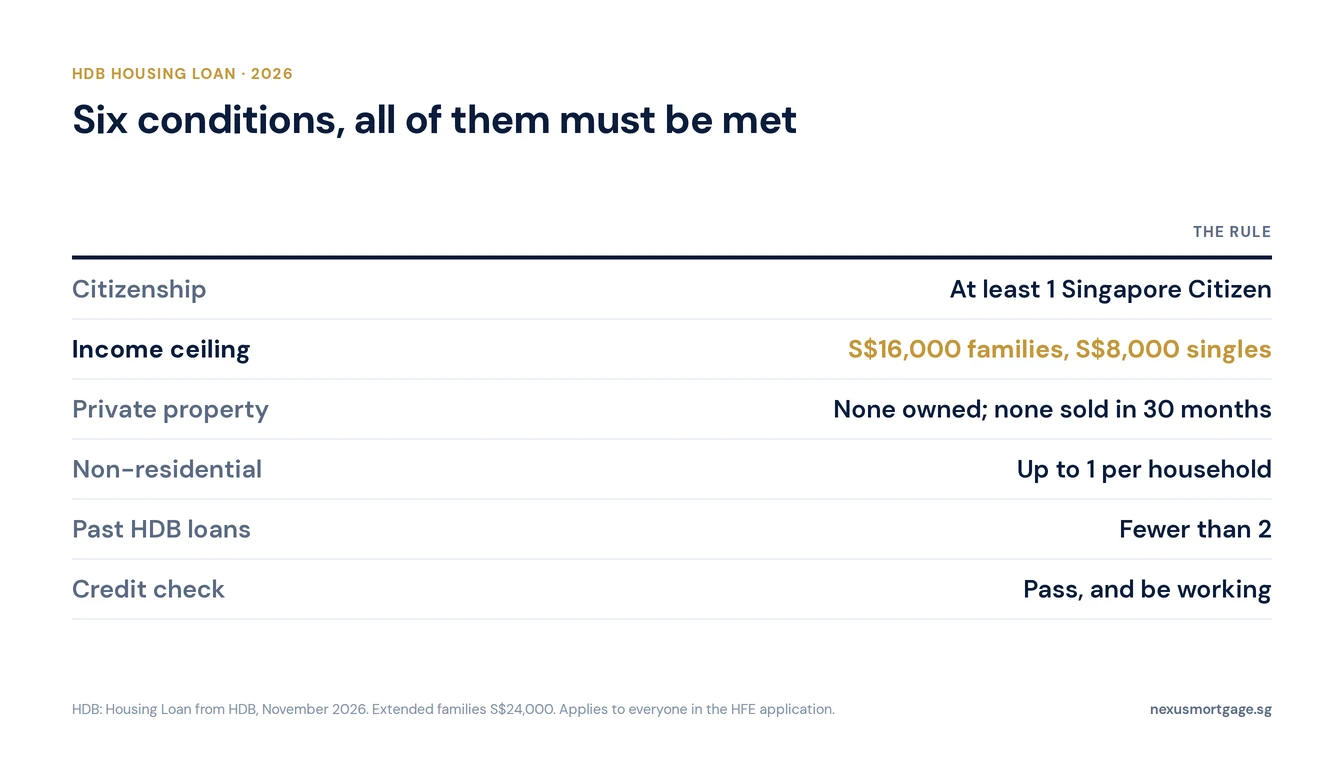
Every applicant and occupier in the HFE application is checked against all six.
| Condition | The rule |
|---|---|
| Citizenship | At least one applicant is a Singapore Citizen |
| Income | Average gross monthly household income up to S$16,000 (families), S$24,000 (extended families), S$8,000 (singles) |
| Private property | No local or overseas private residential property owned, and none disposed of in the 30 months before the HFE application |
| Non-residential property | Up to one per household; any others disposed of at least 30 months before |
| Previous HDB loans | The core family nucleus has not taken two or more HDB housing loans |
| Credit | Pass HDB's assessment, and be working at the HFE application and at disbursement |
Every person listed in the HFE application counts, applicants and occupiers alike. A parent listed as an occupier who still owns a condo can block the whole household.
Citizenship and the Flat You Are Buying
At least one applicant must be a Singapore Citizen. A Singaporean and a PR buying together qualify; two PRs do not, and need a bank loan. Our guide for PRs buying an HDB flat covers that route.
The flat matters too:
- Singles aged 35 and above can take an HDB loan for a 2-room Flexi flat on a 99-year lease from HDB, or a 5-room or smaller resale flat.
- Seniors aged 55 and above cannot take an HDB loan for a 2-room Flexi flat on a short lease.
- No HDB loan is available for short-lease 2-room Flexi flats or Community Care Apartments. Those are paid with cash and CPF.
The Income Ceiling
Your average gross monthly household income must not exceed S$16,000 for families, S$24,000 for extended families and S$8,000 for singles buying under the Single Singapore Citizen Scheme. These are the ceilings raised on 24 August 2026; before that they were S$14,000 and S$7,000. Our article on the S$16,000 ceiling explains what the change did and did not touch, including the Enhanced CPF Housing Grant ceiling, which stayed at S$9,000.
The same ceiling gates new subsidised flats and the CPF Housing Grant, so for many buyers it is the single number that decides which route they are on. Note what it does not gate: an HDB resale flat itself has no income ceiling. Above S$16,000 you can still buy resale, just with a bank loan. See buying resale above the income ceiling.
Private Property: the 30-Month Rule
This is the condition that catches the most people, because it reaches back in time and across borders. Nobody listed in the HFE application may:
- Own or have an interest in any private residential property in Singapore or overseas, completed or uncompleted. That includes an EC unit, a privatised HUDC flat, a shophouse with living quarters, and property held through a nominee or on trust.
- Have disposed of any private residential property in the 30 months before the HFE letter application, counted from the legal completion date of the sale.
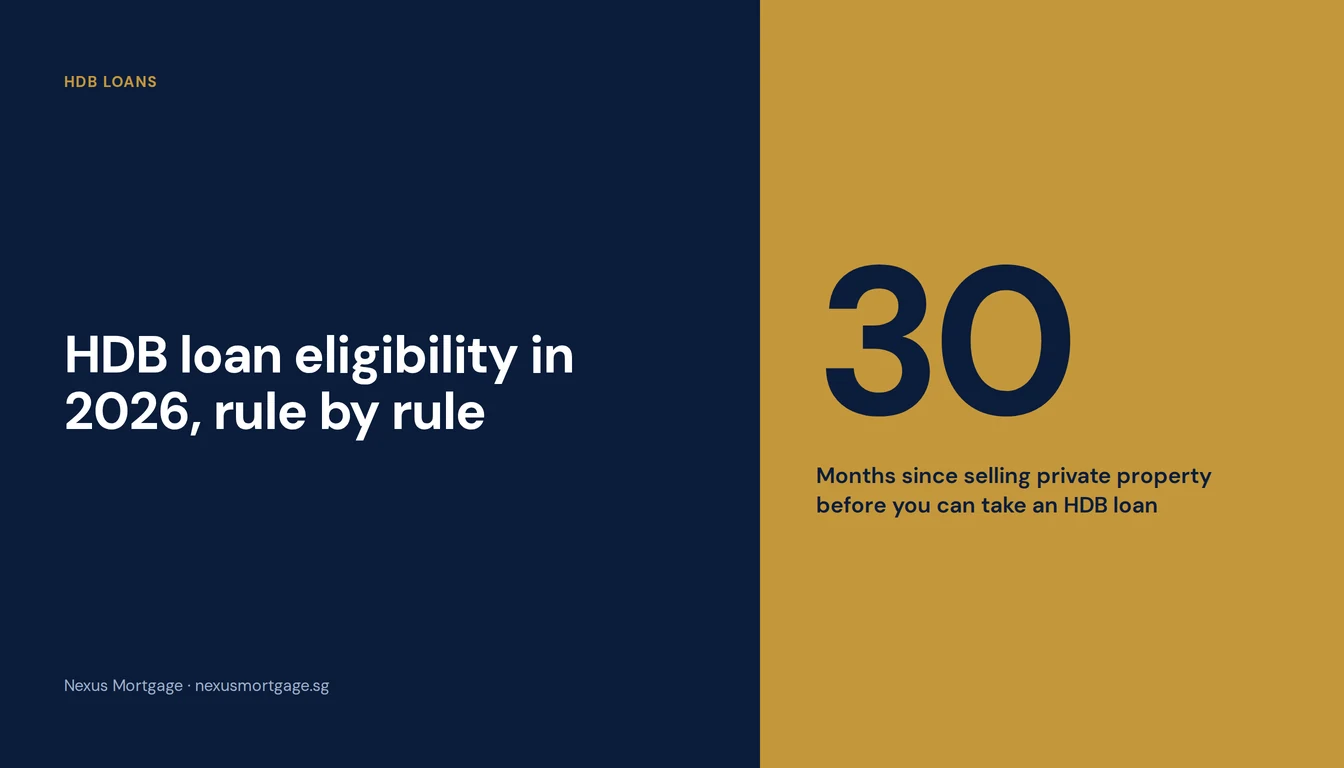
HDB gives its own example: a private property disposed of on 1 July 2024 means you can apply for an HFE letter to take an HDB loan on or after 1 January 2027. If you are selling a condo to move into an HDB flat, that 30-month wait is often the deciding factor between an HDB loan and a bank loan.
Non-residential property is treated more gently. A household may own or have an interest in up to one non-residential property, such as a shop, an office or an industrial unit, when it applies. Any others must have been disposed of at least 30 months earlier.
“The 30-month clock runs from the legal completion of the sale, not the day you sign. Count it before you list the condo, not after.”
Your Second HDB Loan
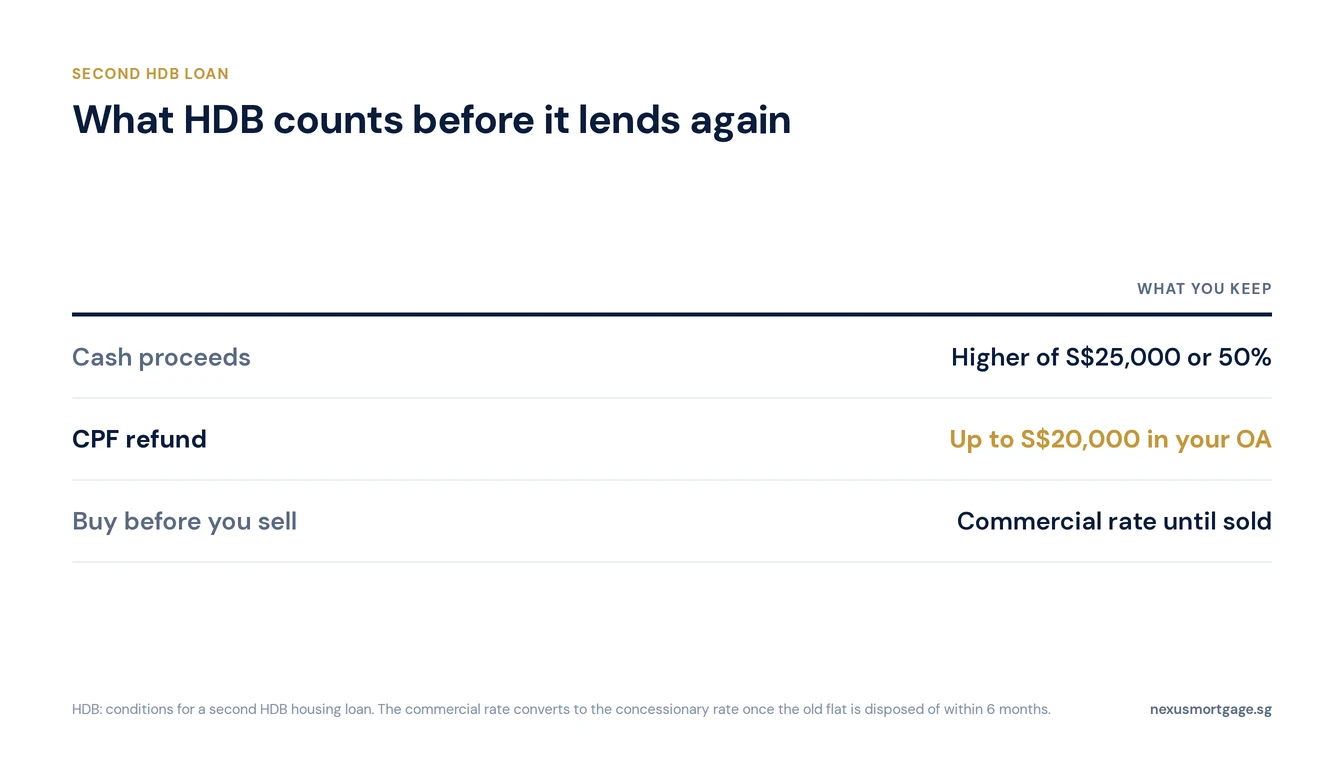
The second loan is smaller than most upgraders expect, because the last flat pays first.
The core family nucleus in the application must not have taken two or more HDB housing loans. So a household that has had one can take a second, on conditions designed to stop over-borrowing:
- Use the proceeds first. You must put the full CPF refund and part of the cash proceeds from the flat or private property you sold into the new purchase. HDB generally lets you keep the higher of S$25,000 or 50% of the cash proceeds, and up to S$20,000 in your CPF Ordinary Account.
- Buying before selling costs more. If you buy the next flat before disposing of the current one, HDB charges a commercial interest rate on the new loan. It converts to the concessionary rate once you dispose of the old flat within six months of the new purchase's legal completion and use the refund and proceeds to pay down the loan.
This is why upgraders and right-sizers often find the second HDB loan smaller than they expected: HDB counts the money from the last flat before it lends.
HDB's Credit Assessment
Meeting the conditions gets you to the door. HDB then assesses whether you can sustain the instalments, looking at your age, monthly income, job stability, existing loans and commitments such as credit cards and car loans, past repayment records and monthly cash savings. You must be working when you apply for the HFE letter and when HDB disburses the loan. For an uncompleted flat, HDB reviews your finances again nearer completion, and can reduce the loan if your position has worsened.
The amount follows from that assessment and a few fixed rules: a loan of up to 75% of the price or value, a tenure of the shortest of 25 years, 65 minus the applicants' average age, or the remaining lease minus 20 years, and an eligible amount computed at the higher of a 3% floor or the prevailing HDB rate, which is pegged at 0.1% above the CPF Ordinary Account rate. If the remaining lease will not cover the youngest buyer to age 95, the 75% is pro-rated down. The repayment itself is capped by the 30% Mortgage Servicing Ratio; see TDSR and MSR explained.
The HFE Letter
The HDB Flat Eligibility letter answers all of the above in one document: whether you can buy a new or resale flat, which CPF housing grants you get, and how much HDB will lend. Five things to know:
- Apply early. Processing takes up to a month after HDB has every document, longer in the run-up to a sales exercise.
- You need it before you commit. For a new flat, you need a valid HFE letter when you apply. For a resale flat, you need it before you take an Option to Purchase.
- It lasts 9 months. A flat application already submitted carries on even if the letter later expires.
- Request bank IPAs at the same time. The HDB Flat Portal lets you ask participating banks for an In-Principle Approval alongside the HFE application, free. That gives you HDB's number and the banks' numbers together. See how an IPA works.
- Household changes invalidate it. Adding or removing a person, a change in marital status or citizenship, or acquiring private property means cancelling and applying again. A change in income alone does not.
If You Are Not Eligible
Failing a condition closes the HDB loan, not the flat. You can finance an HDB flat with a bank loan, at bank rates and under MAS rules, which include a minimum 5% cash downpayment and the 4% stress test. For many households a bank package is cheaper than HDB's 2.6% anyway; the trade-offs are in our HDB loan vs bank loan comparison. And the door only swings one way: you can refinance an HDB loan to a bank later, but never back. See switching an HDB loan to a bank loan.
If you are unsure which side of a rule you fall on, tell us your situation. We check eligibility and run bank IPAs alongside your HFE letter at no cost to you.
This article is general information for Singapore flat buyers. It is not financial or legal advice and not an offer of credit. Eligibility conditions, income ceilings, the 30-month rule, second-loan conditions and HFE letter details are as published by HDB and current as at 14 November 2026; HDB assesses every application on its own facts and prevailing policy. Confirm your eligibility through the HFE letter. Sources: HDB: Housing Loan from HDB, HDB: Application for an HFE Letter, MAS Notice 632 (Residential Property Loans).

About the author — Dan Ler has advised on Singapore home loans since 2017 at Nexus Mortgage SG, an independent brokerage comparing 16+ MAS-regulated lenders. Nexus has facilitated 500+ home loans across HDB, EC, private condo and landed property segments. Banks pay Nexus on disbursement, so there is no cost to the borrower.