Refinancing Your HDB Loan to a Bank Loan in 2026: Is Leaving the 2.6% Worth It?

The HDB concessionary loan charges 2.6%. In 2026, bank packages are near 1.4% fixed (around 1.3% on SORA). That's the widest gap in years, which is why so many owners are switching. On a typical balance you're looking at roughly S$170–S$280 less a month, more on bigger loans. The thing to know before you do it: this is a one-way move. You cannot go back to the HDB loan. So you're trading the rock-stable 2.6% for a lower rate you have to keep low yourself by refinancing every couple of years. Worth it on larger loans. Often not worth it on a small balance near the end of its tenure.
The HDB loan gives you certainty. It sits at 2.6%, barely moves, and you never have to think about it. A bank loan gives you a lower rate you have to manage. It's cheaper now, but it resets, and you can't go back to HDB once you leave. Which one suits you comes down to your loan size, how long you'll keep the flat, and whether you'll actually re-shop your rate every two years.
Why 2026 Changed the Math
For most of the last decade, the HDB concessionary loan was the easy choice. It charges 2.6%, fixed for life, with no refinancing to think about. It's pegged at 0.1% above the CPF Ordinary Account rate (2.5%), so it barely moves. It has sat at 2.6% for years and stays 2.6% through 2026.
What changed is the other side. Through 2025, interest rates fell hard. 3-month Compounded SORA dropped from above 3% to around 1.07% by mid-2026, and banks now offer fixed packages from about 1.40%. For the first time in years, a bank loan is a full percentage point cheaper than the HDB rate. That gap is wide enough that HDB owners are reviewing their loans in real numbers and finding offers well below 2.6%.
So the question isn't "is a bank loan cheaper?" anymore. In 2026 it clearly is. What actually matters is whether the saving on your loan is big enough to give up what the HDB loan gives you.
The Numbers: What You'd Actually Save
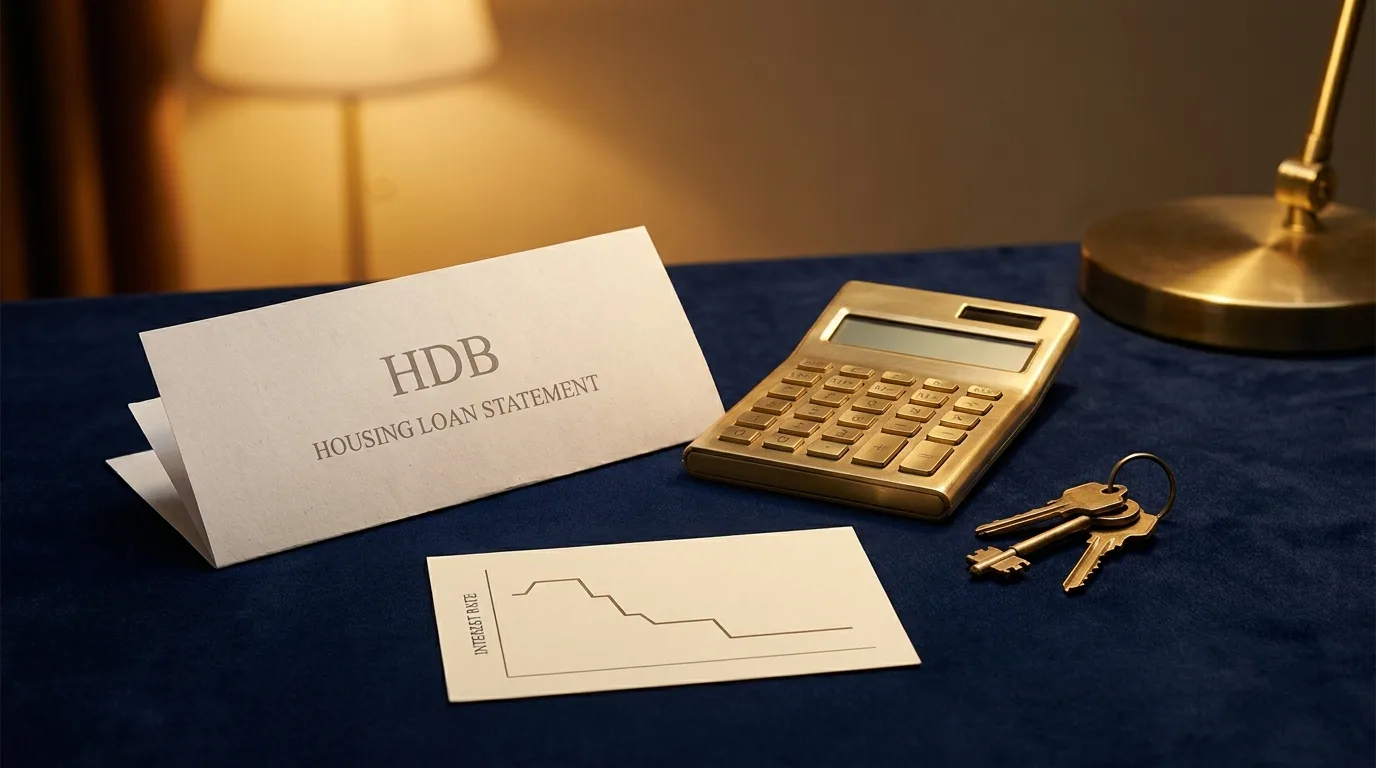
The saving scales with your outstanding loan. The bigger the balance, the more a 1%+ rate cut is worth.
Here's the monthly repayment on a 20-year remaining tenure, comparing the HDB 2.6% against a bank 1.40%, at three common outstanding balances.
| Outstanding loan | At 2.6% (HDB) | At 1.40% (bank) | You save / month |
|---|---|---|---|
| S$300,000 | ~S$1,604 | ~S$1,434 | ~S$170 |
| S$400,000 | ~S$2,139 | ~S$1,912 | ~S$227 |
| S$500,000 | ~S$2,673 | ~S$2,390 | ~S$283 |
The monthly figure is the cashflow saving. In interest terms the gap is bigger. At the lower rate you pay roughly 1.2% of your balance less in the first year: about S$3,600 on a S$300k loan, S$4,800 on S$400k, S$6,000 on S$500k. The monthly saving looks smaller than that because the cheaper loan also sends more of each payment to principal. So you pay less and build equity faster.
The One-Way Catch: No Going Back to HDB
This is the part that matters most, and the part owners most often miss. Once you switch from the HDB concessionary loan to a bank loan, you can't switch back. HDB will not let you refinance a bank loan into an HDB concessionary loan on the same flat. Leave 2.6% and it's gone for good on that property.
Here's why that's a real consideration. The HDB rate is stable and rarely changes. A bank rate is cheaper today, but it resets at the end of each lock-in, usually every two years. If rates climbed back above 2.6% in a few years, someone on the HDB loan just keeps paying 2.6%. You, on a bank loan, would have to refinance again to a new package or risk paying more. You're swapping a guaranteed ceiling for a lower floating cost that you have to keep managing.
That isn't a reason to stay. In 2026 the saving is real and rates are widely expected to stay low. But it is the reason to only switch when the numbers clearly justify giving up that certainty.
2.6% Stability vs Bank Savings
Side by side, what you keep and what you give up:
| HDB loan (2.6%) | Bank loan (~1.4%) | |
|---|---|---|
| Rate | 2.6%, pegged to CPF OA, barely moves | ~1.3–1.9%, resets every 2–3 yrs |
| Stability | Very high — set and forget | You must reprice/refinance at lock-in expiry |
| Switch back | — | Cannot return to the HDB loan |
| Cost to switch | None — no penalty to leave | Legal + valuation ~S$2,000–3,000 (often subsidised on larger loans) |
| Effort | None | Re-shop every couple of years to stay low |
| Best for | Small/short loans, peace of mind | Larger loans, hands-on owners |
One practical point worth repeating: there's no penalty to leave the HDB loan, because it has no lock-in. The only costs are on the bank side (legal and valuation), and many banks subsidise those once the loan is large enough. So the decision really comes down to loan size versus switching cost, plus how much you want to manage a bank rate over time.
Does TDSR or MSR Apply?
A common worry I hear is "my income changed since I bought, will I even qualify?" For most owners refinancing their own home, the answer is reassuring. The usual limits don't gate you.
Refinancing an owner-occupied home is exempt from the 55% Total Debt Servicing Ratio cap. The 30% Mortgage Servicing Ratio is a purchase-time rule for HDB flats and ECs, and it doesn't gate a refinance either. So even if your income has dipped or you've taken on a car loan since you bought, you can usually still refinance. The bank will ask for income documents and run its own credit check, but that internal check is not the regulatory TDSR/MSR test.
Two things would bring the limits back. Taking cash out on top of the refinance (the cash-out portion is assessed), or the flat not being owner-occupied. For a straightforward "lower my rate" refinance of the home you live in, neither applies. That's why these refinances usually go far smoother than the original purchase did.
How to Switch, Step by Step
No penalty to leave the HDB loan, and owner-occupied refinancing isn't gated by TDSR/MSR, so the switch is usually straightforward.
It's a real transaction. A new bank loan redeems your HDB loan. But it's routine when you sequence it right:
- 1Pull your numbers: outstanding balance, remaining tenure, and current flat valuation. These decide whether the saving beats the switching cost.
- 2Compare the market net of cost. Check fixed against SORA packages across the banks, and confirm the legal and valuation cost (and whether the bank subsidises it) still leaves you clearly ahead. Run the refinance savings calculator first.
- 3Apply. There's no TDSR/MSR gate for an owner-occupier, so you're exempt from the ratios. The bank verifies income for its own files and issues a letter of offer.
- 4Your lawyer handles the rest. Conveyancing redeems the HDB loan and registers the new bank mortgage. HDB charges nothing to leave. Plan for a few weeks.
- 5Remember it's permanent. You're on a bank rate for good now, so diarise your lock-in expiry, re-shop when it comes up, and never drift onto a high reset rate.
When It's Worth It, and When to Stay
Switch to a bank loan when
- Your outstanding loan is large, roughly S$250,000 or more, so the 1.2% or so saving clearly beats the legal and valuation cost (and you'll likely get it subsidised).
- You have a good stretch of tenure left, so the saving compounds over years rather than months.
- You're happy to re-shop your rate every couple of years to keep it low.
- You want the cash saving more than the set-and-forget certainty.
Stay on the 2.6% HDB loan when
- Your balance is small or the tenure is short, so the legal and valuation fees eat most of the saving.
- You value certainty over admin and don't want to track lock-ins and refinance every two years.
- You may sell soon, say you're just past MOP and weighing an upgrade, in which case you'd redeem the loan anyway.
- You want the biggest possible CPF and cash buffer, plus the simplicity the HDB loan gives.
If you're buying rather than refinancing, the decision works differently. See HDB loan vs bank loan for new buyers. And for a worked private-property example of how a refinance actually plays out, read our refinancing case study.
Frequently Asked Questions
No. It's a one-way move. HDB does not allow you to refinance a bank loan back into an HDB concessionary loan for the same flat. You keep the lower bank rate, but you give up the option of returning to the stable 2.6% if rates rise later — the single most important thing to weigh before switching.
It scales with your loan. On a 20-year tenure, moving from 2.6% to about 1.4% cuts the monthly repayment by roughly S$170 on a S$300,000 balance, S$227 on S$400,000 and S$283 on S$500,000 — and in interest terms about 1.2% of your balance in the first year (around S$3,600 to S$6,000). The bigger the loan, the more it's worth.
Refinancing an owner-occupied home is exempt from the 55% TDSR cap, and the 30% MSR is a purchase-time rule that doesn't gate a refinance. So you can usually refinance even if your income has changed. The bank still asks for income documents and runs its own credit check, but that's not the regulatory test. Exceptions: taking cash out, or a non-owner-occupied flat.
No. The HDB concessionary loan has no lock-in and no early redemption penalty, so there's no cost to exit. The costs are on the bank side — legal and valuation, roughly S$2,000–3,000, often subsidised on larger loans. Your new bank package then has its own lock-in (usually two years) going forward.
Stay when your balance is small or you have few years left (fees eat the saving), when you value the stable 2.6% over managing refinancing, or when you plan to sell soon. The HDB rate is pegged at 0.1% above the CPF OA rate and changes rarely; a bank loan is cheaper now but resets every two to three years and must be actively kept low.
In 2026 they're well below it — fixed from around 1.4%, SORA near 1.3%. Most forecasts expect rates to stay low through 2026, but nobody can guarantee the future, and bank rates reset at each lock-in. The 2.6% is the certainty you trade away; the saving is real now but must be re-secured every couple of years.
Practically yes — most banks have a minimum loan for their refinancing packages and legal subsidies, commonly around S$200,000–300,000. Below that, the legal and valuation cost can outweigh the interest saved, so refinancing a small remaining HDB loan often isn't worth it. We model the net saving before you commit.
Still on the 2.6% HDB Loan? See What Switching Would Save.
Nexus Mortgage SG models the real net saving on your exact balance — the lower bank rate against the legal/valuation cost — and tells you straight whether it's worth leaving 2.6% or staying put. Independent, and at no cost to you.
Start My Free Report →Want a quick read on your numbers? WhatsApp Dan Ler at +65 8752 0859 for a free, no-obligation HDB refinancing review. Banks pay our fee — you pay nothing.
Run it yourself: refinance savings calculator · current rates.

About the author — Dan Ler has advised on Singapore home loans since 2017 at Nexus Mortgage SG, an independent brokerage comparing 16+ MAS-regulated lenders. He helps HDB owners weigh the 2.6% concessionary loan against current bank packages — net of cost, and honest about when staying put is the better call. Banks pay Nexus on disbursement, so there is no cost to the borrower.
Further reading
- HDB loan vs bank loan — the LTV, tenure and rate trade-offs between the two
- When to refinance your home loan — lock-in expiry, notice periods and the break-cost math
- Repricing vs refinancing — staying with your bank versus moving, and when each one wins
- How much CPF OA you can use for housing — Valuation Limit, the 120% Withdrawal Limit and the BRS set-aside after 55
- Compare current mortgage rates — live fixed and floating packages across 16 banks
Nexus Mortgage SG is an independent Singapore mortgage advisory. This article is general information, not financial advice. Monthly repayments are computed on the stated balances over a 20-year tenure at 2.6% and 1.40% and assume the rate holds; your actual figures depend on your balance, tenure, package terms and future rate resets. The HDB concessionary rate (2.6%, pegged 0.1% above the CPF Ordinary Account rate) and TDSR/MSR rules are set by HDB, CPF and MAS and can change. Switching from an HDB loan to a bank loan cannot be reversed — always confirm your eligibility and current packages before acting. Sources: HDB loan interest rate, CPF: HDB vs bank loan, MAS TDSR.