Flat Rate vs EIR: What a Personal Loan Really Costs
Most personal loans in Singapore are priced at a flat rate: interest is charged on the full amount you borrowed, for the whole tenure, even as you pay it down. That makes the true annual cost, the Effective Interest Rate (EIR), a little under double the advertised rate. A 3% flat-rate loan costs around 5.6% a year. Add a 1% processing fee and a one-year loan climbs to about 7.4%. Compare every offer on EIR, prefer the shortest tenure you can afford, and read the early repayment terms before you sign.
How a Flat Rate Works
With a flat rate, the interest is worked out once, on the original loan amount, and spread evenly across the tenure. MoneySense puts it plainly: interest payments are calculated on the original loan amount, and the monthly interest stays the same throughout, even though the outstanding loan reduces over time.
That is different from how a home loan works. A home loan is priced on monthly rest: each month's interest is charged only on what you still owe, so the interest portion shrinks as you repay. On a monthly-rest loan, the advertised rate and the EIR are the same thing. On a flat-rate loan, they are not.
What EIR Measures
The Effective Interest Rate is the rate that, charged on the balance you actually owe each month, would produce the same repayments. It is the only number that lets you compare a flat-rate personal loan against a reducing-balance loan, a credit line, or another bank's offer on equal terms. The higher the EIR, the more you pay.
Payment frequency matters too. MoneySense's own example: borrow S$1,000 and pay S$200 of interest over a year. Repay it all at the end of the year and the EIR is 20%. Repay it in monthly instalments and the EIR is 41.3%, because you have had the use of less and less of the money as the year went on, while paying the same S$200.
The Worked Example
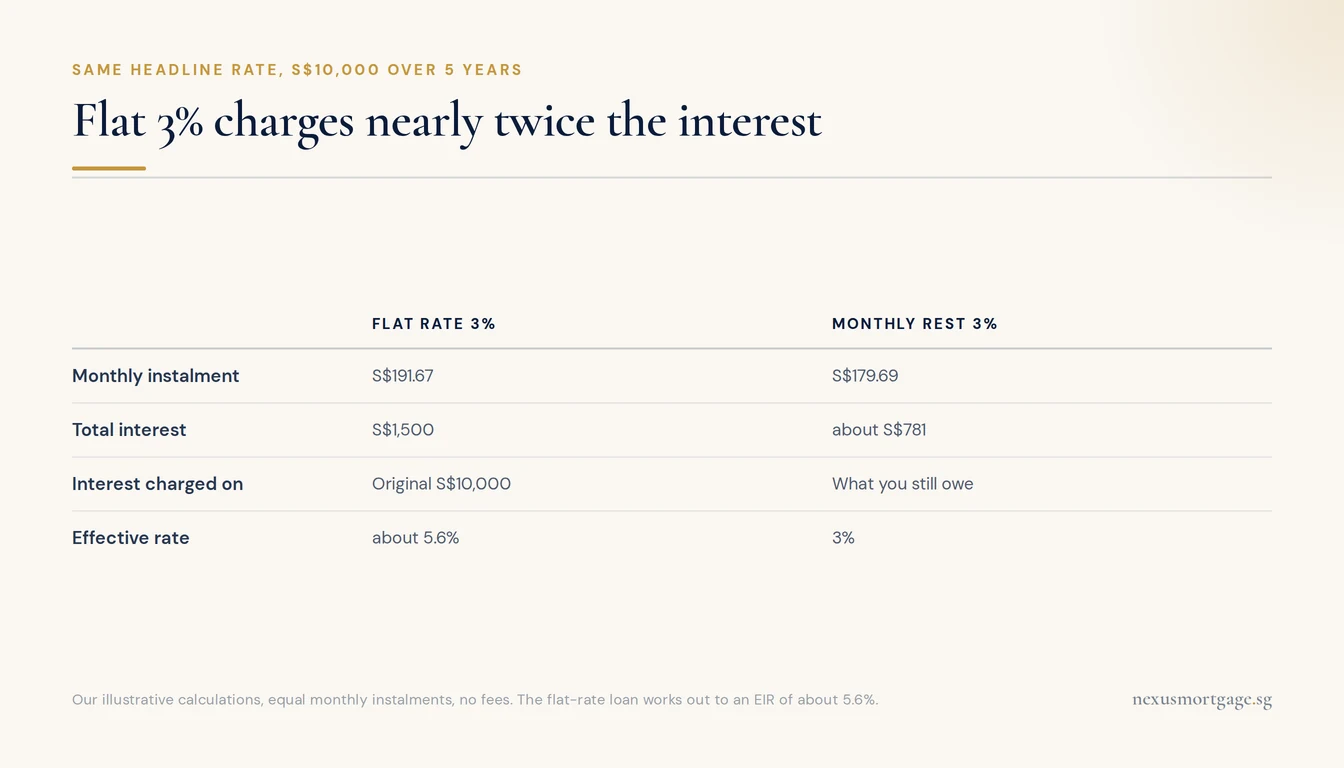
The advertised number is the same. The cost is not.
Take S$10,000 at an advertised 3% flat, no fees.
| Tenure | Monthly instalment | Total interest | Approx. EIR |
|---|---|---|---|
| 1 year | S$858.33 | S$300 | 5.5% |
| 3 years | S$302.78 | S$900 | 5.7% |
| 5 years | S$191.67 | S$1,500 | 5.6% |
Now compare a genuine 3% loan on monthly rest over the same five years: S$179.69 a month and about S$781 of interest. The flat-rate loan charges nearly twice as much interest for the same headline number.
A useful rule of thumb: on a flat-rate loan, the EIR is a little under double the flat rate. In our calculations, 1.5% flat works out to about 2.8% to 2.9%, 2% flat to about 3.7% to 3.8%, and 4% flat to about 7.3% to 7.5%, depending on tenure.
Fees Hit Short Loans Hardest
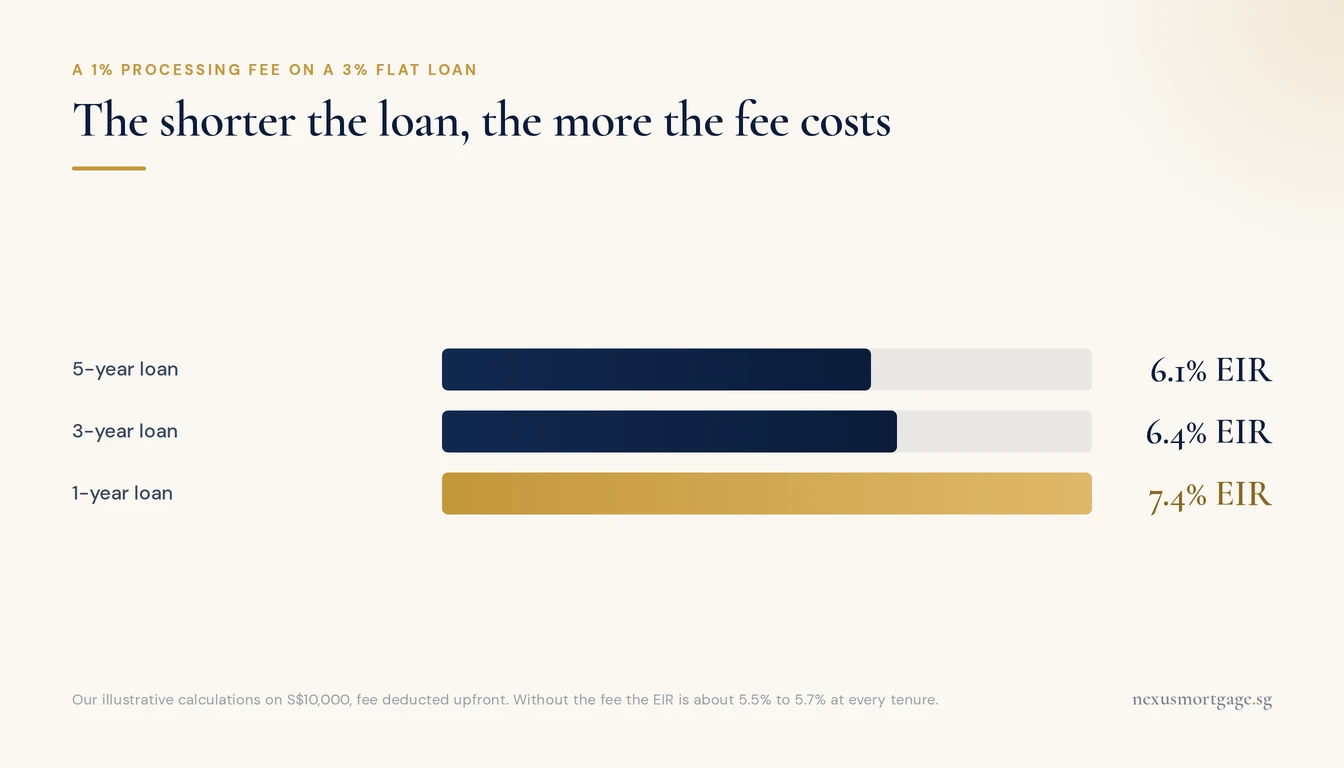
A fee waiver is worth most on a short loan.
A processing fee is usually deducted upfront, so you receive less than you borrowed but repay the full amount. That raises the EIR, and the effect is concentrated in short loans because the fee is spread over fewer months.
| 3% flat, S$10,000 | No fee | 1% fee | 2% fee |
|---|---|---|---|
| 1 year | 5.5% | 7.4% | 9.3% |
| 3 years | 5.7% | 6.4% | 7.0% |
| 5 years | 5.6% | 6.1% | 6.5% |
The practical reading: a fee waiver is worth most on a short loan. If you are borrowing for twelve months, a 1% fee costs you almost two points of EIR. Over five years, it costs about half a point.
Longer Is Not Cheaper
Lower monthly instalments feel cheaper. On a flat-rate loan they are not. Because interest is charged on the full original amount for every year, total interest rises in straight proportion to the tenure: S$300 over one year, S$900 over three, S$1,500 over five on our S$10,000 example.
So pick the shortest tenure whose instalment you can comfortably carry, with room left for a bad month. And bear in mind that a longer tenure keeps the instalment on your record for longer. If you plan to apply for a home loan, every month of personal loan repayment still running at that point counts against you under TDSR. Our guide to how much you can borrow on a personal loan shows how large that effect is.
Four Numbers to Compare
Adverts lead with the lowest flat rate a lender offers, often for a specific tenure, loan size and applicant profile, and sometimes with conditions such as applying online or a minimum amount. Before you accept any offer, get these four numbers in writing:
- The EIR for your actual amount and tenure, and what fees it includes.
- The processing fee, and whether it is deducted from what you receive.
- The early repayment terms: the fee for settling early, and how much of the remaining interest is actually waived when you do.
- The late payment charges, and how interest applies to a missed instalment.
Promotional cashback can be real value, but only compare it after you have compared EIR. A cashback worth S$100 does not make up for an EIR two points higher on a S$20,000 loan.
Frequently Asked Questions
A flat rate charges interest on the original loan amount for the whole tenure. The EIR expresses the true annual cost on the balance you actually owe, and can include fees. On a flat-rate loan the EIR is always higher, typically a little under double.
Around 5.5% to 5.7% a year before fees. S$10,000 at 3% flat over five years costs S$1,500 of interest, against about S$781 for a true 3% loan on the reducing balance.
It raises it, most on short loans. A 1% fee lifts a 3% flat loan from about 5.6% to about 6.1% over five years, but from about 5.5% to about 7.4% over one year.
No. Total interest on a flat-rate loan rises in proportion to the tenure: S$300, S$900 and S$1,500 over one, three and five years on S$10,000 at 3% flat.
Lenders can use slightly different conventions and fee inclusions. The differences are usually small. Compare every offer on the EIR each lender discloses.
The processing fee, the late payment charges and the early repayment terms, including how much remaining interest is waived if you settle early.
Further reading
- How much can you borrow on a personal loan?: the MAS limits per bank and across all banks
- TDSR and MSR explained: how a personal loan instalment shrinks your home loan
- Fixed vs floating home loans: how monthly-rest pricing works on a mortgage
This article is general information about how personal loan pricing works in Singapore. It is not financial advice, and it is not an offer of credit. Nexus Mortgage does not provide personal loans; we advise on home and property financing. All figures are our own illustrative calculations on a S$10,000 loan with equal monthly instalments, with the annual rate taken as twelve times the monthly rate; fees are assumed to be deducted upfront. Lenders' disclosed EIRs may differ slightly by convention. We do not quote any lender's current rates, which change frequently; compare the EIR each lender discloses for your own amount and tenure. Sources: MoneySense: Flat rate, monthly rest and EIR.

About the author — Dan Ler has advised on Singapore home loans since 2017 at Nexus Mortgage SG, an independent brokerage comparing 16+ MAS-regulated lenders. Nexus has facilitated 500+ home loans across HDB, EC, private condo and landed property segments. Banks pay Nexus on disbursement, so there is no cost to the borrower.