Personal Loan Interest Rates in Singapore: Bank by Bank, With the Real Cost
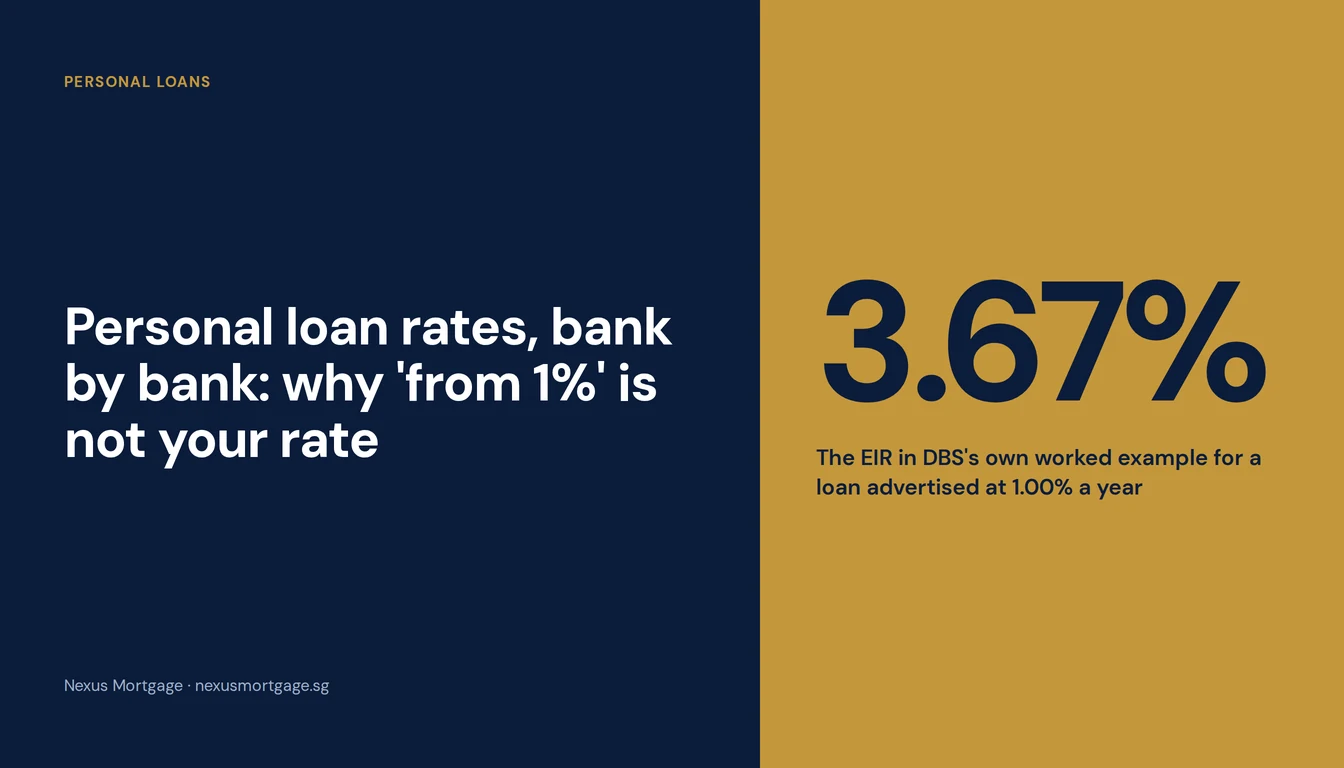
As at 14 November 2026, the main banks advertised personal loans from 0.90% to 1.98% a year flat, which is an EIR from about 1.75% to 4.19%. Those are best-case rates. Your offer depends on your income and credit, and fees change the real cost: DBS's own example, S$10,000 over 12 months at 1.00% plus a 1% fee, is an EIR of 3.67%. Always compare on the EIR including fees, and if you plan to buy or refinance a home soon, remember the instalment cuts your home loan by far more than it costs.
Nexus does not lend personal loans. We write about them because they keep turning up in our clients' home loan applications, usually at the worst moment. This is the comparison we would want before taking one.
Advertised Rates, Bank by Bank
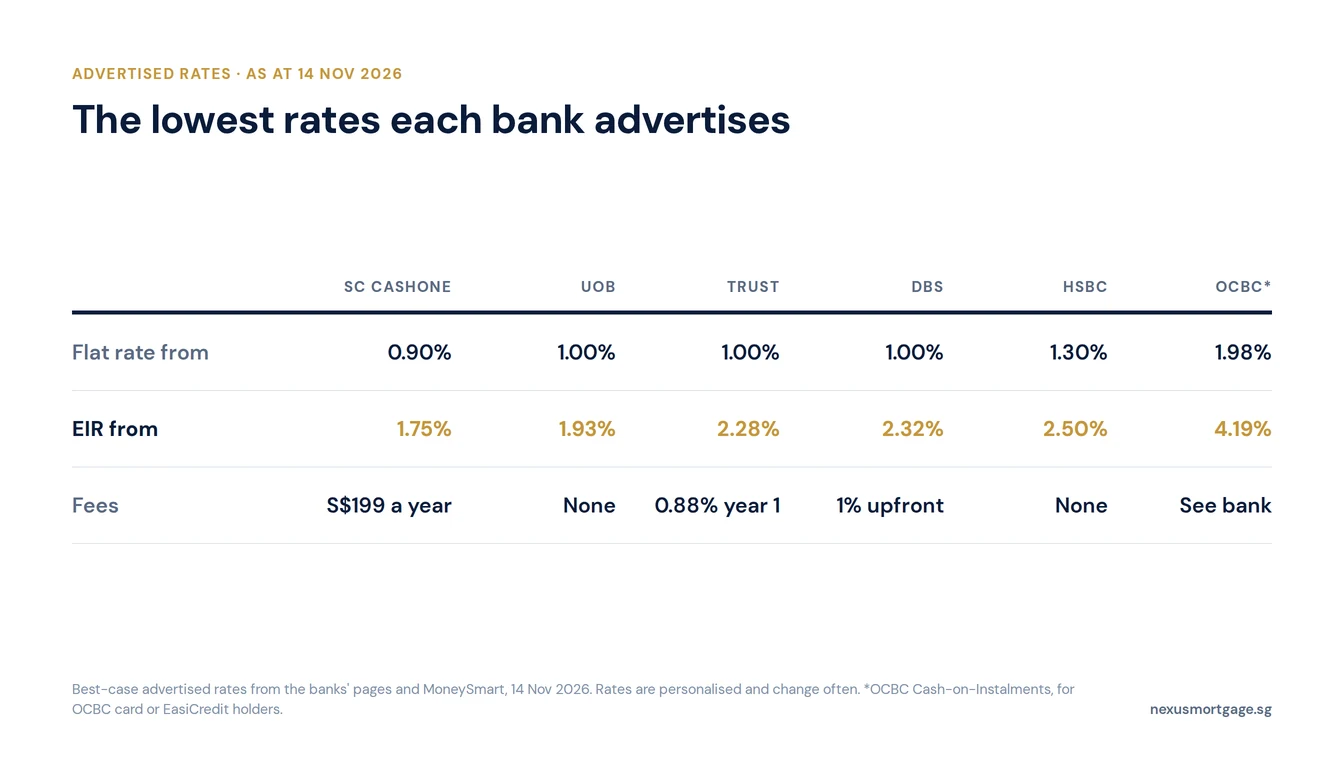
These are floors. The rate you are offered depends on your income and credit.
The lowest rates each bank advertised as at 14 November 2026. Rates and promotions change often, so check the bank before you apply.
| Bank | Flat rate from | EIR from | Fee noted |
|---|---|---|---|
| Standard Chartered CashOne | 0.90% p.a. | 1.75% p.a. | S$199 annual fee (EIR 2.15% with it, on S$20,000 over 5 years) |
| UOB Personal Loan | 1.00% p.a. | 1.93% p.a. | No processing fee (per MoneySmart) |
| Trust Instant Loan | 1.00% p.a. | 2.28% p.a. | EIR includes a 0.88% first-year annual fee |
| DBS / POSB Personal Loan | 1.00% p.a. | 2.32% p.a. | 1% processing fee; S$250 early termination |
| HSBC Personal Loan | 1.30% p.a. | 2.50% p.a. | Promotional rate; zero processing fee |
| OCBC Cash-on-Instalments | 1.98% p.a. | 4.19% p.a. | OCBC credit card or EasiCredit holders only |
OCBC's term loan for customers without an OCBC card, the ExtraCash Loan, is priced much higher. OCBC's own illustration for S$10,000 over 12 months is 10.08% a year on a monthly rest basis (5.54% flat equivalent), with a processing fee of S$200 or 2%, whichever is higher: an EIR of 13.92%.
The spread between the cheapest and dearest is wide, and even a percentage point of EIR adds up over a three or five year loan. But the bigger gap is usually between the advertised rate and the one you are actually offered.
Why “From” Is Not Your Rate
Every rate in that table is a “from” rate: the lowest the bank offers, to its strongest applicants. Banks personalise the rate on your income, your credit report, your existing borrowing and often whether you already bank with them.
DBS shows the gap in its own worked example: a S$10,000 loan over 12 months at 1.00% plus a 1% processing fee is an EIR of 3.67%, against the headline EIR of 2.32% for the same rate and fee. A smaller loan, a shorter tenure and a fixed fee all push the effective rate up.
There are also hard limits on how much each bank can lend you, set by MAS on your income: 2 months' income if you earn S$20,000 to below S$30,000 a year, 4 months' from S$30,000 to below S$120,000. Our personal loan limits guide covers them in full.
What S$30,000 Really Costs
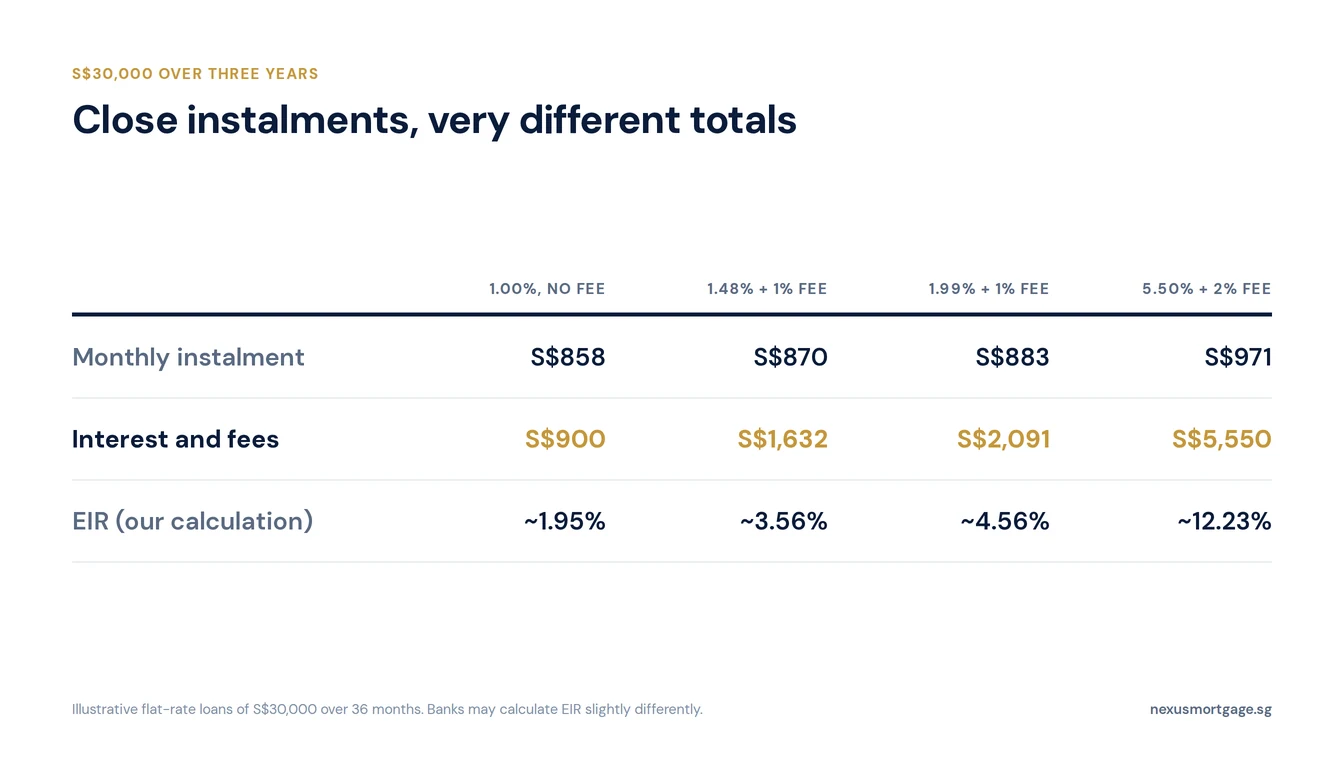
Compare on the total cost and the EIR, not the monthly instalment.
Personal loans charge a flat rate on the full original amount for the whole tenure, even though you are repaying every month, so the effective rate is roughly double. We explain why in our flat rate vs EIR guide. On S$30,000 over three years:
| Flat rate and fee | Monthly instalment | Total interest and fees | EIR (our calculation) |
|---|---|---|---|
| 1.00%, no fee | S$858 | S$900 | about 1.95% |
| 1.48% + 1% fee | S$870 | S$1,632 | about 3.56% |
| 1.99% + 1% fee | S$883 | S$2,091 | about 4.56% |
| 5.50% + 2% fee | S$971 | S$5,550 | about 12.23% |
The instalments look close together, which is why borrowers tend to pick on the monthly figure. The total cost is where the difference shows: over six times as much between the cheapest and the dearest row.
The Fees That Change the Answer
- Processing fees, usually a percentage of the loan taken off what you receive. You pay interest on money you never got, which is why a fee lifts the EIR.
- Annual fees on some products, such as the S$199 on Standard Chartered CashOne or Trust's 0.88% first-year fee.
- Early termination fees if you repay ahead of schedule, for example S$250 on a DBS personal loan. Check this if you might clear the loan early with a bonus or a property sale.
- Late payment charges, plus the knock-on damage to your credit report.
A bank's EIR already includes its standard fees, which is why it is the number to compare. Cash rewards and promotions do not change the EIR; weigh them separately, and only if the loan was the right one anyway.
What It Does to Your Home Loan
This is the part most comparison tables leave out. A personal loan instalment counts against your 55% TDSR, and home loans are sized at a stress-test rate, so each dollar of instalment removes far more than a dollar of home loan. A S$500 monthly instalment removes about S$94,700 of home loan capacity at 4% over 25 years, assuming it is your only other debt.
“If a property purchase or refinance is coming in the next year or two, the cheapest personal loan is often the one you clear before you apply.”
If your unsecured debt has already built up across several cards and loans, our debt consolidation guide covers the options, including the banks' Debt Consolidation Plan.
How to Compare
- Compare the EIR, not the flat rate, for the amount and tenure you actually want.
- Check your own rate in each bank's app or with a quote; the advertised rate is the floor.
- Read the fee schedule, especially the early termination fee.
- Borrow only what you need, for the shortest tenure you can afford.
- Think about your next home loan before you sign, not after.
Nexus does not provide personal loans. For personal loan comparisons we work with our partner BizSaver, a loan comparison platform that says it works with more than 60 banks and loan providers in Singapore. If you are weighing a personal loan against a home purchase or refinance, WhatsApp us and we will look at both together.
Frequently Asked Questions
As at 14 November 2026, Standard Chartered CashOne at 0.90% a year flat (EIR from 1.75%), then UOB, Trust and DBS at 1.00%, HSBC at 1.30% and OCBC (card holders) at 1.98%. These are best-case rates; yours depends on your profile.
The flat rate is charged on the original loan for the whole tenure. The EIR is the true annual cost on the balance you owe, including fees, and is roughly double. Compare on the EIR.
Advertised rates are for the strongest applicants. DBS's own example, S$10,000 over 12 months at 1.00% plus a 1% fee, is an EIR of 3.67%, against its headline EIR of 2.32%.
Processing fees, annual fees on some products, early termination fees (S$250 at DBS) and late payment charges. Standard Chartered CashOne has a S$199 annual fee.
Up to 2 months' income per bank if you earn S$20,000 to below S$30,000 a year, or 4 months' from S$30,000 to below S$120,000, with no MAS cap from S$120,000. Unsecured interest-bearing debt across all banks and card issuers should stay under 12 times monthly income.
Yes. A S$500 monthly instalment removes about S$94,700 of home loan capacity at 4% over 25 years, assuming it is your only other debt.
Further reading
- How much can you borrow on a personal loan: the MAS income limits
- Flat rate vs EIR: why the real rate is nearly double
- Debt Consolidation Plan: when unsecured debt has built up
- TDSR and MSR: how every monthly debt caps your home loan
- SME business loans: if the money is really for your business
This article is general information on personal loans in Singapore. It is not financial advice and not an offer of credit. Nexus Mortgage does not provide personal loans; BizSaver is a Nexus partner and Nexus may benefit from that relationship. Advertised rates are the lowest each bank published as at 14 November 2026, from the banks' own pages and MoneySmart's comparison, rechecked 14 November 2026; rates are personalised and change often, so confirm with the bank. The S$30,000 table is our own illustrative calculation over 36 months; banks' published EIRs may use slightly different methods. The home loan figure assumes a 4% stress rate over 25 years and no other debt. Current as at November 2026. Sources: Standard Chartered CashOne, DBS Personal Loan, OCBC personal loans, MoneySmart personal loan comparison.

About the author — Dan Ler has advised on Singapore home loans since 2017 at Nexus Mortgage SG, an independent brokerage comparing 16+ MAS-regulated lenders. Nexus has facilitated 500+ home loans across HDB, EC, private condo and landed property segments. Banks pay Nexus on disbursement, so there is no cost to the borrower.