SIBOR Rate Singapore: The Benchmark No Longer Exists
SIBOR no longer exists. It was last published on 31 December 2024 and discontinued immediately after. SOR, the older Swap Offer Rate, ended earlier on 30 June 2023. Both were replaced by Compounded SORA. If you had a SIBOR-pegged mortgage, your bank converted it, automatically in June 2024 if you did not switch yourself. An industry adjustment spread was applied so the change was broadly value-neutral at that moment. The number to look up now is 3M Compounded SORA.
SIBOR Is Gone: The Dates That Matter
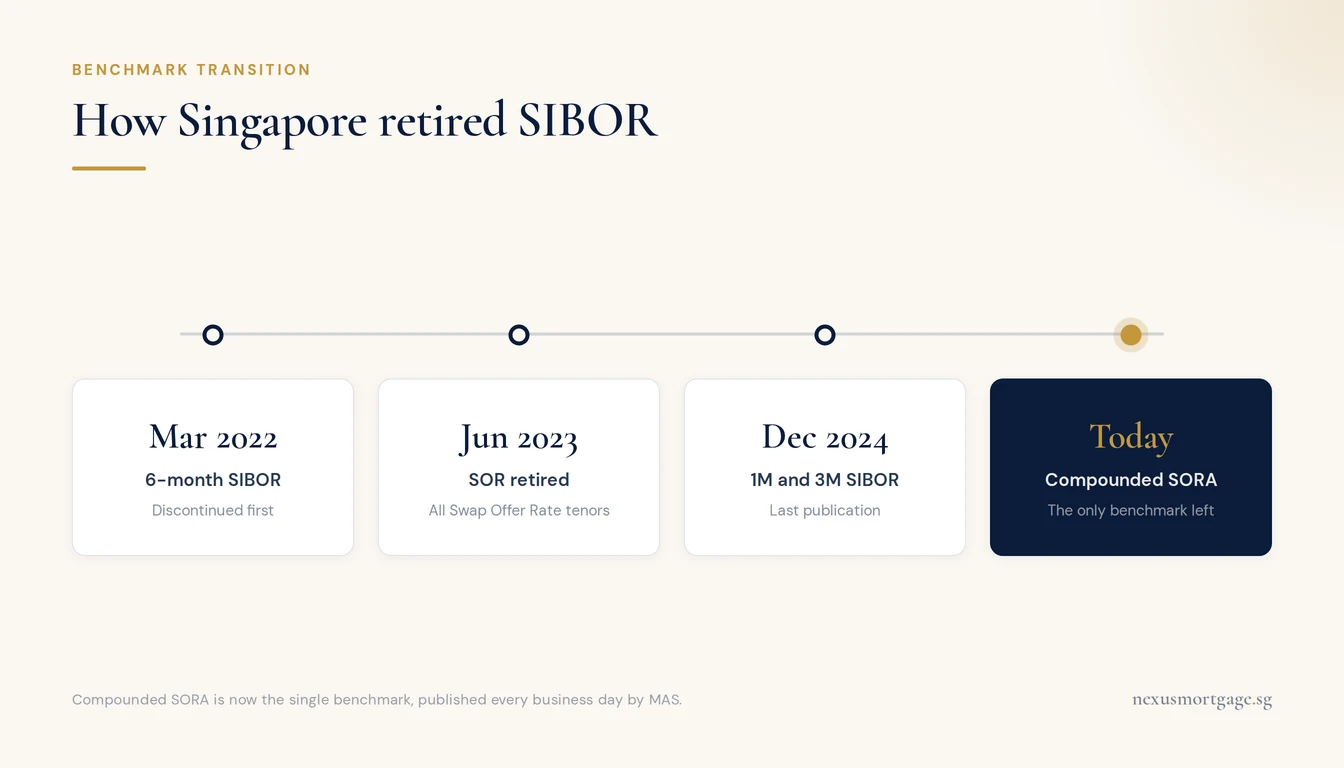
Every SIBOR tenor is now retired. Nothing is left to convert.
If you have landed here searching for “SIBOR rate today” or “3 month SIBOR rate”, the short version is that there is nothing to look up. The benchmark was retired, and no current figure is published for any tenor.
| Benchmark | Status | Final date |
|---|---|---|
| 6-month SIBOR | Discontinued | 31 March 2022 |
| SOR (Swap Offer Rate), all tenors | Discontinued | After 30 June 2023 |
| 1-month and 3-month SIBOR | Discontinued | Last published 31 December 2024 |
| Compounded SORA | Current benchmark | Published every business day by MAS |
The 12-month tenor had already been retired before the December 2020 industry announcement, which dealt with the remaining 1-month, 3-month and 6-month tenors. As of today, no SIBOR tenor is published at all.
The transition was not sudden. It ran for years under the Steering Committee for SOR & SIBOR Transition to SORA (SC-STS), convened by MAS together with the Association of Banks in Singapore. SC-STS published its final conversion approach on 30 June 2023. The remaining loans were then converted automatically in June 2024, well before the benchmark stopped publishing.
So a SIBOR-pegged mortgage in Singapore today is not something that quietly survived. It was converted.
Why Singapore Retired SIBOR
SIBOR was a submission-based benchmark. A panel of banks reported the rate at which they believed they could borrow from each other, and those submissions were averaged. In quiet markets there were few actual transactions behind those numbers, so the rate leaned on expert judgement.
That model fell out of favour globally after the LIBOR scandals, and regulators moved towards benchmarks anchored in real, completed transactions. Singapore followed the same path. SOR had a more immediate problem: it was derived from USD LIBOR, so once LIBOR ended, SOR could not continue.
SORA is built differently. It is the volume-weighted average rate of actual unsecured overnight interbank borrowing in Singapore dollars, and MAS has published it since 2005. It cannot be a matter of opinion, because it is computed from trades that genuinely happened.
How SORA Actually Differs From SIBOR
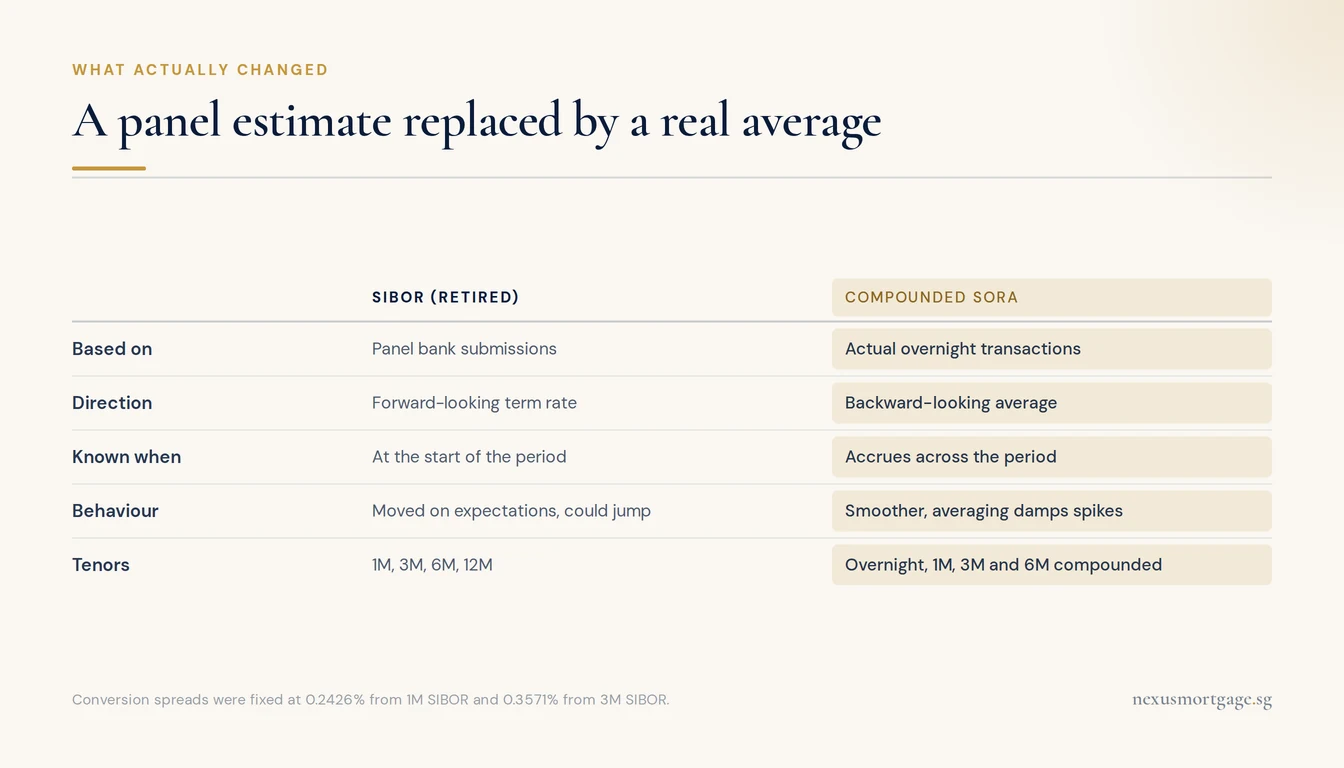
SIBOR was an estimate of what banks would charge. SORA is a record of what they did.
The distinction that matters to a borrower is direction in time.
| SIBOR (retired) | Compounded SORA (current) | |
|---|---|---|
| What it was based on | Panel bank submissions | Actual overnight transactions |
| Direction | Forward-looking term rate | Backward-looking average |
| Known when? | At the start of the period | Accrues across the period |
| Behaviour | Moved on expectations, could jump | Smoother, averaging damps spikes |
| Tenors | 1M, 3M, 6M, 12M | Overnight, plus 1M, 3M and 6M compounded |
One point is widely misunderstood, so it is worth being precise. Retail home loans in Singapore use compounded-in-advance SORA: the rate for your coming period is computed from the preceding three months of already-published daily SORA. So you do still know your rate at the start of the period. What changed is what the number is built from. It is now realised overnight transactions rather than a forward-looking panel submission.
The practical upshot: SORA is steadier. A single volatile week moves a three-month average far less than it moved a forward-looking term rate. For a borrower, that means fewer sharp surprises, but also that a falling market reaches your instalment more slowly. SC-STS chose the 3-month tenor for the retail package precisely because it is more stable than 1-month and less lagged than 6-month.
For how the two published tenors behave against each other, see our live SORA rate page, which covers 1M versus 3M and how each feeds your effective rate.
What Happened to SIBOR-Pegged Home Loans
Nobody was left holding a loan pegged to a benchmark that no longer published. The industry route was the SORA Conversion Package (SCP), and it ran in two stages.
| Window | What happened |
|---|---|
| 1 Sep 2023 – 30 Apr 2024 | Active transition. Borrowers could choose the SCP or one of the bank's prevailing packages. |
| 1 – 30 June 2024 | Automatic conversion. Any remaining SIBOR loan was converted by the bank under the SC-STS approach. |
| Until 31 Dec 2024 | Deadline for the one-time fee-free switch to a prevailing package. |
The SCP repriced your loan as 3-month Compounded SORA + your existing loan margin + an adjustment spread. Your original contractual margin was carried over unchanged. It was not renegotiated.
The terms SC-STS recommended
Under the industry package, the switch to the SCP carried no conversion fee and no new lock-in period. Any existing lock-in simply continued to run, and subsidy clawback periods carried over rather than resetting.
One detail was genuinely valuable. Switching to the SCP or to a prevailing package within the same bank was not treated as a refinancing under MAS property loan rules. TDSR, LTV and MSR were therefore not recomputed. Moving to a different bank did not get that relief.
There was an asymmetry worth knowing about. The SCP added no new lock-in, but taking a bank's prevailing package instead could impose a fresh one of two or three years. Some borrowers made that trade without registering it.
The design goal was continuity, not repricing. The conversion was intended to leave you in broadly the same economic position on the day it happened. Your loan kept its contractual margin; only the benchmark underneath it changed. That is the point most borrowers miss, because it is where the money is.
The Adjustment Spread, in Plain Terms
SIBOR and Compounded SORA are not the same number. SIBOR included a bank credit and term premium that an overnight risk-free average does not, so SIBOR consistently sat above Compounded SORA.
Swapping one for the other without adjustment would have cut rates arbitrarily, so SC-STS set an adjustment spread to bridge the structural gap. Your converted rate became, in effect:
3M Compounded SORA + adjustment spread + your original loan margin
Two methods, depending on when you converted
During the active transition window the spread was a spot figure: the average gap between SIBOR and compounded SORA over the preceding three months, floored at zero. ABS Co republished it on the first business day of each month.
At automatic conversion in June 2024 a different method applied. The spread there was the historical median over the five years from 30 June 2018 to 30 June 2023.
The final retail figures applied at automatic conversion were:
| Conversion | Adjustment spread |
|---|---|
| 1-month SIBOR → 3M Compounded SORA | 0.2426% |
| 3-month SIBOR → 3M Compounded SORA | 0.3571% |
So roughly a quarter to a third of a percentage point, permanently added to the SORA component. That spread is fixed for the remaining life of the loan. It does not decay or get revisited.
Because it was calibrated to a five-year historical median rather than to conditions on the conversion date, the switch was broadly value-neutral at that moment. It was never a promise about the future, and rates have moved a great deal since.
What to Do Now
If you still think of your loan as a SIBOR loan, it is worth ten minutes of checking. A converted loan carries a margin set under the original contract, potentially years ago, in a very different rate environment.
- Ask your bank three things in writing: what benchmark the loan is pegged to now, what the current effective rate is, and whether any lock-in or clawback still applies.
- Separate the benchmark from the spread. The benchmark is market-set and identical for everyone. The spread is contractual, and it is the part that varies between borrowers and lenders.
- Check your effective rate against today's rates across the banks. Conversion protected continuity. It did not keep you competitive.
- Work out whether repricing or refinancing wins. A legacy spread is a common reason a loan quietly drifts above market. Our guides on when to refinance and repricing versus refinancing set out the trade-off, including break costs and notice periods.
Being on a converted loan is not itself a problem. Being on a converted loan with a spread nobody has looked at since it was written usually is.
Frequently Asked Questions
There is no SIBOR rate today. SIBOR was last published on 31 December 2024 and was discontinued immediately after that date, so no current SIBOR figure exists for any tenor. The 6-month tenor had already gone on 31 March 2022. Singapore home loans are now priced against Compounded SORA, which MAS publishes each business day as an overnight rate plus 1-month, 3-month and 6-month compounded series. If you are searching for a SIBOR rate because you hold a SIBOR-pegged mortgage, that loan has already been converted by your bank.
SIBOR was a forward-looking term rate submitted by a panel of banks, and it relied in part on expert judgement rather than purely on completed transactions. Following the global move away from LIBOR-style submission-based benchmarks, Singapore transitioned to SORA, which is calculated from actual overnight interbank borrowing transactions. The industry transition was overseen by the Steering Committee for SOR and SIBOR Transition to SORA (SC-STS), convened by MAS and the Association of Banks in Singapore.
It was converted under the SORA Conversion Package. Borrowers could switch voluntarily between 1 September 2023 and 30 April 2024, and any remaining SIBOR loans were automatically converted between 1 and 30 June 2024, ahead of SIBOR's final publication on 31 December 2024. The converted rate is 3-month Compounded SORA plus your original loan margin plus an adjustment spread, which for retail loans at automatic conversion was 0.2426% from 1-month SIBOR or 0.3571% from 3-month SIBOR. That spread is fixed for the remaining life of the loan. If you are unsure what your loan is pegged to now, ask your bank for the current effective rate and the peg in writing.
No. SIBOR was a forward-looking term rate built from panel bank submissions, and it included term and credit risk premia. Compounded SORA is built from actual overnight interbank transactions and carries neither. Retail packages use compounded-in-advance SORA, so you still know your rate at the start of each period; the difference is that the number now comes from realised transactions over the preceding months rather than from what a panel of banks expected. SORA also moves more smoothly, because averaging damps short spikes.
SOR, the Swap Offer Rate, was discontinued for all tenors on 30 June 2023, ahead of SIBOR. SOR was derived from USD LIBOR, so it could not outlive it. Searches for a 5-year SOR rate usually relate either to legacy contracts or to 5-year fixed home loan packages, which are priced by the bank rather than pegged to any published SOR figure.
Check what it became. Ask your bank for the current effective rate, the benchmark it is now pegged to, and whether any lock-in still applies. Then compare it against current market packages, because a converted loan carries forward the margin from the original contract plus a fixed adjustment spread, and that combination may no longer be competitive. Conversion protected you from disruption at the time; it did not guarantee you a good rate afterwards.
Further reading
- Live SORA rate today — the 1M and 3M compounded figures that replaced SIBOR, refreshed each business day
- FDR, FHR and DMR pegs explained — the board-rate pegs that sit alongside SORA, and why they behave differently
- When to refinance your home loan — lock-in expiry, notice periods and the break-cost math
- Repricing vs refinancing — staying with your bank versus moving, and when each one wins
- Compare current mortgage rates — live fixed and floating packages across 16 banks
This article is general information for Singapore borrowers. It is not financial advice. Benchmark transition dates and the industry conversion approach reflect published guidance from MAS and the Steering Committee for SOR & SIBOR Transition to SORA (SC-STS) as at August 2026. The treatment of any individual loan depends on your contract and your bank. Confirm your current peg, effective rate and lock-in with your lender in writing. Sources: MAS: Interest Rate Benchmarks Transition, MAS: SORA, ABS: SIBOR Enhancements & discontinuation notice, SC-STS: Adjustment Spreads for the Conversion of SIBOR Loans to SORA (30 June 2023), SC-STS: Timelines to Cease Issuance of SOR- and SIBOR-Linked Products.

About the author — Dan Ler has advised on Singapore home loans since 2017 at Nexus Mortgage SG, an independent brokerage comparing 16+ MAS-regulated lenders. Nexus has facilitated 500+ home loans across HDB, EC, private condo and landed property segments. Banks pay Nexus on disbursement, so there is no cost to the borrower.