MRTA vs HPS vs Term Life: Mortgage Insurance in Singapore, Explained

Why This Decision Exists at All
Mortgage insurance is cover that pays off your outstanding home loan if a borrower dies or becomes permanently disabled, so the property stays with the family. A mortgage is usually the largest debt a household ever carries, and it does not die with you. If a borrower passes away or becomes permanently disabled mid-loan, the family either keeps servicing the instalments or sells the home. Mortgage insurance exists to break that outcome: it pays down the outstanding loan so the property stays with the family, unencumbered.
In Singapore the choice comes down to three instruments: the CPF Board's Home Protection Scheme (HPS) for HDB flats, Mortgage Reducing Term Assurance (MRTA) from private insurers, and ordinary level term life insurance used to cover the mortgage. They solve the same problem with very different mechanics, and the right answer depends on your property type, health, family situation and refinancing plans.
One scope note before the detail: Nexus is a mortgage brokerage, not an insurance adviser. This article explains how the products interact with your home loan, because that is where we see the decisions go wrong. For the policy side, we refer readers to Ronald Cheong, a financial advisor with Prestige Raffles, who prices HPS exemption, MRTA and level term against a real loan schedule rather than a generic quote.
HPS: the Default for HDB Owners
The Home Protection Scheme is CPF's own mortgage-reducing insurance, and for most HDB owners it is not optional: if you use CPF savings to pay your HDB instalments, HPS is mandatory unless you qualify for an exemption. It covers death, terminal illness and total permanent disability, up to age 65 or the end of the loan, whichever is earlier.
- Premiums come from CPF OA, paid annually, so there is no cash outlay. Pricing depends on age, sum assured and loan tenure.
- Cover is proportional. Each owner insures their share of the loan obligation. A couple splitting the mortgage 50/50 each carries HPS on 50%, and one death clears half the loan, not all of it. You can elect higher shares (up to 100% each) so either death fully clears the flat.
- HDB flats only. Private property owners cannot use HPS at all.
- Exemption is possible if you already hold private policies (term, whole life, MRTA, endowment) that adequately cover the outstanding loan — you apply to CPF with the policy details.
HPS is deliberately no-frills: no cash value, no portability, no cover past 65. Its job is to make sure an HDB flat financed with CPF never becomes a forced sale after a death. It does that job cheaply and automatically.
MRTA: Cover That Shrinks With the Loan
MRTA is the private-market version of the same idea. The sum assured starts at your loan amount and reduces along an amortisation schedule as your projected balance falls. Because the insurer's exposure shrinks every year, MRTA is the cheapest way to cover a large mortgage, typically bought as a single premium or a short premium term at inception.
The mortgage-specific mechanics matter:
- The reduction schedule is fixed at purchase, based on the loan size, tenure and an assumed interest rate. If you later refinance to a longer tenure, take a repayment holiday or take an equity term loan on top, your real outstanding balance can sit above the MRTA cover line — a gap families discover at the worst moment.
- Policies are often assigned to the bank. The payout goes to the lender to clear the loan, not to your family's bank account. Clean for the mortgage, nothing left over.
- It is tied to one property and one loan. Sell and upgrade, and the old MRTA usually cannot follow you; you buy a new policy at your new age and health. That re-underwriting is the hidden cost of the cheap premium.
Level Term Life: the Flexible Route
The third option is not a mortgage product at all: an ordinary term life policy with a level sum assured that happens to be sized to your mortgage. It costs more than MRTA for the same starting cover, because the sum assured does not shrink. What the extra premium buys is flexibility:
- Portability. The policy is attached to you, not the property. Refinance, upgrade, sell, decouple — the cover rides along untouched.
- Family gets the payout, not the bank. They can choose to clear the loan, keep servicing it at 1-point-something percent, or use the money where it is needed more.
- A widening surplus. As the loan amortises down while the cover stays level, the gap between the two becomes de facto family protection at no extra cost.
For borrowers who already need life cover for dependants, one right-sized term policy can do both jobs, which is often cheaper than a small term policy plus a separate MRTA.
Side-by-Side Comparison
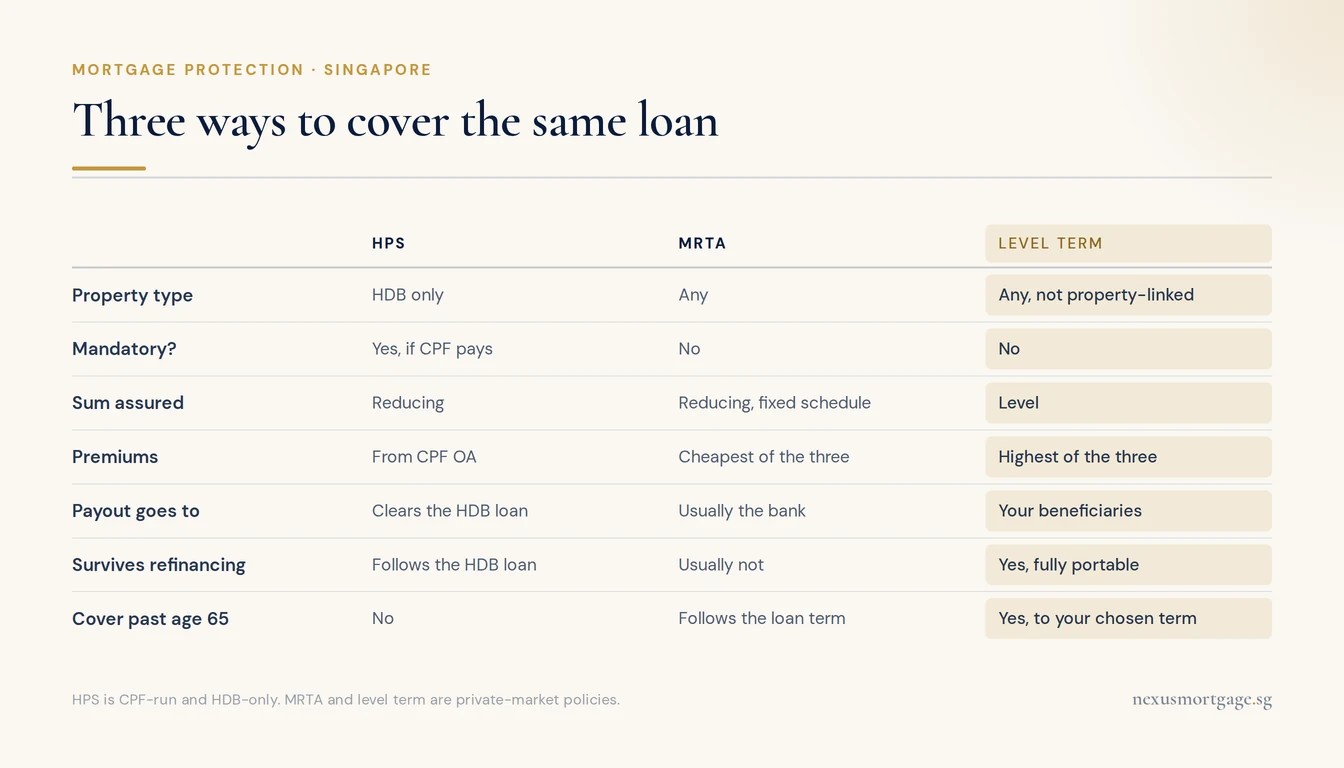
The row that decides most private-property cases is whether the cover survives refinancing.
| Feature | HPS | MRTA | Level term |
|---|---|---|---|
| Property type | HDB only | Any | Any (not property-linked) |
| Mandatory? | Yes, if CPF pays the instalments (exemption possible) | No | No |
| Sum assured | Reducing, matched to HDB loan | Reducing, fixed schedule set at purchase | Level |
| Premiums | From CPF OA, annual | Cash, single or short-pay; cheapest of the three | Cash, regular; highest of the three |
| Payout goes to | Clears the HDB loan | Usually the bank (assigned) | Your beneficiaries |
| Survives refinancing / upgrading | Follows the HDB loan | Usually not — new policy, new age, new underwriting | Yes, fully portable |
| Cover past age 65 | No | Follows the loan term | Yes, to the term you choose |
The table above shows the mechanics. What it cannot show is the premium gap for your age, health and loan tenure, and that gap is usually what decides it. Ronald quotes MRTA and level term on the same loan schedule so you compare like for like, and he handles the CPF HPS exemption paperwork if you already carry enough private cover.
How to Pick, by Profile
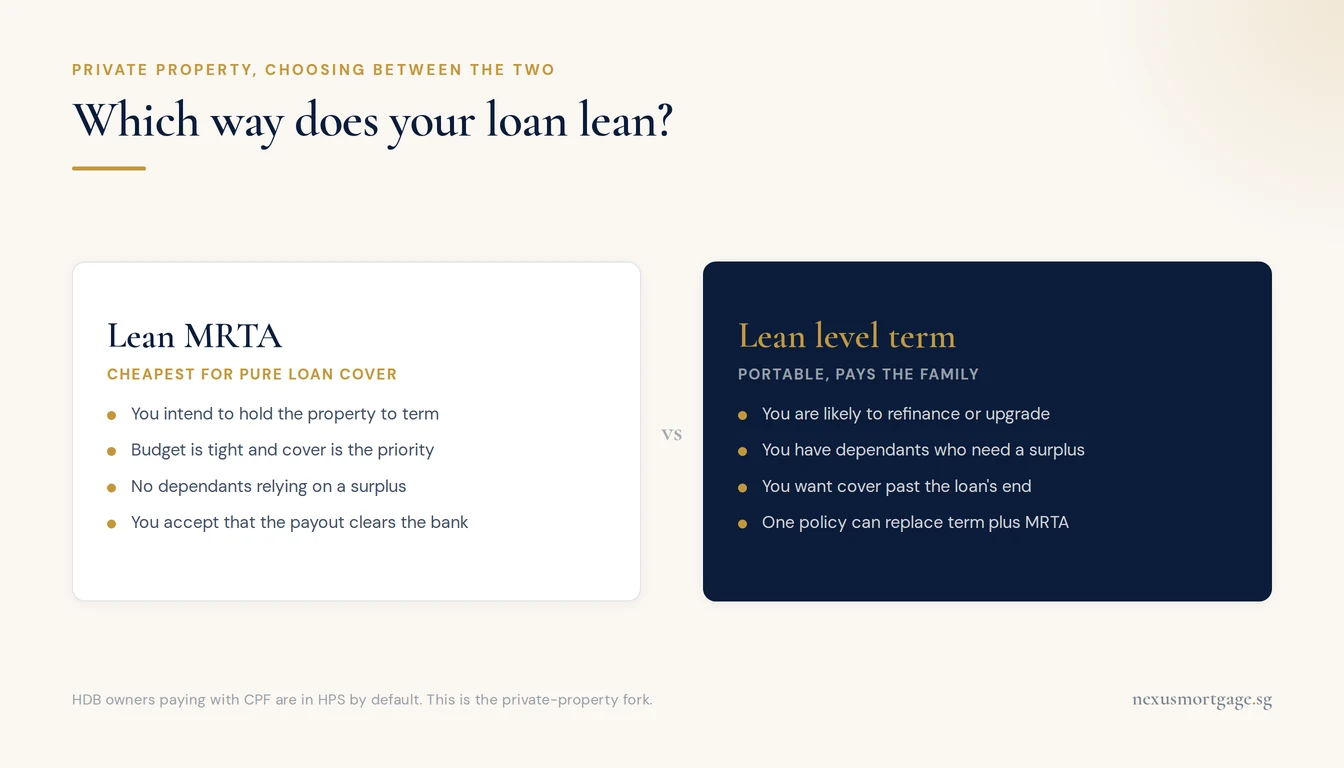
If your mortgage plans involve movement, buy cover that moves with you.
- HDB owner paying with CPF: you are in HPS by default, and for most flats that is the right, cheapest answer. Consider the exemption route only if you already carry substantial private cover — and check the household share election so one death clears the whole loan, not half of it. Background: how CPF OA funds an HDB flat and HDB loan vs bank loan.
- Private property, tight budget, stable plans: MRTA covers the pure mortgage risk at the lowest premium. Best when you intend to hold the property and the loan to term.
- Private property, dependants, or likely to refinance/upgrade: level term. Every refinancing we broker for MRTA holders surfaces the same friction — the old policy does not follow. If your mortgage plans involve movement, buy cover that moves with you. See reprice vs refinance and HDB to condo upgrading for the moves that trigger it.
- Joint borrowers: whatever the instrument, check what happens on the first death. Cover sized to each person's half leaves the survivor with half a mortgage and one income. How you hold the title matters here too: see joint tenancy vs tenancy in common.
If you want the numbers rather than the principle, send Ronald your profile on WhatsApp and he will size the cover against your actual outstanding balance. If you would rather not message, leave your details on the enquiry form and we will loop him in.
The insurance question is really a mortgage-strategy question: how long will this exact loan, on this exact property, actually exist?
Three Traps to Avoid
- Confusing fire insurance with mortgage insurance. The fire policy your bank requires (and HDB's fire insurance for flats) covers the building's structure, not your loan. It does nothing for your family if a borrower dies. You may need both; they are not substitutes.
- Letting MRTA drift below the real balance. Refinancing to a longer tenure or adding an equity or cash-out loan raises your outstanding above the policy's reduction curve. Whenever we restructure a loan, the insurance sizing should be re-checked the same week, which is why we hand the new schedule straight to Ronald on cases where cover is already in place.
- Assuming the bank requires it. For private property, mortgage insurance is not legally required, and reluctant buyers sometimes skip cover entirely because "the bank didn't ask." The bank protects itself with the property as collateral. The insurance is for your family, not the bank.
Frequently Asked Questions
Only in one case: HDB owners who service their loan with CPF must be covered under the Home Protection Scheme, unless exempted on the strength of existing private policies. For private property there is no legal or bank requirement to carry mortgage insurance — only fire insurance on the building is required by lenders.
Both are reducing cover that tracks your loan down. HPS is CPF-run, HDB-only, paid from CPF OA and capped at age 65. MRTA is a private policy for any property, paid in cash, with the reduction schedule fixed at purchase and the payout usually assigned to the bank.
MRTA is cheaper for the same starting cover; term life is portable, pays your family rather than the bank, and keeps a level sum assured while the loan shrinks. Broadly: hold-to-term borrowers lean MRTA, movers and families with dependants lean term. Ronald Cheong, a financial advisor with Prestige Raffles, can price both for your age and health: WhatsApp +65 9369 8284.
The policy usually cannot transfer to the new loan, especially across banks or properties. You either keep the old policy running against its original schedule (risking a cover gap) or buy fresh cover at your current age. Factor this into the refinancing math — we flag it on every case, and refer the re-cover to Ronald Cheong at Prestige Raffles on +65 9369 8284.
Each owner elects a share of cover, and the shares must total at least 100% of the loan obligation. At the default proportional split, one owner's death clears only their share. Couples who want either death to fully clear the flat should each elect 100% — the premium difference is usually modest.
Get Your Mortgage Cover Sized Properly
HPS share elections, MRTA that has drifted below the real balance, level term for a family that will move again: all of it is a five-minute conversation once someone has the loan schedule in front of them.
Ronald Cheong
Financial Advisor, Prestige Raffles
Or view Ronald's LinkedIn profile first.
On the loan side, Nexus maps your options across 16+ MAS-regulated banks so the cover is sized against the right balance. Get the free mortgage report, or WhatsApp Dan Ler at +65 8752 0859. Banks pay our fee, you pay nothing.

About the author — Dan Ler has advised on Singapore home loans since 2017 at Nexus Mortgage SG, an independent brokerage comparing 16+ MAS-regulated lenders. Nexus has facilitated 500+ home loans across HDB, EC, private condo and landed property segments. Banks pay Nexus on disbursement, so there is no cost to the borrower.
Further reading
- CPF OA and your HDB loan — how OA funds the flat, and what HPS premiums sit alongside
- Reprice vs refinance — the restructuring moves that should trigger an insurance re-check
- HDB loan vs bank loan — the financing fork that decides whether HPS applies
- Refinancing an HDB loan to a bank loan — the switch that ends HPS eligibility and forces a private policy
- Cash-out refinancing and equity loans — the fastest way to leave MRTA cover below the real balance
- Joint tenancy vs tenancy in common — how the title holding changes what a payout actually settles
- HDB to condo upgrading — why movers usually want portable cover
- Decoupling property — ownership changes that orphan property-tied policies
- Free Singapore mortgage report — Dan's full written breakdown with a 16-bank comparison
Nexus Mortgage SG is an independent Singapore mortgage advisory, not a licensed insurance intermediary. This article is general information on how insurance products interact with home loans, not financial or insurance advice; consult a licensed financial adviser for policy recommendations. Ronald Cheong is a financial advisor with Prestige Raffles and operates independently of Nexus Mortgage SG; any quotation, recommendation or advice on a policy is his and follows his firm's own advisory process. Positions as of 17 August 2026. Sources: CPF Home Ownership / HPS, HDB, MAS, MoneySense.