The November 2026 BTO Launch: Your Real Deadline Is 25 September
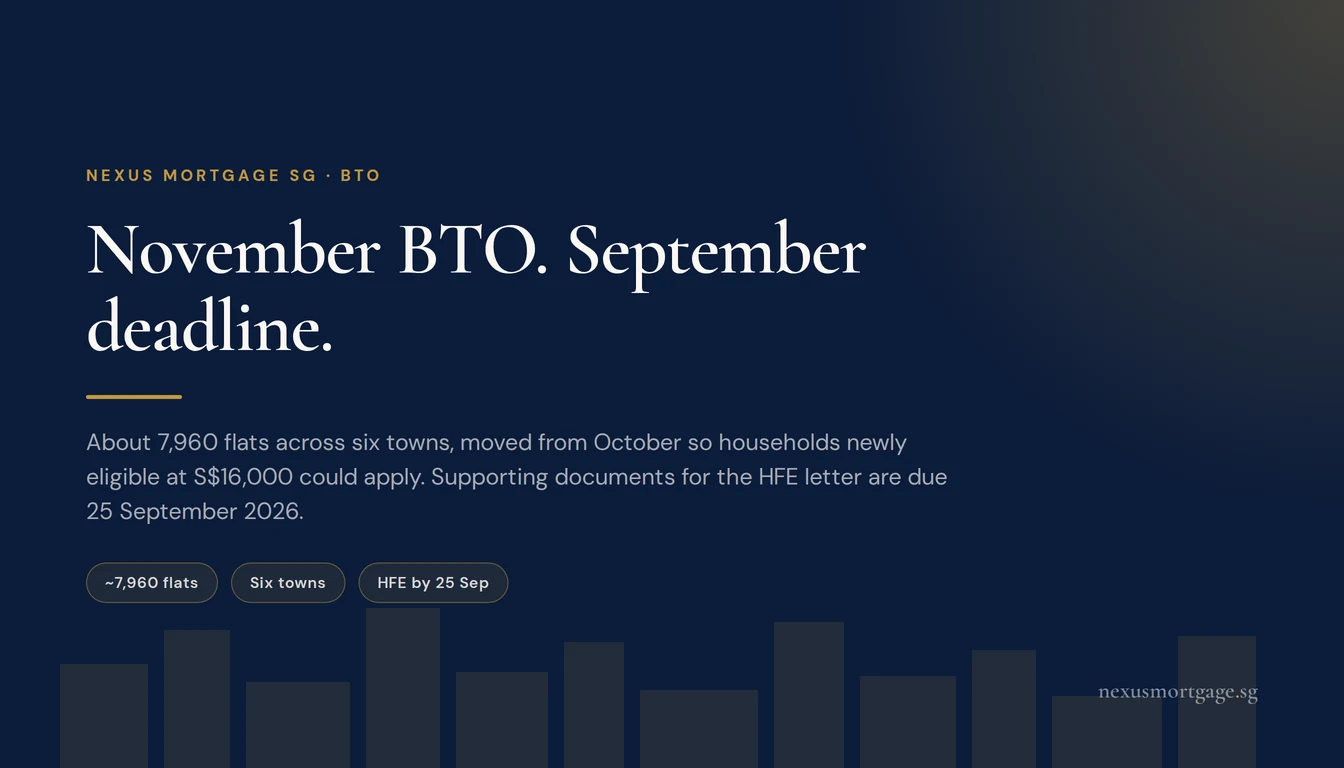
The November 2026 BTO exercise offers about 7,960 flats across Bedok, Geylang, Sembawang, Tengah, Toa Payoh and Yishun. It was moved from October so that households newly eligible under the S$16,000 income ceiling could apply in time. Your binding date is 25 September 2026, when all supporting documents for the HFE letter are due. Two things worth deciding before you ballot: whether a Prime project's 10-year MOP and subsidy clawback suit you, and whether the extra ballot chance per child from February 2027 makes waiting the better bet.
Why October Became November
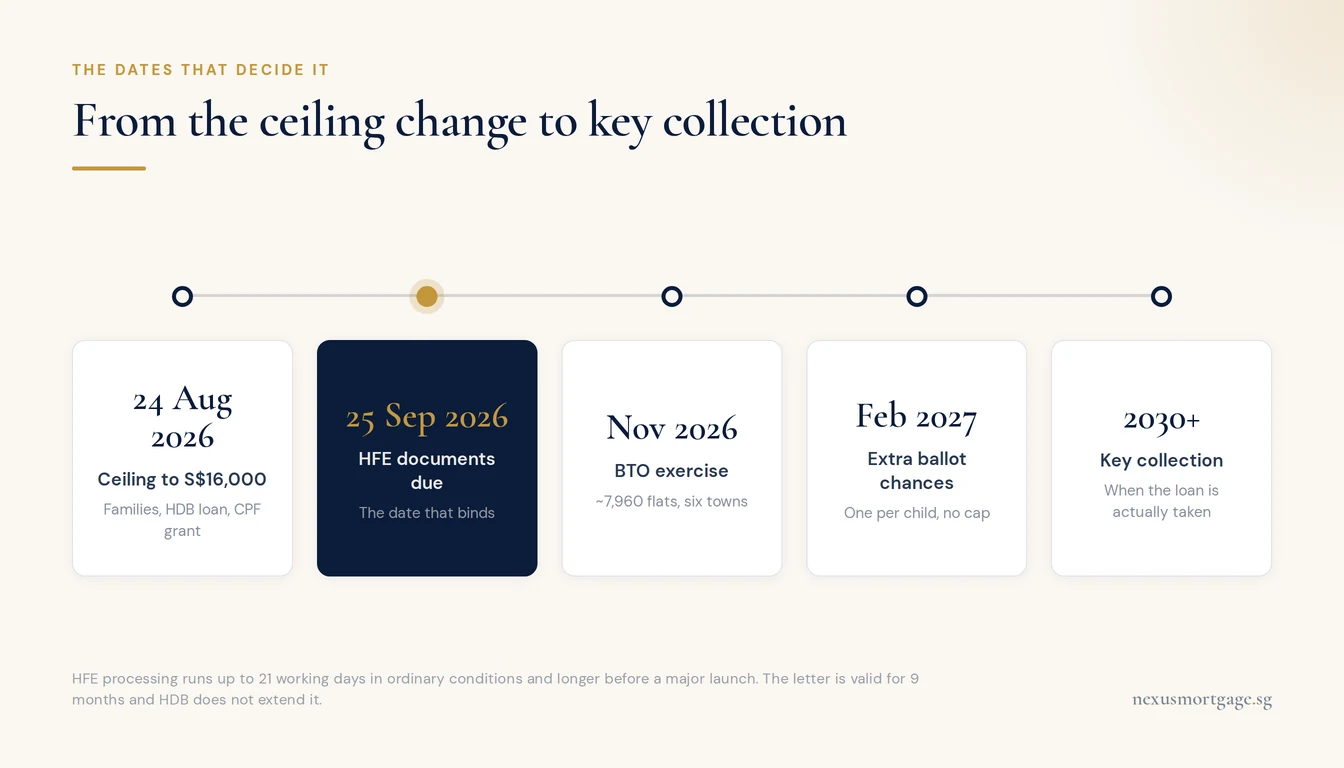
The launch is in November. The decision point is in September.
HDB does not move a sales exercise for no reason. This one moved because of the income ceiling.
On 24 August 2026, the ceiling for a new subsidised flat, the HDB concessionary loan and the CPF Housing Grant went from S$14,000 to S$16,000 for families, and from S$7,000 to S$8,000 for singles aged 35 and above. A whole cohort of households became eligible overnight, and an HFE letter is not something you obtain in a week. Pushing the exercise from October to November bought them a month.
If you are in that newly eligible band, the full picture of what changed and what did not is in our guide to the S$16,000 income ceiling. The short version: you gained the flat and the 2.6% loan, and you almost certainly did not gain the Enhanced CPF Housing Grant, whose own ceiling stayed at S$9,000.
The Line-Up, Town by Town
Roughly 7,960 flats across six towns. The figures below are from the launch previews. HDB confirms final counts, flat types and classifications at launch, so treat them as indicative.
| Town / site | Units (approx.) | Expected class | The draw, and the drawback |
|---|---|---|---|
| Bedok, Bayshore (two projects) | ~2,500 | Prime or Plus | Waterfront near East Coast Park, Bayshore MRT on the TEL. Thin on primary schools. |
| Yishun, Chencharu | ~1,580 | Standard | Largest 5-room offering, Khatib MRT, Northpoint City. Best ballot odds of the batch. |
| Toa Payoh West (Caldecott) | ~1,430 | Prime | Circle Line and TEL interchange, first Community Care Apartments in Toa Payoh. Priciest, no 3-room. |
| Sembawang North | ~1,310 | Standard | Strong 4- and 5-room supply, schools nearby. Weak transport, no MRT close by. |
| Tengah | ~710 | Standard | The only site offering every flat type including 3Gen. Jurong Region Line not complete until 2028. |
| Geylang, Mattar | ~440 | Plus | Mature area, walk to Mattar MRT. Smallest project, expect heavy oversubscription. |
The Toa Payoh West site is the one drawing the attention, and for good reason: a central location next to a two-line interchange does not come up often. It is also the one where classification will cost you the most, which is the next section.
Prime, Plus, Standard: What It Costs You
Under the 2024 framework, every BTO project is classified Standard, Plus or Prime, and the classification is not a label. It is a set of restrictions that follow the flat for a decade and change what your equity is worth on exit.
| Standard | Plus and Prime | |
|---|---|---|
| Minimum Occupation Period | 5 years | 10 years |
| Subsidy clawback on resale | None | Yes, a percentage of resale price |
| Who can buy it from you | Open resale market | Restricted by income ceiling and other conditions |
| Renting out the whole flat after MOP | Allowed | Not allowed |
| Subsidy at purchase | Standard | Higher |
The financing consequence people miss is the clawback. It is levied as a percentage of the eventual resale price, not of the discount you originally received. In a rising market that means the amount you hand back grows with the market, so the equity you thought you were building is partly HDB's.
That is not an argument against Prime. A central flat at a subsidised price with a ten-year horizon is a genuinely good deal for a household that wants to live there for ten years. It is an argument against treating a Prime flat as an appreciating asset you will flip at MOP, and against borrowing to the maximum on the assumption that your exit equity looks like a Standard flat's.
If you are weighing the upgrade path, the same clawback question runs through our HDB to condo upgrade guide.
The HFE Letter and the Real Timeline
The HFE letter is the gate. Without a valid one you cannot ballot, cannot register intent to buy and cannot exercise an Option to Purchase. It is a single document that settles four separate questions at once: your scheme eligibility, your income assessment, your HDB loan quantum and your grant band.
- Deadline for supporting documents: 25 September 2026 for the November exercise.
- Processing: up to 21 working days in ordinary conditions, and longer immediately before a major launch, which is exactly when you will be applying.
- Validity: 9 months from issue. HDB does not extend it. If it lapses, you reapply and are reassessed.
- The income assessment is a trailing 12-month average of gross household income across every working applicant and essential occupier. Submission fixes it.
That last point deserves a moment. If your household is close to S$16,000 and a bonus sits inside the trailing window, you may be assessed over the ceiling on a technicality. Check your own twelve-month average before you file rather than discovering it in the outcome.
November or February: The Ballot Maths
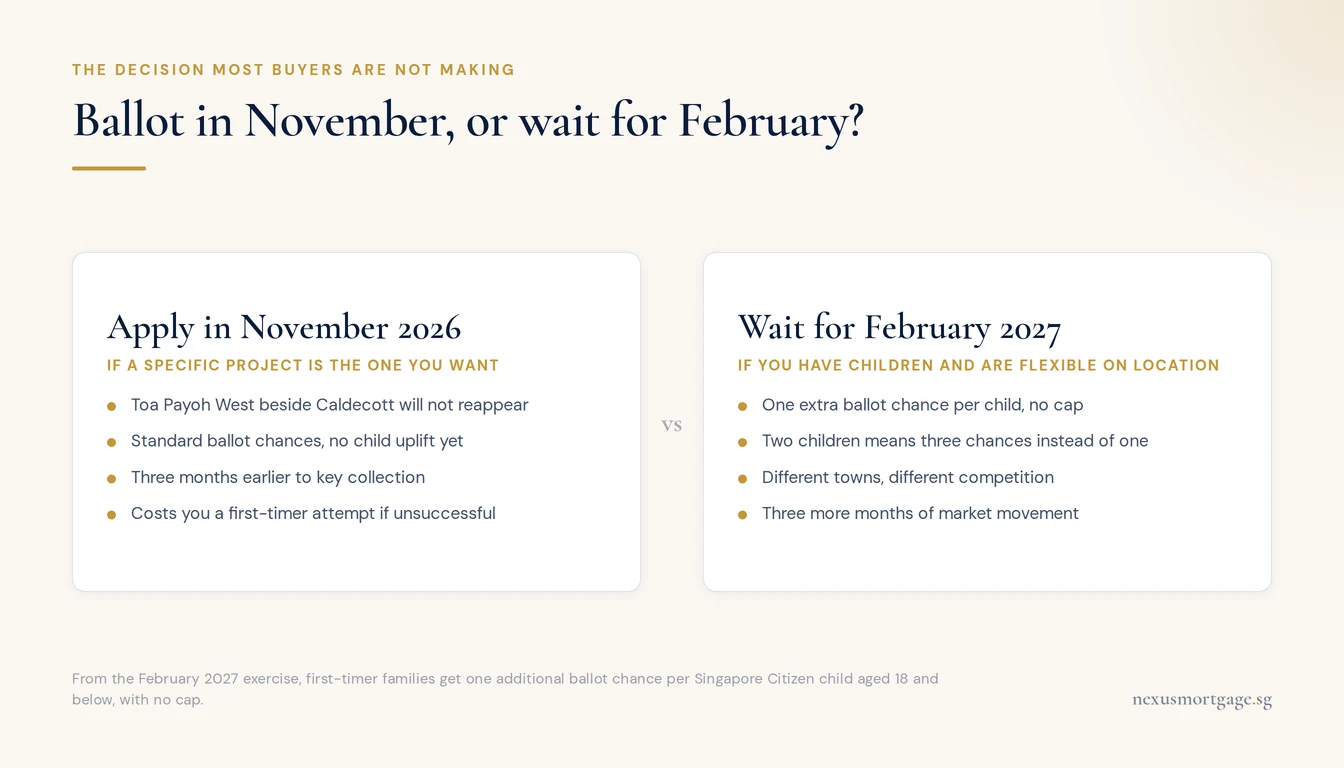
A family with two children triples its chances by waiting one exercise.
Here is a genuine decision, and almost nobody is framing it as one.
From the February 2027 sales exercise, first-timer families receive one additional ballot chance for every Singapore Citizen child aged 18 and below, with no cap. That is a step change in odds, not a rounding adjustment.
| Household | Nov 2026 exercise | Feb 2027 exercise |
|---|---|---|
| First-timer couple, no children | Standard chances | Standard chances (no change) |
| First-timer family, one child | Standard chances | +1 additional chance |
| First-timer family, two children | Standard chances | +2 additional chances |
| First-timer family, expecting | Standard chances | +1 additional chance |
So: if you have children and you are flexible on location, February 2027 gives you materially better odds on a different set of towns. If a specific November project is the one you actually want, particularly Toa Payoh West, apply in November, because that site will not reappear.
Applying in November does not forfeit February. It costs you a first-timer ballot attempt and three months. Weigh that against the odds improvement, and against the fact that resale prices have been soft through 2026, which quietly makes the resale route more competitive than it looked a year ago.
The Loan Decision You Do Not Make Yet
A question we get constantly at this stage: should I lock in a rate now?
You cannot. A BTO flat is three to five years from key collection, and no lender prices a package that far out. Rates today are historically low, with three-month Compounded SORA around 1.1% and fixed packages from the low 1.4s, but none of that is available to a flat completing in 2030. The loan decision happens close to key collection, on the rates that exist then.
What you decide now is the price bracket you commit to, and that should be driven by your real borrowing capacity rather than the current rate. Banks size loans at the MAS 4% floor rate with the 30% Mortgage Servicing Ratio binding on any HDB flat, so the number that governs is the stressed one, not the advertised one.
When key collection does arrive, the HDB versus bank choice has an asymmetry worth remembering: HDB to bank is allowed, bank back to HDB is not. Taking the HDB loan first preserves the option to switch; taking a bank loan first closes the door permanently. Our HDB loan versus bank loan comparison runs the full cost both ways.
Your September Checklist
- Compute your trailing 12-month average income before you file, not after. This is the number that decides eligibility, loan quantum and grant band together.
- Submit HFE documents well before 25 September. Processing runs long in the weeks before a launch. Do not aim for the deadline.
- Model the deal with EHG at zero unless your assessed income is at or below S$9,000. The EHG ceiling did not rise with the flat ceiling.
- Decide on classification with your eyes open. Ten years and a clawback is a fair price for a central flat you will live in. It is a poor one for a flat you plan to flip.
- If you have children, price the February 2027 option before defaulting to November.
- Get an In-Principle Approval alongside the HFE letter. The HFE tells you what HDB will lend. An IPA tells you what a bank will lend, which is often a very different number and the one that sets your resale ceiling if you go that route instead. We run it across every lender at once, at no cost to you.
This article is general information for Singapore buyers. It is not financial advice. BTO project details, unit counts and classifications are from launch previews and are confirmed by HDB only at launch; verify against HDB before applying. Eligibility, HFE assessment and grant quantums are administered by HDB and CPF; TDSR, MSR and LTV by MAS. Rate figures are indicative as at 8 September 2026 and are not an offer of credit. Income ceiling figures reflect the revision announced at the National Day Rally on 23 August 2026 and effective 24 August 2026. Sources: HDB: Buying a Flat, Prime Minister's Office: National Day Rally 2026, MAS Notice 645 (TDSR), CPF: Home Ownership.

About the author — Dan Ler has advised on Singapore home loans since 2017 at Nexus Mortgage SG, an independent brokerage comparing 16+ MAS-regulated lenders. Nexus has facilitated 500+ home loans across HDB, EC, private condo and landed property segments. Banks pay Nexus on disbursement, so there is no cost to the borrower.