DBS vs UOB vs OCBC Home Loans 2026: Which Bank Fits Your Profile?

DBS, UOB and OCBC are Singapore's three local banks and write most of its home loans; which one fits you depends on loan size, rate-peg preference and subsidy math, not the headline rate. "Which bank has the best home loan" is the most-asked question in this business, and the honest answer is that it changes weekly and depends on your loan size, property type and how long you plan to hold the package. This page compares the three local giants structurally — the things that stay true between rate refreshes. For today's actual numbers, the live 16-bank table on our rates page is refreshed continuously, and each bank has its own detail page: DBS, UOB, OCBC.
How to Actually Compare Banks (Not Just Rates)
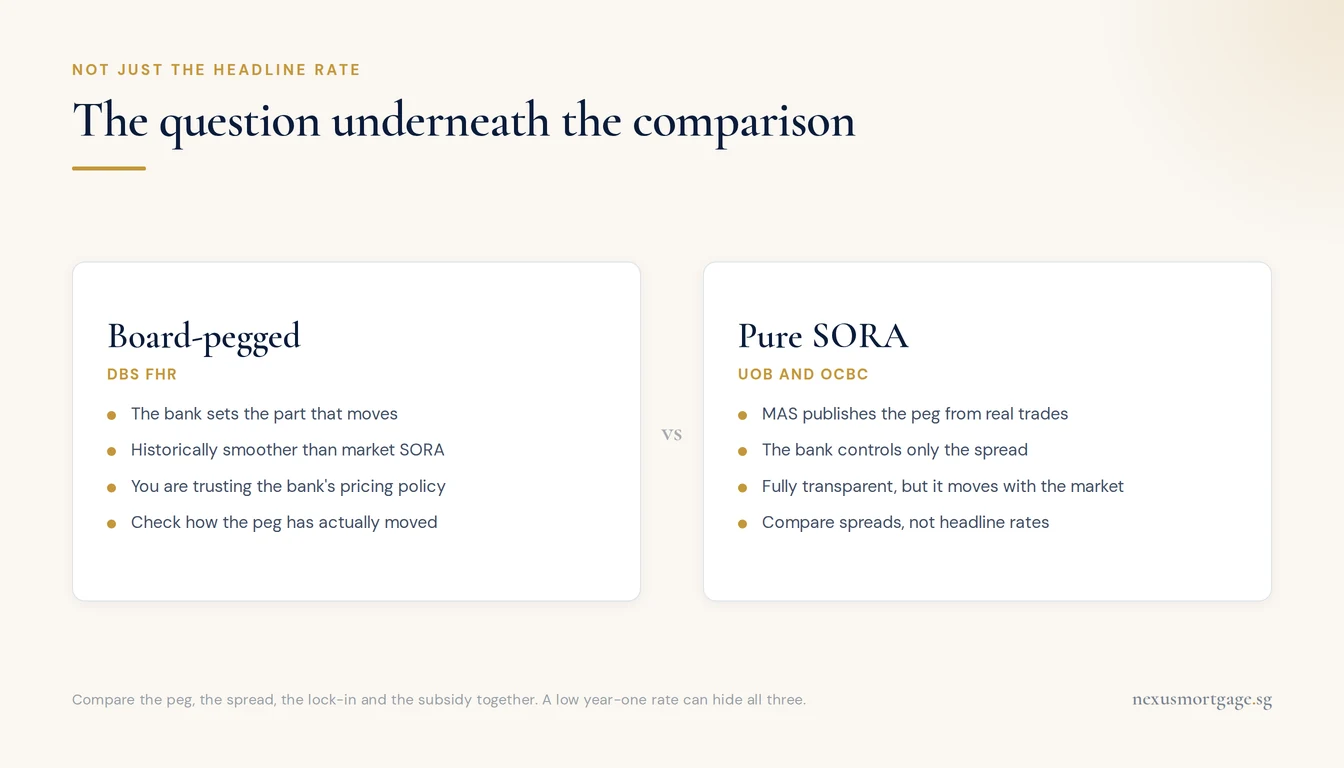
Whoever sets the peg decides how much of your rate you can predict.
Headline rates across the big three usually sit within a few basis points of each other — competition sees to that. Where borrowers actually win or lose money is in the structure around the rate:
- What the floating rate is pegged to, and who controls it.
- What happens after the lock-in — the thereafter rate and how easy repricing is.
- Quantum tiers — the rate you see advertised often needs a minimum loan size.
- Subsidies — legal and valuation support that offsets switching costs, usually scaled to loan size.
Rate Structures: FHR Boards vs Pure SORA
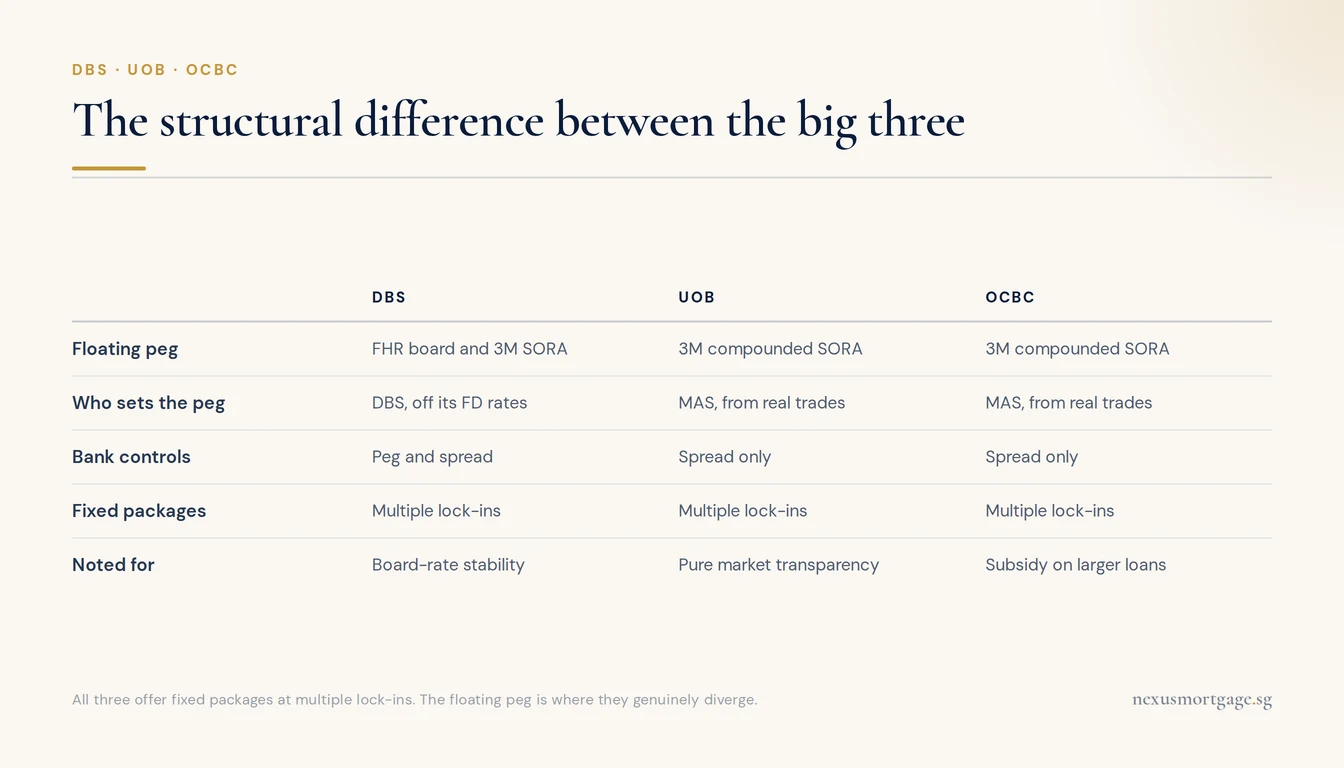
DBS controls both the peg and the spread. UOB and OCBC control only the spread.
| Bank | Fixed packages | Floating peg | Structural note |
|---|---|---|---|
| DBS | Yes, multiple lock-ins | FHR (Fixed Home Rate) board and 3M compounded SORA | FHR is set by DBS off its fixed-deposit rates — bank-administered, historically stable but not market-driven |
| UOB | Yes, multiple lock-ins | 3M compounded SORA | Pure market peg — the bank controls only the spread, not the benchmark |
| OCBC | Yes, multiple lock-ins | 3M compounded SORA | Pure market peg; subsidy support on larger loans offsets most switching costs |
The peg question matters more than most borrowers realise. A 3M compounded SORA package moves with the published MAS benchmark (live SORA here) — transparent both ways. A board rate like DBS's FHR is administered by the bank: it has historically moved slowly, which cushions you when market rates spike, but the bank decides when and how it moves. Neither is strictly better; they are different risk postures. The history of these peg families is in the FDR/FHR/DMR guide.
Lock-ins, Quantum Tiers and Subsidies
- Lock-ins at all three run the familiar shape: promotional years one and two, a thereafter rate that jumps, and a penalty (typically ~1.5%) for leaving early. The "thereafter" line is where cheap packages get expensive — diarise the expiry and reprice or refinance on schedule (the decision framework).
- Quantum tiers: advertised rates generally carry minimum loan sizes. Small loans (under roughly the few-hundred-thousand mark) often price a notch higher everywhere — sometimes the "best bank" for a small loan is simply the one whose tier you clear.
- Subsidies: new-purchase and refinancing packages frequently include legal/valuation subsidies, scaled to quantum — OCBC in particular leans on subsidy support for larger refinancing loans. A slightly higher rate with a full subsidy can beat a lower rate without one over a 2-year horizon; we do that arithmetic on every case.
Which Bank, by Borrower Profile
- Rate-spike worrier, wants floating: the DBS FHR board has historically been the gentler ride in rising-rate years; pure SORA at UOB/OCBC is the better ride down when the benchmark falls. Decide which direction you are insuring against.
- Transparency-first borrower: pure 3M SORA (UOB/OCBC) — you can verify every reprice against the published benchmark.
- Large refinancing loan: get the subsidy math quoted at all three; on bigger quantums the subsidy differences often decide it, not the rate.
- Small loan: check quantum tiers first — the "best" advertised rate may not be available to you at all.
- HDB borrower choosing a bank over the HDB loan: all three price HDB packages; the real decision is the HDB-loan-vs-bank fork before the bank beauty parade.
The truthful comparison is never "DBS vs UOB vs OCBC" in the abstract — it is "these three quotes, for this loan size, this week." Structure persists; rates rotate.
Beyond the Big Three
The local trio write most of Singapore's mortgages, but the sharpest package on a given week is frequently a foreign or mid-tier lender fighting for share — HSBC, Standard Chartered, Maybank, CIMB, RHB and others. Our recent SME case study closed at CIMB precisely because the big three were not the best fit that week. A broker's 16-bank comparison exists because the answer moves; the live table is on the rates page.
Five Questions to Ask All Three Banks
Whichever way you lean, put the same five questions to every quote and compare the answers in writing:
- What is the thereafter rate, and what has this package's thereafter actually reset to for existing customers in the past two years?
- What does repricing cost when my lock-in ends — admin fee, timeline, and will I get the same shelf as a new customer?
- What exactly does the subsidy cover — legal, valuation, fire insurance — and is there a clawback period if I refinance out early?
- Which quantum tier does my loan fall into, and how far is the next tier's rate from mine?
- What happens on partial prepayment during the lock-in — is there a free prepayment allowance, and how does it interact with the penalty?
The spread between three honest answers to those questions is routinely worth more than the headline-rate difference. It is also exactly the comparison a broker runs for you across all sixteen lenders at once.
Frequently Asked Questions
It rotates weekly with promotions and quantum tiers, which is why this page compares structure instead of quoting a number that would be stale by the time you read it. The live 16-bank comparison on our rates page carries current pricing, and packages in the low-1% range have been the competitive zone through 2026.
FHR is a board rate administered by DBS, historically slow-moving in both directions. 3M compounded SORA is the published MAS benchmark — market-driven and fully transparent, moving with Singapore interest rates. FHR cushions spikes; SORA passes through falls. Neither dominates in all conditions.
Commonly, on new-purchase and refinancing packages, scaled to loan size — with OCBC notably leaning on subsidies for larger refinancing quantums. Always compare the package net of subsidy over your intended holding period, not the headline rate alone.
Same rates either way — banks pay the broker on disbursement, so the borrower price is identical. The difference is coverage: a bank's officer can only quote their own shelf; a broker compares 16+ lenders including weeks when a foreign bank undercuts all three locals. There is no scenario where the borrower pays more via a broker.
Yes — that is refinancing, and post-lock-in there is no penalty. The alternative is repricing onto a new package with your current bank, which is cheaper and faster but limited to that bank's shelf. The trade-off is worked through in our reprice-vs-refinance guide.
Get All Three Quoted — Plus the 13 Banks They Compete With
Your loan size and profile decide which bank actually wins this week. We pull live pricing across 16+ MAS-regulated lenders and show the net-of-subsidy math, free.
Compare 16 Banks Free →Prefer a personal comparison? WhatsApp Dan Ler at +65 8752 0859. Banks pay our fee — you pay nothing.

About the author — Dan Ler has advised on Singapore home loans since 2017 at Nexus Mortgage SG, an independent brokerage comparing 16+ MAS-regulated lenders. Nexus has facilitated 500+ home loans across HDB, EC, private condo and landed property segments. Banks pay Nexus on disbursement, so there is no cost to the borrower.
Further reading
- FDR, FHR and DMR pegs explained — the board-rate history behind the DBS structure
- Fixed vs floating in 2026 — the decision that comes before the bank decision
- Reprice vs refinance — what to do when your lock-in ends
- Live 16-bank rate table — today's actual numbers for all three banks and their competitors
- Free Singapore mortgage report — your personalised 16-bank comparison in one PDF
Nexus Mortgage SG is an independent Singapore mortgage advisory. This article is general information, not financial advice, and deliberately avoids quoting package rates that change weekly — see the live rates page for current pricing. Bank structures described reflect publicly available package information as of 24 August 2026. Sources: MAS, ABS (SORA administration), bank published rate boards via our rates page.